IN THIS ISSUE...
SPRING 2023 VOLUME 69 NUMBER 1
PLANT SCIENCE
BULLETIN
A PUBLICATION OF THE BOTANICAL SOCIETY OF AMERICA
Trauma Awareness: A Botany360
Recap ....p. 6
Early registration deadline for Botany 2023.... p. 12
Botanists Needed for UN Decade on Ecosystem
Restoration .... p. 4
HOW DO I PREPARE MYSELF AS A
RESEARCHER TO BE COMPETITIVE FOR A
PUI FACULTY POSITION?
HOW CAN I GAIN TEACHING
EXPERIENCE NECESSARY FOR MY
PUI JOB APPLICATION?
HOW CAN I PREPARE
MY APPLICATION
MATERIALS FOR A
SPECIFIC PUI JOB
?
S
ee
p
. 16
for
the
A
nSwerS
!
H
ow
D
o
I P
rePare
for
a
f
aculty
P
osItIon
at
a
P
rImarIly
u
nDergraDuate
I
nstItutIon
?
Spring 2023 Volume 69 Number 1
FROM the EDITOR
Greetings,
As our long-time readers know, the content of Plant Science Bulletin
reflects the professional interests and concerns of BSA members. In
this issue, you will find articles that were developed out of Botany
2022 panel discussions, such as the piece on preparing for a faculty
position at a PUI, and from Botany360 workshops, such as those
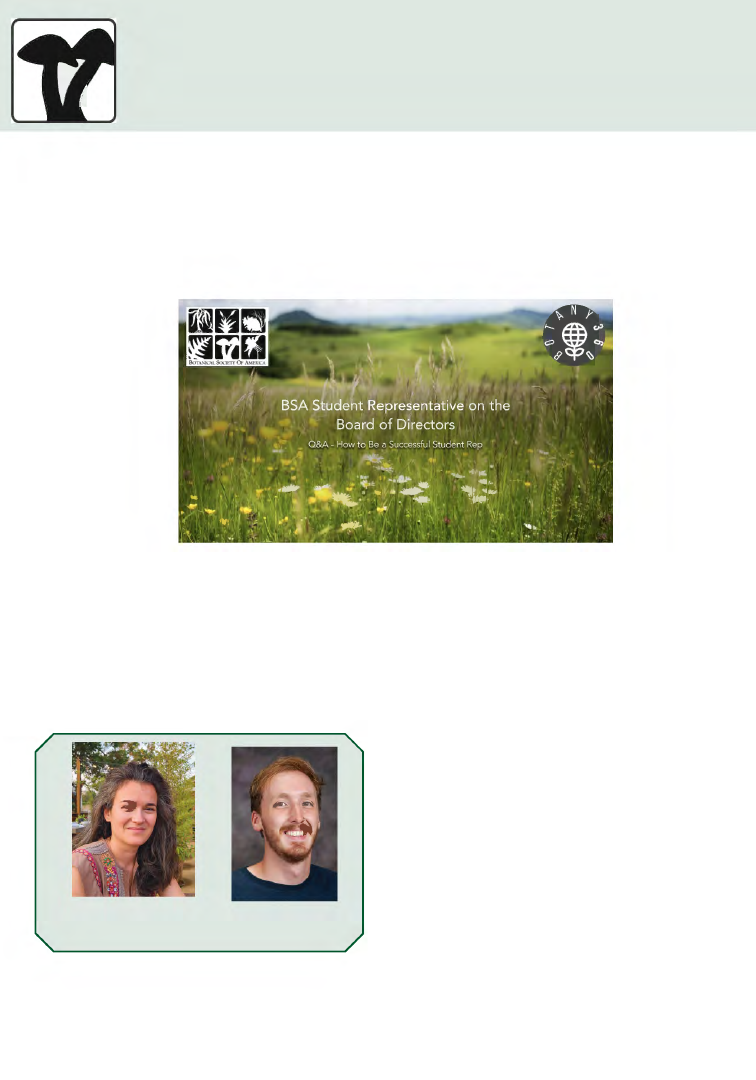
on trauma awareness and becoming a BSA student representative.
As always, we invite articles from BSA members and friends on the
issues that matter. You can submit an article directly to me or contact
me to discuss your idea!
Sincerely,
4
Botanists Needed for UN Decade
on Ecosystem Restoration
There is wide interest internationally on
improving habitats to sustain biodiversity
and supply other ecological services. Climate
change has stressed environments worldwide
and significant action is needed to add to our
natural resources. The United Nations has put
together a professional group to encourage
and organize initiatives. This includes many
partners such as their UN Environment
Program, the Food and Agricultural
Organization, the International Union for
the Conservation of Nature (IUCN), The
Nature Conservancy, as well as scientific
groups including the Society for Ecological
Restoration.
Each project is planned and implemented
by local groups and listed in the UN Decade
program. More information about the
program and its resources can be seen at www.
decadeonrestoration.org.
Among the principles that the UN Decade
are using are ones important to the mission
of BSA: broad public participation; benefits
to nature and people; knowledge integration;
management of resources; policy integration.
Together these goals advance the health and
sustainability of botanical resources. The full
Principles for Ecosystem Restoration report is
available at https://www.fao.org/documents/
card/en/c/CB6591EN.
Botanists have an important and critical role
to improve this international effort. Members
of the BSA are experts in different taxonomic
groups and their life history needs, as well as
plant communities of all types and throughout
the world. The UN Decade initiative is a
wonderful opportunity to expand the service
of our members as advisors to many programs
being planned worldwide. Individual
members may volunteer their expertise in
taxa and in habitat structure and function
when asked by UN Decade teams planning
each habitat restoration program.
Participation in the UN Decade program
offers many benefits:
• Members can use their professional
skills to advance environmental con-
ditions, worldwide.
• The value of botany as a scientific
discipline can reach new audiences,
helping people realize the great value
of botanical training for the modern
world.
• Participation in this program may en-
courage others from all backgrounds
to consider botany and related science
cities as career goals.
SOCIETY NEWS
PSB 69 (1) 2023
5
• Submit a record of a habitat restora-
tion project in which you have par-
ticipated. Report these at www.ser-rrc.
org/submit-a-project.
If you choose to register as an expert, you
may be asked to participate at some level in
a project. Please let the BSA know if you
have registered by writing to the BSA office
at hcacanindin@botany.org. In that way, BSA
would have a record of members willing to
help in this international program. Then we
can better explain the value of our organization
to the general public.
Thank you for considering participation in
this important international program.
There are some simple ways for BSA members
to become involved:
• Register in the Alliance of Nature-
Positive Universities. This is a global
network of individuals associated with
higher education to “prompt the pri-
oritization of nature and its restoration
within the higher education sector; in
their operations and supply chains, on
campuses and within the cities where
they operate.” Learn more and register
at https://www.decadeonrestoration.
org/join-university-challenge.
• Submit resources to help restoration
actions, such as articles and reports,
webinars, and videos that would add
botanical knowledge. Please submit
these and register your expertise at the
Restoration Resource Center: www.
ser-rrc.org/recource-database/sub-
mit-a-resource.
PSB 69 (1) 2023
6
Trauma Awareness:
A Botany360 Recap
Unfortunately, trauma is pervasive in our
society. From individual traumas experienced
as a child, to traumatic events affecting entire
communities, to historical traumas that are
passed from generation to generation among
marginalized and oppressed groups. And just
like other aspects of our personal lives and
identities, we bring our traumas with us to our
work, school, and interactions with others. On
our paths to becoming a more equitable and
inclusive Botanical Society of America, we
must work to acknowledge, understand, and
interrupt trauma.
In December 2022, the BSA offered a free
Botany360 webinar to explore this topic, “A
Trauma Awareness Workshop,” facilitated by
the former BSA Diversity Equity Inclusion and
Outreach Programs Coordinator Sarah Sims.
It offered a framework for defining trauma,
explored five types of traumas; shared data on
the prevalence of trauma; investigated how
trauma impacts individuals as well as entire
communities; and laid out a path to becoming
trauma informed. Sarah offers a recap of that
workshop here so that more of our botany
community can take steps to better care for
ourselves and one another.
This recap article talks about different types
of traumas and may be distressing for some
readers. Please take breaks or discontinue
reading as needed. Your mental health and
safety are important. If you are in crisis, you
can receive help by calling the National Sui-
cide and Crisis Lifeline: 988.
1
WHAT IS TRAUMA?
What do you think of when you hear the
word trauma? When I participated in my
first trauma awareness training, my answer
to this question was decidedly narrow and
revealing of my privilege as a person who had
not experienced many traumas in their life. I
have since come to understand the three Es of
trauma: event, experience, effects: a framework
that defines trauma as individual.
2
The first E,
event, is quite expansive. It might be an actual
traumatic experience of either physical or
psychological harm, or it might be the threat
of harm. Additionally, and importantly for
a more nuanced understanding of trauma,
is that the event might also be the lack,
withholding, or control of the resources that
one needs for their health and development.
event, yet due to their personal histories and
By Sarah Sims
Former BSA Diversity Equity Inclusion and
Outreach Programs Coordinator
1
Learn more about the new National Suicide and Crisis
Lifeline at https://988lifeline.org/faq/ and
https://www.samhsa.gov/find-help/988/faqs.
2
https://ncsacw.acf.hhs.gov/userfiles/files/SAMHSA_
Trauma.pdf
PSB 69 (1) 2023
7
identities, they will experience it (the second
E) differently, and thus it will have different
effects (the third E) on them. There are many
different types of traumas, which we’ll go over
in the next section. But what is important to
really understand here is that we really can’t
say what is or isn’t, or what should or shouldn’t
be traumatic for any given person.
TYPES OF TRAUMA
This list of five categories of trauma is in no
way meant to be exhaustive or conclusive, but
rather is a starting point for understanding
the different ways in which trauma works.
Individual or private trauma is perhaps what
most people think of when they hear the
word trauma. Private trauma is typically
person to person, usually happens within the
home or family, and is often characterized
by secrecy, shame, and even self-blame.
Individual traumas include different types of
abuse, as well as family separation, having an
incarcerated parent, a major illness, and other
events that negatively impact personal life.
Public traumas are events that happen in the
public sphere often directly impacting many
people, such as a natural disaster, a mass
shooting event, or a pandemic. Because of
the large-scale nature of this trauma, it does
not typically carry secrecy or shame; however,
there is often an “expiration date” placed on
the accompanying grief and fear. For example,
you may hear people assert “that happened
many years ago, so they should be over it by
now.”
Community and environmental trauma is
a collection of experiences or realities that
negatively impact an entire community. For
example, individuals living in a neighborhood
that has high rates of crime and violence and
little access to quality housing and healthy
food may experience the impacts of such
community trauma. We can also define
community, not as geographical boundaries,
but as people who share an identity. In this
example, a public trauma such as a shooting
in an LGBTQ night club combines with the
historical trauma (discussed below) of anti-
LGBTQ hate to engender a community
trauma in which many/all LGBTQ people may
feel traumatized by such an event (even if they
were not present at the time and place of the
attack). Another example of environmental
trauma intersecting with individual trauma
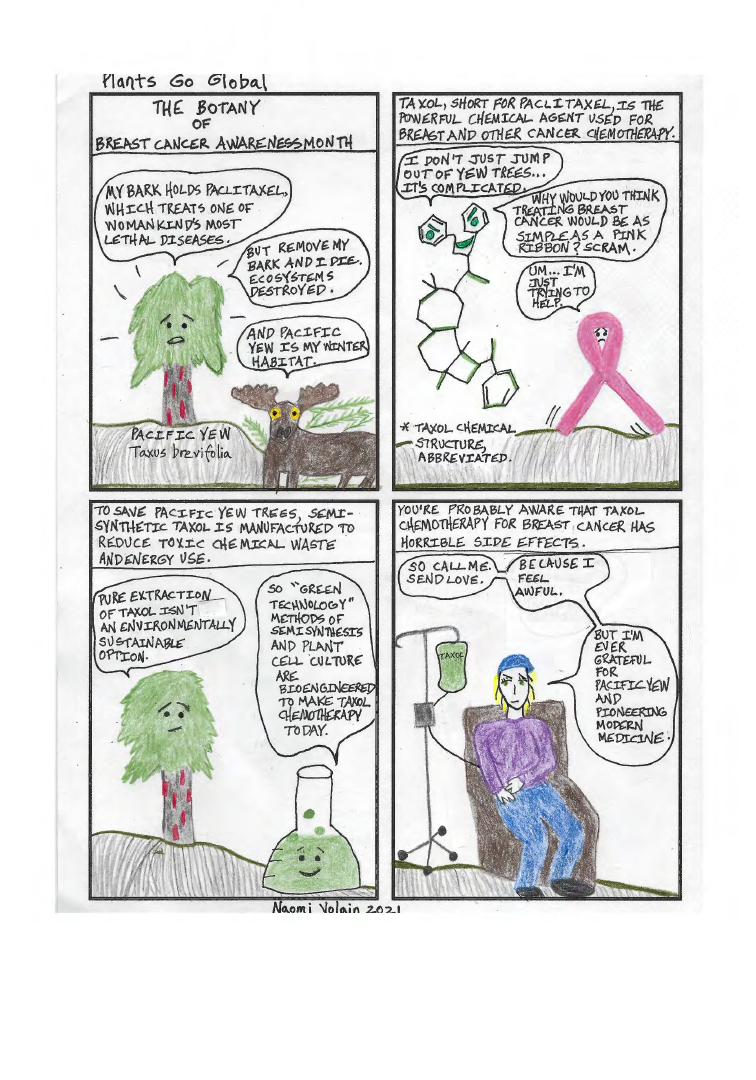
comes from Naomi Volain, BSA member,
botany teacher and science cartoonist. She
is a breast cancer patient now in remission,
and her comic "The Botany of Breast Cancer
Awareness" connects conservation issues
to the trauma of breast cancer treatment
(Figure 1).
Historical trauma is a function and result of
systemic oppression, violence, and erasure.
It is experienced collectively by those that
share one or more oppressed identities. While
the term historical trauma may indicate
events that happened in the past, this type
of trauma is in fact adaptive and cumulative.
For example, while enslavement may have
ended, Black Americans continued to be
traumatized throughout our nation’s history
and into the present via acts of terror such
as lynching, discriminatory laws, and the
everyday trauma of both overt racism and
racial microaggressions present in the systems
individuals must operate within (such as the
education system, healthcare system, etc.).
Historical trauma is felt by individuals but also
passed from generation to generation (and is
therefore also called generational trauma).
PSB 69 (1) 2023
8
Figure 1. A comic by Naomi Volain connecting conservation issues to the trauma of breast cancer treatment.
PSB 69 (1) 2023
9
THE TRAUMA RESPONSE
While the previously described types of
trauma are very different, they produce the
same response in the brains and bodies of
individuals: they trigger our automatic stress
response system. The stress response system
might look different in each individual (some
people may respond more actively [fighting
or fleeing], whereas others may freeze or
fawn). But the important thing to remember
is that it is a protective function occurring
automatically (without thought) in the lower
regions of our brain. Just as we cannot define
for others what is or is not traumatizing for
them, we also cannot prescribe how they will
or should react to a traumatic event.
The automatic stress response happens in
the moment for all of us when faced with
a traumatic or extremely stressful/scary
situation (think of how your body leaps into
gear if you are almost sideswiped on the
highway). But for people who are currently
experiencing, or have experienced, ongoing
trauma, their trauma response becomes
more of their normal or typical response to
situations that might be described by many as
only mildly stressful.
3
As an outsider, it can be
hard to recognize such reactions through the
lens of trauma, but we must work to do so in
order to break the cycle of re-traumatization.
INTERSECTING
TRAUMAS:
WHAT’S IN THE SOIL
Most of the time, a person’s traumas do not
exist in a silo. Rather they intersect with other
traumas, and the realities of the environments
we live, work, and play in and how others in
those environments may perceive us. Think of
an individual as a tree. The leaves are private/
individual traumas they may be experiencing.
But every tree exists in soil that further informs
how its leaves may grow, and that soil may
have nutrients (that help it heal from trauma)
as well as toxins (that can trigger past traumas
or be a source of new trauma). Individuals
may grow in many different soils—their home
life, a religious community, a friend group,
their professional life, etc.
So, what is in the soil of the botany community?
We all bring our own traumas with us to our
work, but how does our work setting either
resist or engender retraumatization? Many
of the workshop participants offered that
academic settings are steeped in systemic
oppression and reinforce the biases and
discrimination that have contributed to the
historical traumas of many marginalized
communities. Additionally, the fast-paced,
competitive, and achievement-focused
characteristics of the academic environment
may be triggering for colleagues and students
who have experienced traumas.
3
To learn more about the mechanics of the brain and
body’s response to trauma and how this stress response
system can have lasting impacts on cognition, health,
and wellness, I recommend The Body Keeps the Score:
Brain, Mind and Body in the Healing of Trauma by
Bessel van der Kolk.
PSB 69 (1) 2023
10
MOVING FROM TRAUMA
AWARE TO TRAUMA
INFORMED
What can we do? If we know that a majority of
people have experienced at least one trauma
in their lives,
4
and we can’t go back and
erase past traumas, and we likely are not in a
position to prevent many present and future
traumas, what can we do to interrupt this
cycle? The good news is that you don’t have
to be a therapist to be therapeutic!
5
To act in
a trauma-informed way, remember the four
R’s. Realize the widespread impact of trauma.
Naomi’s cartoon beautifully illustrates this
first R; in Naomi’s words, “Simplifying the
trauma of breast cancer with Breast Cancer
Awareness’s pink ribbon doesn’t address
the real need of cancer patients—for their
people to be present for them, and honestly
acknowledge the trauma of cancer treatment.”
Recognize the signs and symptoms of trauma
in yourself and others. Respond by fully
integrating knowledge about trauma into
policies, procedures, and practices. And seek
to actively Resist retraumatization.
6
4
The first major study on childhood trauma, “The Adverse Childhood Experiences Study,” published in 1998 by
Kaiser Permanente and the CDC showed that over 50% of American adults had experienced at least one of ten
traumatic events as a child; 25% had experienced two or more, 1 in 16 had experienced four or more, and 1 in 22
had experienced six or more. The traumatic events they surveyed were: sexual abuse, physical abuse, verbal abuse,
emotional neglect, physical neglect, adults in the home with drug or alcohol use problems, adults in the home with
mental health issues, adults in the home who have been incarcerated, domestic violence, and parent separation.
5
If you are interested in learning more about various therapies used to address trauma past and present,
I recommend The Body Keeps the Score by Bessel van der Kolk. This title as well as What Happened to You?:
Conversations on Trauma, Resilience, and Healing by Oprah Winfrey and Bruce Perry also extrapolate
on how those of us who are not therapists can be a support for those who have experienced trauma.
6
The Substance Abuse and Mental Health Services Administration (SAMHSA) offers guidance for organizations
to move from being “trauma aware” to “trauma informed” by analyzing and reforming practices, culture, policies,
and systems: https://ncsacw.acf.hhs.gov/userfiles/files/SAMHSA_Trauma.pdf
ABOUT BOTANY360
Botany360 is a series of programming that
connects the plant science community
throughout the year with professional
development, discussion sessions, and
networking and social opportunities. If you’d
like to see upcoming events or view recordings
of past events, visit https://botany.org/home/
resources/botany360.html.
PSB 69 (1) 2023
11
Jacquelyn Gill is an associate professor of paleoecology at the University of Maine’s Climate
Change Institute. She is a paleoecologist and biogeographer, bringing the perspectives of
space and time to bear on questions in ecology and global change science. Her work takes
a community ecology approach to help understand how species and their interactions
have responded to interacting drivers (like climate change and extinction) through time.
She directs the BEAST Lab, which investigates 1) the legacies “biotic upheavals” like the
extinction of Pleistocene megafauna on vegetation, 2) biotic interactions and drivers of
landscape change on large spatiotemporal scales, 3) plant range dynamics and vulnerability to
climate change, and 4) what paleoecology, Indigenous archaeology, and Traditional Ecological
Knowledges can tell us about human-environment interactions in the past.
She is a co-host of the podcast Warm Regards and author of the blog “The Contemplative
Mammoth”, welcoming conversations and advice on science, early career academia, and
diversity in STEM. She is a co-founder of the March for Science and a 2020 recipient of NCSE’s
Friend of the Planet award.
JACQUELYN GILL
BOTANY 2023
PLENARY SPEAKER
SUNDAY, JULY 23 7:30 PM
BOISE CENTER, BOISE, ID
Register now - www.botanyconference.org - Early Registration deadline May 31.
PSB 69 (1) 2023
12
Have you registered yet?
Come home to Botany 2023
at the beautiful
Boise Centre, Boise, Idaho
Connect, Collaborate & Learn
with Colleagues from Around the Globe
Over 900 Scientific Presentations
Including Symposia - Colloquia - Poster Session - Social Events
Field Trips - Wildflower Walks - Workshops - Exhibits
Special Lectures by Prominent Scientists
Register now - www.botanyconference.org - Early Registration deadline May 31.
READ OUR TESTIMONIALS
AN INVITATION
FROM A MEMBER
https://bit.ly/41uM70n
WHY BOISE?
https://bit.ly/3AjUZd4
A NOTE FROM
BOISE
https://bit.ly/3mXx7Jm
13
By Rachel S. Jabaily
1
, Colorado College, Associate Professor of Organismal Biology and Ecology
Private 4-year residential, selective, liberal arts college
Jennifer L. Ison
2
, College of Wooster, Associate Professor Biology, Private 4-year residential,
selective, liberal arts college
Christopher T. Ivey
2
, California State University, Chico, Professor of Biological Sciences
Comprehensive public university, Hispanic-serving institution
Rachel M. McCoy
2
, St. Norbert College, Assistant Professor of Biology, Private 4-year residen-
tial, Norbertine Catholic, liberal arts university
Mackenzie L. Taylor
2
, Creighton University, Associate Professor of Biology, Private 4-year
residential, Jesuit, liberal arts university
Carrie A. Wu
2
, University of Richmond, Associate Professor of Biology and Environmental
Studies Program Coordinator, Private 4-year residential, selective, liberal arts university
1
Author for correspondence (rjabaily@coloradocollege.edu)
2
Co-authors contributed equally and are listed in alphabetical order.
SPECIAL FEATURE
This article originated from discussions
in a workshop held by the Primarily
Undergraduate Institution Section of the
Botanical Society of America (BSA) at our
Botany 2022 meeting in Anchorage. We hope
this article will provide some useful ideas
and tips for people interested in applying for
faculty positions at bachelor’s degree granting
Primarily Undergraduate Institutions (PUIs).
We recognize that our experiences are not
universal. While our trajectories toward,
and experiences in, our current positions
as PUI faculty members may vary, we share
Preparing for a Faculty Position at a
Primarily Undergraduate Institution (PUI)
a common passion for undergraduate
mentoring and teaching in plant biology.
Our perspectives reflect our experiences as
botanists within PUI institutions, and while
we offer these suggestions in the hopes of
fostering more successful academic botanists,
much of the content in the article could apply
to other subdisciplines within biology. In this
article, our intent is to share our collective
perspectives to help others explore strategies
about how to successfully chart their own
path towards a PUI faculty position.
PSB 69 (1) 2023
14
WHAT IS A PRIMARILY
UNDERGRADUATE
INSTITUTION (PUI)?
Primarily Undergraduate Institutions
encompass a wide swath of the higher
education landscape. The National Science
Foundation defines PUIs as “... accredited
colleges and universities (including two-year
community colleges) that award Associate’s
degrees, Bachelor’s degrees, and/or Master’s
degrees in NSF-supported fields, but have
awarded 20 or fewer Ph.D./D.Sc. degrees in
all NSF-supported fields during the combined
previous two academic years.” Some PUIs
have a very heavy research expectation,
whereas others have very little support for
research. PUIs include public and private R2
universities, small (often private) liberal arts
colleges (SLACs), and community colleges.
In some cases, the institution may not fall
into the NSF-defined category of PUI, but the
specific context of the college or department
is best characterized as primarily serving
undergraduates.
For many faculty members at PUIs,
undergraduate education in the classroom
is the central component of their job. The
“teacher-scholar model” is typically highly
valued at these types of institutions as well.
Scholarship within the discipline is considered
a valuable component of developing and
maintaining excellence in teaching. PUI
faculty also engage in service to their
institutions and the profession. Expectations
for successful job candidates will vary, but
one commonality is that all these institutions
are primarily undergraduate. As you move
through your professional training, consider
how your professional work (research,
teaching, service) can center on involving and
supporting undergraduate students.
HOW DO I PREPARE
MYSELF AS A
RESEARCHER TO BE
COMPETITIVE FOR A PUI
FACULTY POSITION?
During graduate school, focus on completing
your dissertation and publishing your work
to prepare for a future successful PUI job
application. During grad school and beyond,
be strategic about crafting your portfolio
to demonstrate the likelihood of continued
professional success by publishing papers,
applying for and hopefully receiving grant
funding, and solidifying a research program
that can continue to produce publications
with undergraduate students. PUIs commonly
expect faculty to develop a research program
that is manageable and successful with a
solely undergraduate-populated lab. Once
employed, it can be more challenging for
departmental colleagues to provide specific
advice for interesting research directions.
Invest in your research trajectory prior to
applying for jobs. To earn tenure at a PUI,
faculty members typically need to publish
papers (often a mixture from projects started
before the position and from projects initiated
at the institution) and will be encouraged to
apply for grants.
Many of us experienced the rewards of
mentoring undergraduate research students
while we were graduate students in botanical
lab and field projects. We built career-
long relationships with our undergraduate
co-authors and worked with them on
presentations, publications, and their own
applications for jobs and graduate school. Seek
out similar relationships during your graduate
school years, because all of these experiences
PSB 69 (1) 2023
15
can be added to your CV and discussed in job
application materials, making you a great fit
for a PUI job.
Because the number of botanists in any PUI
faculty is likely to be small, botanists are often
expected to take on service requirements such
as managing a greenhouse or curating an
herbarium. Applicants with these skills may
be favored, so gaining some experience in
these areas will likely be beneficial. Utilizing
these resources in your research and teaching
will be excellent to discuss in job applications.
HOW CAN I GAIN
TEACHING EXPERIENCE
NECESSARY FOR MY
PUI JOB APPLICATION?
Most people pursuing a tenure-track faculty
position at a PUI are interested in a balance
between teaching and research. Providing
evidence that you are developing that balance
as a graduate student and postdoc can be
beneficial. Aim to gain experience in the types
of teaching you wish to continue, including
laboratory and field-based courses.
Traditionally, academics get their first
teaching opportunities as a teaching assistant,
perhaps in a lab section of a larger course
overseen by a faculty member. The support
or guidance in instructional techniques at
this stage varies, so the importance of teacher
training is increasingly recognized in graduate
programs. If your program offers workshops,
classes, or other opportunities to develop
teaching skills, take advantage of them.
Some faculty offer senior graduate students
opportunities to give guest lectures in their
courses, which can be a terrific way to learn
how to interact with a large group of students.
If you can serve as instructor-of-record on a
course as a graduate student, consider doing
it, even if it takes time away from other work.
Instructor-of-record role indicates a much
deeper teaching experience, equivalent to
teaching as a professor.
Opportunities to build teaching and
mentorship experience continue after
completing your PhD. Some institutions will
hire recent graduates as instructors of record
for a semester or two while they are looking
for a postdoc or faculty position. Professional
societies, including the BSA, routinely offer
workshops and colloquia at annual meetings
dedicated to developing teaching strategies
and showcasing engaged pedagogy. Ambitious
undergraduates are usually eager to contribute
to a research project under the mentorship of
a postdoc or recent graduate.
You can pursue teaching experiences within
a PUI, which can be enlightening as well
as helpful for demonstrating interest in
permanent faculty positions. Some PUIs offer
various forms of teaching postdocs, and some
PUI faculty offer research postdoc positions
directly. Some of these positions allow postdocs
to earn instructor-of-record experience as
well. Postdoctoral positions within PUIs
are not common, but these provide valuable
insight into the circumstances experienced by
faculty working at PUIs. Many, if not all, PUIs
provide professional development training
opportunities associated with teaching or
will support early career faculty who express
an interest in finding such opportunities.
Colleagues within a department can also
provide mentorship in teaching methods
and strategies for postdocs, visitors, and new
faculty members.
PSB 69 (1) 2023
16
Another common opportunity to gain
teaching experience within a PUI is through
a temporary, non-tenure-track position.
Faculty members with these positions may be
called Visiting Assistant Professors (VAPs),
contingent faculty, or some other title that
distinguishes them from permanent faculty.
These positions are typically used to replace
faculty who are on sabbatical, fill unforeseen
vacancies in a department, or assist with
unexpected changes in curricular needs. They
are usually teaching-heavy and may have few, if
any, research expectations or resources. These
will likely provide significant opportunities
to obtain instructor-of-record teaching
experience and may also be a time and space
to develop new scholarly collaborations and
pursuits. However, finding time and resources
to build or maintain a research program while
in such positions can be challenging. Using
time as a VAP to bring to fruition novel ideas
or to continue ongoing collaborations may
be a successful strategy, perhaps instead of
pursuing a research-focused postdoc position.
Some PUIs allow and encourage VAPs to
mentor research with students and give their
VAPs access to in-house supplies, grants, funds,
and professional development opportunities.
Ask ample questions to see what is possible
if you are considering a VAP, especially if this
is instead of a postdoc position. The choice
of whether to accept a VAP should depend
on the specifics of the position, the relative
strengths and gaps in your background, and
your overall professional goals.
A VAP may very occasionally convert to
a tenure-track position. However, unless
a pathway to tenure-track conversion is
articulated in official documentation for the
position, do not count on this as a guarantee.
Sometimes current VAPs are converted into
tenure-track positions without an additional
external search, but this is rarely the case.
Many institutions have policies discouraging
or prohibiting the practice, preferring (or
requiring) an open search. As a current
VAP, you might be a preferred candidate in
an open search, as many PUIs highly value
authentic teaching experience with their
specific institution or similar. However, it can
be emotionally challenging to be present at
your VAP institution when other candidates
are interviewing for the job you want. This is
a topic that you should be sure to discuss with
the search and/or department chair.
DO I NEED A POSTDOC
POSITION TO BE A
SUCCESSFUL PUI JOB
CANDIDATE?
A postdoctoral position is a great way to
gain a new perspective through an expanded
scholarly network, and many successful job
candidates have postdoctoral experience.
Many permanent PUI jobs require
continuing research productivity for tenure
and evidence of scholarly engagement in
multiple types of questions, methodology,
analyses, and study systems can demonstrate
flexibility. Postdoctoral experiences can also
demonstrate continued productivity, scholarly
independence from your dissertation lab
group, and a more expansive intellectual
contribution. Botany is a dynamic and rapidly
changing field, and PUIs need faculty who
demonstrate an interest in keeping abreast of
changes to effectively train their students.
PSB 69 (1) 2023
17
We found substantial variation in our
academic preparations prior to obtaining a
faculty position, and similarly, our experiences
on search committees varied among our
institutions. At some institutions, we have
only seen applicants with both postdoctoral
and instructor-of-record experience progress
in the hiring process. In other cases, applicants
were competitive immediately out of graduate
school if their record was otherwise strong.
If you lack postdoctoral experience but
seem otherwise to be an excellent fit for an
advertised position, contact the chair of the
search committee for clarification about
minimum qualifications before applying.
WHEN IN MY
EDUCATION/TRAINING
JOURNEY SHOULD I
START LOOKING FOR A
FACULTY JOB AT A PUI?
You may find it helpful to start preparing
for a PUI faculty position early in your
academic training. Talk with faculty members
in positions like those that interest you so
you have a better appreciation for what the
reality of the job might entail. Attending
PUI-specific events through the BSA as well
as the American Society of Plant Biologists
and other professional organizations can help
you meet the community and find mentors.
Familiarize yourself with the annual job cycle
through the ecoevoljobs wiki, compare job ads
from various types of institutions, and learn
about differences among institution types. Be
mindful that preparing the various statements
of a full job application is time-consuming,
especially the first round. Customizing essays
to individual institutions also takes significant
time. Applying for jobs that look interesting
before you are likely to be viable (i.e., before
your dissertation is complete) may be
informative, this may not be the best use of
your energies. That said, if you see an amazing
PUI job posted that is just what you want, do
not assume it will be posted again in future
years—go for it!
WHAT INFORMATION
SHOULD I FIND IN A
PUI JOB AD?
Many PUI jobs are posted in the same places as
R1 and other academic jobs: the Chronicle of
Higher Education, HigherEdJobs, Science, and
Nature, as well as the websites of the specific
institutions and on social media. Community-
sourced anonymous wiki pages conglomerate
job postings from these sites and allow people
to post anonymous questions and updates on
the various searches as they progress. Two of
interest to our community are ecoevojobs.net
and evoldir. The BSA webpage (www.botany.
org) also lists many relevant jobs.
The ad should state clearly if the position is
tenure track or not, the levels at which people
can apply (e.g., assistant professor, open to all
ranks, PhD required), and what department
or program within the institution is hiring.
The ad should also indicate the general areas
of teaching and research that are expected.
The ad may indicate what types of courses an
applicant should be prepared to teach, to what
extent research productivity is valued, and
other major required components of the job.
You may need to meet all, or just some, of the
criteria to be competitive.
PSB 69 (1) 2023
18
Although job ads are written by faculty
committees, some institutions have Human
Resources staff that mandate large chunks
of the job ad. As a result, there may only be
a paragraph or two that the department is
able to influence. If the ad seems very broad,
it could mean the department is casting a
wide net to look for all-around excellent
colleagues, and the disciplinary expertise is
not as important. It could also signal lack of
cohesion among members of the department
in what the position would accomplish. There
should be a point of contact included in the
job ad, often the department chair or another
faculty member who is serving as the search
committee chair. Contact them if you have
questions or need clarification about the
position.
WHAT OTHER THINGS
MIGHT I CONSIDER WHEN
DECIDING WHETHER TO
APPLY?
Most PUI departments are small, and
consequently candidates that have broader
expertise or perspectives may be perceived
as more useful future colleagues. Be prepared
to envision yourself in a broader range of
PUI jobs; even if your training is primarily in
botany, you may be a great fit for a job seeking
an ecologist, an evolutionary biologist, a
geneticist, or other type of broadly defined
biologist. Consider the expectations of the
job. Does it seem like the balance of teaching
and research is what you would like? What is
the teaching load? What are the expectations
for tenure and promotion? If current faculty
members post their CVs, you may be able to
determine their academic records at the time
they applied for their jobs and/or when they
received tenure and gauge typical research
output. Keep in mind that expectations for
scholarly productivity have change over
the past decades across academia, at times
drastically, and that the standards and
expectations of research engagement often
change with tenure rank. Pay special attention
to the academic record of the assistant professors
(i.e., recent hires).
You may be able to gain some insight into
the culture of the department by looking at
the department website and exploring faculty
lab websites or public social media accounts.
Are there professors in the department or at
the institution that seem like they could be
interesting to interact or collaborate with?
Also consider the values of the institution,
its mission statement, and major initiatives
discussed on the website. Does this resonate
with you? You should consider location and
cost of living, but keep an open mind.
HOW CAN I PREPARE MY
APPLICATION
MATERIALS FOR A
SPECIFIC PUI JOB?
Typically, job applications for PUIs require a
cover letter, curriculum vitae (CV), a teaching
statement, a research statement, and some
type of Diversity-Equity-Inclusion (DEI) or
fit-to-mission statement. Cover letters and
statements are typically two pages or so in
length. These statements may be combined
in various ways, and not all documents may
be required in the initial application. Think
carefully about how to make these documents
as easy to read as possible, with section
headings, page numbers, and headers that
reinforce whose documents they are. Be sure
you seek out mentors who can provide you
PSB 69 (1) 2023
19
examples and can provide feedback on your
documents. Keep in mind that customization
will require substantial time if you are
applying to multiple jobs, but is important for
advancing in most searches.
Cover Letter
The cover letter should convey, with specificity
and realistic enthusiasm, why you are a great
fit for the particular position. Make it clear
up front that you understand that this is a
PUI. General applications or applications
that seem tailored for an R1 job will not do
well in the search and are easy to spot. In the
letter, address each aspect of the job in their
perceived order of importance in the position.
Speak to teaching, undergraduate mentorship
in research, your own research trajectory,
and involvement in the broader community.
Any customization to the specific institution,
and reference to any major initiatives of the
PUI (e.g., DEI initiatives, new or ongoing
interdisciplinary programs, community
engagement) will benefit you. You may
mention if there are affiliate programs or other
interdisciplinary initiatives at the institution
to which you might contribute as a scholar or
teacher, broadening your appeal to the PUI.
In general, departments will be looking for
a candidate who can strengthen existing
curricular programs, fill a gap in the
department, and/or diversify the department.
If the job application mentions specific courses
or general areas of teaching that are required,
be sure you discuss each clearly and potentially
early in the letter. For example, if the ad
states that the candidate would be expected
to contribute to introductory biology, be
sure to indicate your willingness and, ideally,
excitement to do so. If you have experience as
a TA, guest lecturer, or instructor-of-record,
highlight this in your letter with clear and
consistent language about your role.
CV
The curriculum vitae (CV) is a comprehensive
assembly of your professional achievements
and should be thoughtfully organized to
highlight the qualities a PUI seeks. There
are many ways to format a CV, so look at
examples and consistently update yours as
you move through your career. Consider
moving information about your teaching
and mentoring experience toward the
beginning of the CV. Highlight the roles of
undergraduate mentees in your publications,
presentations, etc. You may find it useful to
annotate your publications list to include your
role on specific papers. The BSA often hosts
professional development opportunities at
our Botany conference for people to have their
CV reviewed by other botanists, so take part if
you can!
Research Statement
In your research statement, discuss both
your current research progress and future
trajectory, making it clear how you plan to
develop your research program in the context
of the institution. Committees appreciate
applicants that make it easy for them to
envision a smooth and successful integration
into the department. Expectations for
undergraduate research should be clear from
the job advertisement or from college and/or
department mission statements. You should
explicitly discuss the role of undergraduates
in your proposed research program. Describe
how you have (or plan to) recruit research
students and how you mentor them through
research, keeping DEI considerations central.
PSB 69 (1) 2023
20
Describe ways in which your research might
be integrated into your teaching. Highlight
any previous outcomes from training and
mentoring undergraduates, such as preparing
proposals, presentations, and/or publications,
and demonstrate how you will continue to
integrate your students into the broader
scientific community. Identify two or three
projects that would be manageable as an
undergrad thesis or summer project, and that
would be publishable. Elaborate on these in
the application materials to show that you
have a realistic but ambitious perspective.
Student work will underpin much of your
research productivity, but there will be aspects
of your scholarship where you are central.
Be sure you also speak to contemporary,
major projects utilizing and building upon
your specific academic background. Identify
potential sources of external grant funding
you might seek, including the NSF RUIs
(Research in Undergraduate Institutions) and
ROAs (Research Opportunity Awards).
Clarify what resources you would need to
be successful, while keeping in mind that
PUIs often have limited start-up budgets and
access to equipment. You should demonstrate
flexibility and creativity, especially if your
research is expensive. Are there nearby
collaborators? Would you consider developing
local fieldwork? Make it obvious to readers
that your work will not only be possible, but
also fruitful and meaningful in the context
of the institution. Applicants who describe at
length their plans for future graduate students
and postdocs, require highly specialized,
large research facilities, or require extensive
fieldwork throughout the year, suggest
unfamiliarity with the environment at PUIs,
and thus are unlikely to be viewed favorably
by hiring committees.
Teaching Statement
The teaching statement should address your
general philosophy as an educator, your values
when developing courses and in working
with students, and specific examples of your
pedagogy in practice. What do you value
when designing a course, choosing topics,
and creating assignments and assessments?
How do students interact with you and each
other in your classroom? What materials do
you bring into the classroom, lab, and field?
What skills do your students develop? How is
DEI enhanced in your classroom and through
student interactions?
In your teaching statement, be sure to speak to
the specific courses or academic areas that the
job is seeking. The ability to teach a specific
course can be a make-or-break requirement
for a candidate, and the search committee will
be looking at your qualifications and interest
in teaching what they stated in the ad. If
possible, look through the course catalog and
highlight existing courses that you would be
able to teach beyond those requested. Avoid
limiting your discussion of teaching to upper-
level courses or seminars. Faculty members at
PUI institutions are often expected to teach
core curricular courses such as introductory
biology, genetics, ecology, or evolutionary
biology. Many Biology departments at PUI
institutions offer courses to non-majors as
well, which can be important for departmental
budgets and expanding the reach of STEM
instruction. If you are enthusiastic about
developing a new course, discuss that in
the teaching statement and address other
ideas that you have to enhance the student
educational experience at the institution.
Consider the broader curriculum and possible
interdisciplinary or college foundational
courses or programs that you might contribute
PSB 69 (1) 2023
21
to, enhancing the overall mission outside of
the specific hiring department.
DEI Statement
The DEI or fit-to-mission statement should
be personal and authentic, with no pro-
forma requirements. Some job ads include
a specific prompt to guide your statement.
You are not required to disclose any of your
identities or backgrounds in this or any part
of your job materials, but this could be a great
place to do so if you are comfortable sharing.
Many institutions are highly interested in
recruiting and retaining diverse faculty, and
the search committee may not have access
to demographic information of candidates.
Reflect on your own background, experiences,
positionality, and intersectionality, and how
you continue to educate yourself. How has
your field, and academia in general, built and
reinforced power structures and marginalized
people? How have you contributed (or could
you contribute) to changing structures
and systems? How do you approach DEI
considerations in your roles as teacher,
mentor, scholar, colleague, and community
member? Keep in mind that the BSA has
many great initiatives you can get involved
with to enhance DEI goals within our society,
like the BSA PLANTS program and service on
our DEI committee.
Letters of Reference
You will be asked to provide the names of
three or more professional references. Your
references will either be contacted about
letters of recommendation if you pass initial
screening processes, or the letters may be
required at the deadline of your application,
usually submitted by your letter writers
themselves. Your most recent employer
(chair of your current department or other
administrator) may also be contacted about a
general background check by HR at some point
in the process. You should seek out a deeper
conversation with your letter writers about
your experiences together, what you hope
they emphasize (including contextualization
of any potential weak points in your
application), your plans for your future, and
if they have any concerns. Letter writing and
customization is a major time commitment
for your mentors and an important outcome
of your relationship together. It is critical that
you think carefully about who will provide
reference letters for you. All the letters together
should illustrate your progress and potential
as both a scholar and a teacher, but each letter
need not speak about every topic. Ask your
letter writers explicitly if they can provide
a strong or positive letter about you. As
members of search committees, we have seen
(very rarely) letter writers express misgivings
about a job candidate, which impedes their
consideration for a job. And remember to give
your recommenders sufficient time to craft
and submit their letters!
HOW ARE APPLICATION
MATERIALS EVALUATED
TO DETERMINE WHO
PROGRESSES IN THE
SEARCH?
The process of evaluating applications varies
between institutions. Typically, application
materials will be reviewed by the faculty
hiring committee, although other members
of the department may also have a chance
to contribute feedback in this early stage. An
initial screen of all applicants may remove those
PSB 69 (1) 2023
22
who do not meet the minimum qualifications
or who have incomplete applications. Full
reads of all documents are then systematically
completed by committee members. Searches
may use a rubric to assess candidates’ strength
in various areas, including enthusiasm for
work at this specific PUI, teaching experience
and interest, academic record, publication
record, previous work with undergraduates,
DEI issues, and perceived ability to contribute
to the curriculum. Letters of support may be
evaluated at this stage. The search committee
discusses the applicants, balancing many
factors (area of expertise, experience, DEI, etc.).
The strongest applicants are then typically
invited for a phone or online interview. For
a tenure-track search for one position, 8 to
15 candidates may be invited for the initial
interviews, and of those, 2 to 4 may be
invited to subsequent in-person interviews.
In some cases, the search moves immediately
to on-campus interviews. Check in with the
ecoevojobs wiki to see if the community is
updating the stage of the search, because
some people on this forum share comments
when they have cleared a particular stage in
the interview process. The interview process,
which deserves its own similar space, is not
discussed in detail in this article. Please
see King-Smith et al. (2021) for further
information.
CONCLUSION
Each of us has found great inspiration and
satisfaction working at PUIs, even across the
wide diversity in institutions and backgrounds
represented by the authors. Our undergraduate
students are eager partners in our research
endeavors and educational journeys, and
the unique challenge of building academic
scaffolds for these emerging scholars is
satisfying and an endeavor worthy of pursuit.
We applaud and encourage others with similar
interests and hope that the information
herein can be useful for your preparation.
PUIs encompass a broad part of the higher
education landscape, and every institution
and every search process is different. Reach
out to others within our BSA community
for guidance and support, and ask questions
of faculty at schools that are similar to those
that you would consider for a future job. Our
botanical community thrives when we have
our members secured in faculty positions,
helping to educate the next generation of
scientists and citizens. We hope you may be
as professionally and personally fulfilled and
happy as we have been in our PUI endeavors.
ACKNOWLEDGEMENTS
Discussions with Nathan Jud, Susana
Wadgymar, and Mike Moore, as well as their
contributions to the PUI workshop at Botany
2022, were instrumental in the development
of this article. The workshop was supported by
NSF Award No. 2218485 “Botany 2022, PUI
Section: Careers and Mentorship at Primarily
Undergraduate Institutions” awarded to Dr.
Nathan A. Jud (William Jewell College), Dr.
Jennifer Ison (College of Wooster), Dr. Carrie
Wu (University of Richmond), and Dr. Rachel
McCoy (St. Norbert College). The authors
also thank two anonymous reviewers and M.
Jabaily for helpful comments on earlier drafts
of this article.
REFERENCES
King-Smith, C., C. Lund Dahlberg, and B.
Riggs. 2021. Obtaining a faculty position at
a primarily undergraduate institution (PUI).
BMC Proceedings 15 (Suppl 2): 3. https://doi.
org/10.1186/s12919-021-00207-6
PSB 69 (1) 2023
23
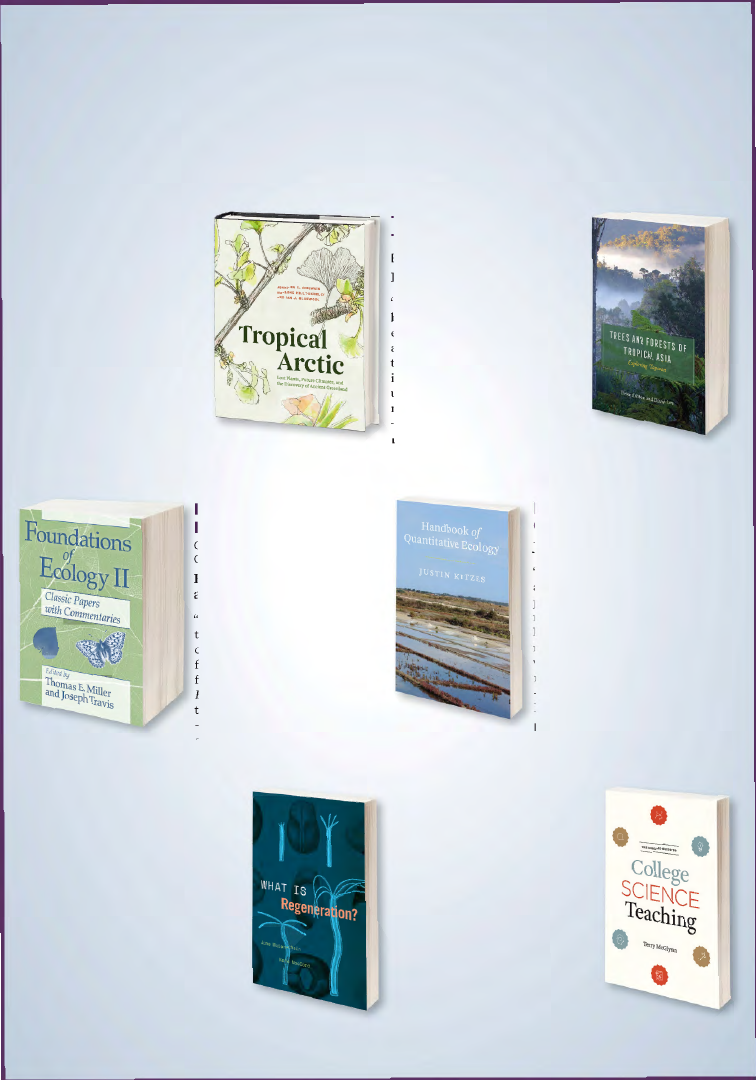
CHICAGO
New from
The University of Chicago Press www.press.uchicago.edu
Tropical Arctic
Lost Plants, Future
Climates, and the Discovery
of Ancient Greenland
<
p style="position: absolute; top: 294px; left: 27px; white-space: nowrap;" class="ft236"><
p style="position: absolute; top: 310px; left: 27px; white-space: nowrap;" class="ft236">
“The authors warn that current
greenhouse-gas emissions are
becoming comparable in impact
to the volcanic emissions that
triggered the collapse of Triassic
Greenland’s fl ora.”—Nature
CLOTH $30.00
Trees and Forests of
Tropical Asia
Exploring Tapovan
“This profoundly inspirational
book, a personal deep-dive into the
ecology, evolution, biogeography,
and conservation of the forests of
tropical Asia, is a lyrically written,
instant classic, a page-turner nat-
ural history saga in the mold of a
modern-day Alfred Russel Wallace.”
—Stephen P. Hubbell
PAPER $45.00
Foundations of
Ecology II
Classic Papers with
Commentaries
“Having a compilation of papers
that experts consider most signifi -
cant is highly valuable, particularly
for students less familiar with the
fi eld. As a whole, Foundations of
Ecology II is a worthy extension of
the now-classic fi rst volume.”
—Judith L. Bronstein, University
of Arizona
PAPER $75.00
Handbook of
Quantitative Ecology
“A stroke of genius. Kitzes does
an excellent job of translating the
properties of biological systems into
mathematical models, using basic
logic and without any advanced
math. His approach is a powerful
way to demystify these models and
make them intuitive.”
—Corlett Wolfe Wood, University of
Pennsylvania
PAPER $25.00
What Is Regeneration?
“The most thought-provoking and
enjoyable book I’ve read in years. I
thoroughly recommend it to all who
want to exercise their grey matter, to
think diff erently and without horizons.”
—Marine Biologist
PAPER $20.00
The Chicago Guide
to College Science
Teaching
“Although the text will be most
useful to new instructors—graduate
students and early-career faculty
—even established professors will
likely fi nd refreshing perspectives
and ideas.”—American Entomologist
“Smart, thoughtful, and practical.”
—Quarterly Review of Biology
PAPER $18.00
24
By
Amelia Neely
BSA Membership &
Communications
Manager
E-mail: ANeely@</i>
botany.org
MEMBERSHIP NEWS
2022 GIFT MEMBERSHIP
DRIVE DRAWING WINNER
Thank you to everyone who purchased
gift memberships during the 2022 Gift
Membership Drive (October–December
2022)! You can purchase one- or three-year
gift memberships at any time for both students
and developing nations’ colleagues. Want
to donate a gift membership to students or
developing nations’ colleagues instead? Simply
put your own name and email in the recipient
fields. Visit crm.botany.org to get started.
Congratulations to Katelyn Gobbie, the 2022
Gift Membership Drive winner of the free
registration to Botany 2023 – One World!
Katelyn is a graduate student at John Carroll
University. Katelyn’s primary interests are
in plant ecology, botany, conservation, and
adaptation to environmental change. Katelyn
has a B.S. in Biology from John Carroll
University and formerly worked as a Field
Botanist Technician with the Cleveland
Metroparks. Her thesis work will focus on
biological soil crusts, particularly mosses, in
gypsum and non-gypsum soils of the Mojave
and Chihuahuan deserts.
BOTANY360 UPDATES
Botany360 is a series of programming that
connects our botanical community during the
360 days outside of Botany Conferences. The
Botany360 event calendar is a tool to highlight
those events. The goal of this program is
to connect the plant science community
throughout the year with professional
development, discussion sessions, and
networking and social opportunities. To see
the calendar visit botany.org/calendar.
If you want to coordinate a Botany360 event
email me at aneely@botany.org.
Botany360
Event Recordings
• Ace It! - Write a Better Title (March 2, 2022)
• Ace It! - Write a Better Abstract (March
23, 2022)
• De-mystifying the MS submissions pro-
cess: Before you submit (Part 1) (May 11,
2022)
• De-mystifying the MS submissions pro-
cess: Before you submit (Part 2) (May 18,
PSB 69 (1) 2023
25
2022)
• So you want to get involved with section
leadership... (June 5, 2022)
• Applying to Grad School - A Q&A Ses-
sion (September 20, 2022)
• Utilizing Botany Conference Content in
Your Teaching (November 2, 2022)
• Intro to Reviews and Meta-Analysis (No-
vember 7, 2022)
• How to be a Successful BSA Student
Representative (slides only) (January 18,
2023)
• Prepping for PLANTS: An Information-
al Webinar about the PLANTS Travel
Awards for Underrepresented Under-
grads (March 10, 2023)
BSA PROFESSIONAL
HIGHLIGHTS
New this year, we are including a BSA
Professional Member Highlights section each
month in the Membership Matters newsletter.
Below you will find the first two highlights
of 2023. If you would like to be highlighted,
email Amelia Neely at aneely@botany.org.
Dr. Amelia Merced of the USDA-FS
International Institute of Tropical Forestry.
(Twitter: ;@AmeliaMerced Website: https://
ameliamerced.weebly.com/)
Dr. Merced is a botanist interested in evolution,
ecology, and conservation of bryophytes.
Although trained as a plant anatomist
and microscopist, she currently conducts
field studies and works with the bryophyte
collection at the herbarium of the University
of Puerto Rico, Río Piedras. She is interested
in the diversity and distribution of bryophytes
in Puerto Rico and how they respond to
anthropogenic and non-anthropogenic
disturbances. An integral part of her work is
to communicate science to the community.
Dr. Kadeem Gilbert is an Assistant Professor at
Michigan State University (Kellogg Biological
Station and Department of Plant Biology).
(Twitter: ;@GilbertKadeem Website: www.
kadeemgilbert.com)
Dr. Gilbert studies carnivorous plants
(particularly
Nepenthes) and their
interactions with insects and microbes. He
also studies symbioses between plants and
other organisms more broadly, focusing on the
ability of plants to physiologically modify the
properties of the microenvironment to which
their symbionts are exposed. Dr. Gilbert was
a USDA-NIFA Postdoctoral Fellow at Penn
State before moving to his new position in
2021.
PSB 69 (1) 2023
26
BSA STUDENT
CHAPTER UPDATES
BSA Student Chapters are a great way to
network with peers within institutions
of learning through engaging activities,
as well as take advantage of special
BSA discounts—including a
$10
Student Membership and discounted
registration to Botany Conferences.
Last year the BSA Student Representatives
and the BSA Business Office worked together
to revise the requirements for BSA Student
Chapters. These included the following
requirements:
• Each chapter must have a faculty advisor
• Each chapter must have a President and a
Secretary/Treasurer
• The President and Secretary/Treasurer
must be current BSA members
• Each chapter must report on 2 chapter
activities each year
The BSA Student Chapters were given one year
to fulfill these requirements. The following are
the current BSA Student Chapters:
• Bucknell University - Student Chapter
• L.H. Baileys Botany Bunch - Cornell Uni-
versity - Student Chapter
• IISER Bhopal - Student Chapter
• Northwestern University - Student Chap-
ter
• Oklahoma State University - Student
Chapter
• Otterbein University - Student Chapter
• South Dakota State University - Student
Chapter
• The Botany Club of Louisiana State Uni-
versity - Student Chapter
• University of Central Florida - Student
Chapter
• University of Hawai'i at Mānoa - Student
Chapter
• Weber State University - Student Chapter
We are excited to welcome the following new
Student Chapters:
• Bartoo Botanical Society at Tennessee
Tech University
• The Gustavus Botanical Society - Student
Chapter
• Idaho State University Botany Club - Po-
catello - Student Chapter
Below are some fun and exciting events that
the Student Chapters organized in 2022:
• Bioblitzes
• Field trips: visiting a preserve, plant
research lap tour, BOOtanical Red Butte
Gardens, herbarium tour
• Going to symposiums and other lec-
tures
• Having guest speakers
• Hikes
• Planting: erosion prevention, natives,
plant swaps
• Plant sales and fundraisers
• Workshops: Paper making, natural soap
making with invasive Hedera helix, pot-
tery painting, pumpkin carving/painting,
plant ID, Monstera leaf coaster decorat-
ing, terrarium making, bioinformatic
workshop, seed collection and seed bomb
workshop, plant sample mounting: tech-
niques in herbarium
Visit the Student Chapter webpage at https://
botany.org/home/membership/student-
chapters.html to learn more about the
program and to see photos. If you want to start
a Student Chapter at your institution, fill out
the form at https://bit.ly/3KvNs6Hs or email
Amelia Neely at aneely@botany.org.
PSB 69 (1) 2023
27
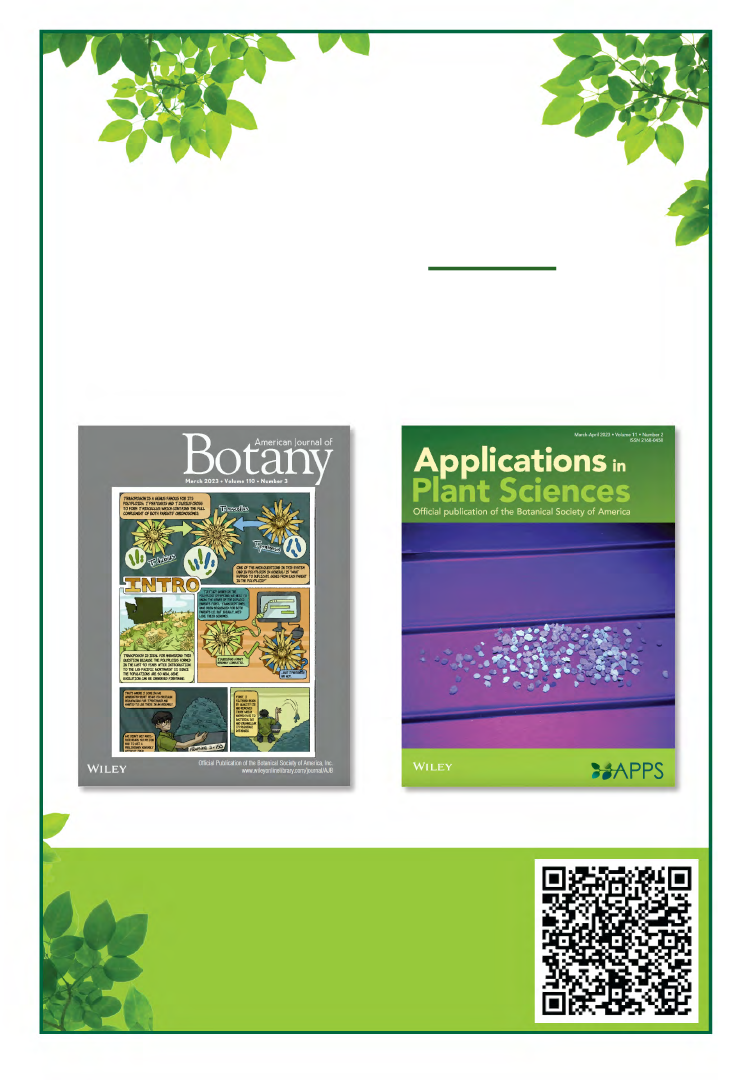
You may be able to publish
Open Access
for free
in the American Journal of Botany
or Applications in Plant Sciences!
Find out more at
https://bit.ly/2FYYzPT!
PSB 69 (1) 2023
28
FROM THE
PSB
ARCHIVES
60 years ago
Ira L. Wiggins describes a history of botanical exploration of Baja California, Mexico from 1696 to 1959.
“There are areas very difficult of access, where even pack animals cannot be used and one must proceed
under his own leg power. Water is always a problem toward the end of the dry season—and in some areas
virtually the year around. Local food supplies are scanty or nil. Heat prostration is a common threat. Yet
the country holds an appeal that is hard to resist, and botanical rewards are great. It will be a long time
before the botanical investigations in Baja California are completed.”
Wiggins, Ira L. 1963. Botanical Investigations in Baja California, Mexico. PSB 9(1): 1-6.
50 years ago
“Following the influence of Coulter and Chamberlain at the turn of the century, the teaching of plant
morphology in the United States has become almost synonymous with the study of plant life histories in
a semi-taxonomic survey of the plant kingdom. As a result, the reproductive aspects of plant structure
tend to receive the lion’s share of attention whereas features of general organization and organography are
usually relegated to a brief but often inaccurate description of the plant’s ‘habit.’ While this outlook may
be justified in treatments of algae and fungi where vegetative morphology is simpler and reproductive
structures more complex, it seems less defensible in the study of higher plants where the reverse is true.
Furthermore, when taught only within the taxonomic framework presently in vogue, morphology emerges
simply as a handmaiden of systematics rather than a basic science in its own right.”
Kaplan, Donald R. 1973. The Teaching of Higher Plant Morphology in the United States. PSB 19(1): 6-9.
40 years ago
“Information has been received that a project is underway to restore the gravesite of Stephen Hales, the
person who did so much to put botany on a scientific basis and who is considered to be the founder of
plant physiology. Professor E. T. Pengelley (Univ. of Calif., Riverside) visited the Parish Church of St. Mary
in Teddington, Middlesex, England, where Stephen Hales was vicar for 51 years and is buried under the
tower of the church (inside the church). The flat tombstone is badly worn after two centuries, and the
inscription is completely illegible (although the original inscription is known).
“The American Society of Plant Physiologists has undertaken the restoration project, but the assistance of
other societies and individuals will be needed to complete the project. If the Botanical Society of America
could raise $500.00, recognition of the contribution would be indicated on a plaque at the gravesite.”
Gifford E.M. Restoration Of Stephen Hales’ (1677-1761) Gravesite. 1982. PSB 28(6): 42.
Note:
The 1983 volumes 1-4 are missing from the digital archives.
29
SCIENCE EDUCATION
By Dr. Catrina Adams,
Education Director
Jennifer Hartley,
Education Programs
Supervisor
Welcome New PlantingScience
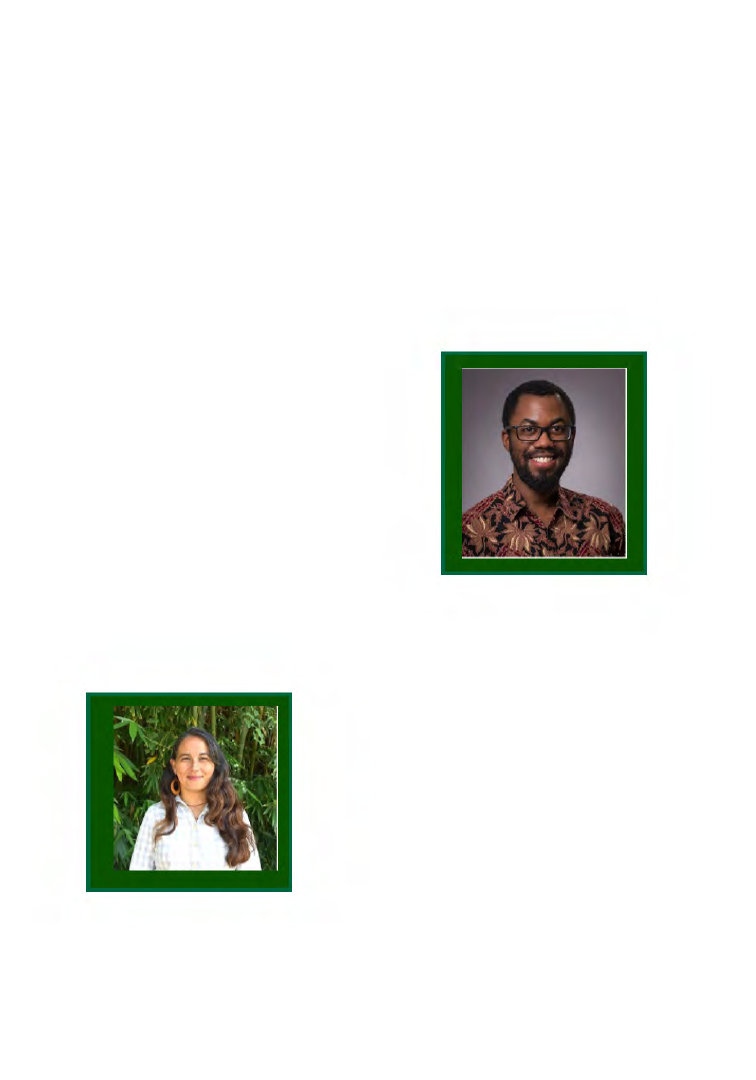
Coordinators
The PlantingScience staff has been fortunate
to work with some amazing scientists since
it began in 2005. In addition to volunteering
their time and attention to mentoring our
participant student teams, some also step up
to serve as liaisons for teachers, monitoring
conversations and ensuring that students have
messages waiting each time they log in.
And then there are our coordinators!
Coordinators are our interns, and during busy
sessions we rely on them to help us answer
questions, address concerns, and keep the
session moving forward. We’re so pleased to
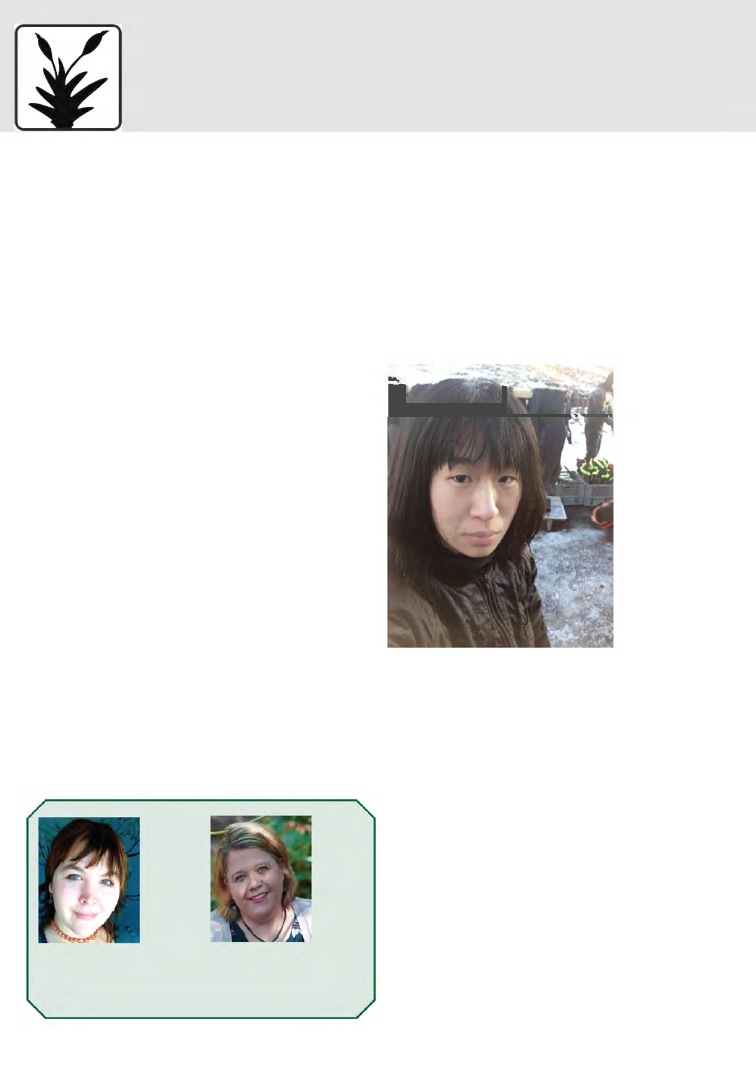
announce that our 2023
coordinators are and
Jin (Ching-Yi) Liao and Shan Wong!
Jin Liao joined PlantingScience in 2019
and served as a liaison in 2020, just as the
COVID-19 pandemic was really taking
hold. She came to us through the American
Society of Plant Biologists, and her favorite
themes to mentor are Agronomy Feeds the
World, Plants Get Sick, Too!, and the Wonder
of Seeds. These themes all closely related to
her research, which focuses on autophagy
(the process by which eukaryotic cells break
down and recycle old or damaged cellular
structures) and hormone signaling in plants
when they are under stress.
Jin is also passionate about travel and science
communication. She keeps a blog called Jin’s
LifeRXiv (https://jinsliferxiv.com/) where she
posts some of her creative efforts to convey
complex plant processes and concepts in
the form of diagrams, artwork, and even a
webcomic featuring an Arabidopsis plant
named ‘Araby’. Her blog also describes
handicrafts, such as using popsicle sticks
to
create wall shelving in the molecular
shapes of plant hormones! Jin has recently
taken a postdoc position at the University of
California - Davis, and we’re so pleased she
decided to spend some of her time working
with us to keep the spring and fall sessions
running smoothly!
PSB 69 (1) 2023
30
Shan Wong joined PlantingScience in 2021
and served as a liaison and mentor in fall
of 2021 and spring of 2022. Shan became
involved with orchid conservation while
interning at Kadoorie Farm and Botanic
Garden in Hong Kong. As an undergraduate,
she studied the relationships between native
and invasive orchids and their mycorrhizal
fungi, and she has gone on to study vanilla
orchids at Texas Tech University, where she
is preparing to complete her PhD. Shan also
studies arthropods, specifically spiders!
Shan’s favorite Investigation Theme is The
Wonder of Seeds, and one of her favorite
PlantingScience memories is of a class that
invited her to meet via a video call during
their session. She says, “During the meeting,
students were excited to show me their seeds
treated with different light conditions in the
experiment and curious about how I pursued
my career in plant science. I was thrilled to
help students learn more about plant science
and happy to inspire them to consider their
career in plant science.”
PLANTINGSCIENCE
UPDATE
We’ve reached the middle of the Spring 2023
session of PlantingScience! Right now, more
than 300 middle school students are spending
more time talking about food crops than
they likely ever have before. In particular, in
Dewitt Middle School in Michigan, the entire
7th grade is working on Wonder of Seeds, and
two of their 8th grade classes are studying
Agronomy Feeds the World. Many thanks
to the mentors and liaisons who are pitching
in this session; some of us were able to take
part in some Zoom sessions with the students,
and they are very excited about their projects!
Besides DeWitt, we have participating groups
from 12 other schools this season who are
studying Brassica genetics, C-fern life cycles,
celery plant tissues, and phytopathology.
We are also working with our website provider,
HubZero, to make some improvements to our
platform. With the help of our current groups
and our coordinators, we’re begun piloting
new approaches to mentor recruitment and
building up some of our support options.
More exciting changes to come!
Finally, we’re also looking ahead to our
efficacy research to begin this summer.
Over 100 teachers have applied to take
part, and we are currently recruiting early
career scientists to participate as F2 Fellows.
Information about this opportunity can be
found on the PlantingScience website (www.
plantingscience.org).
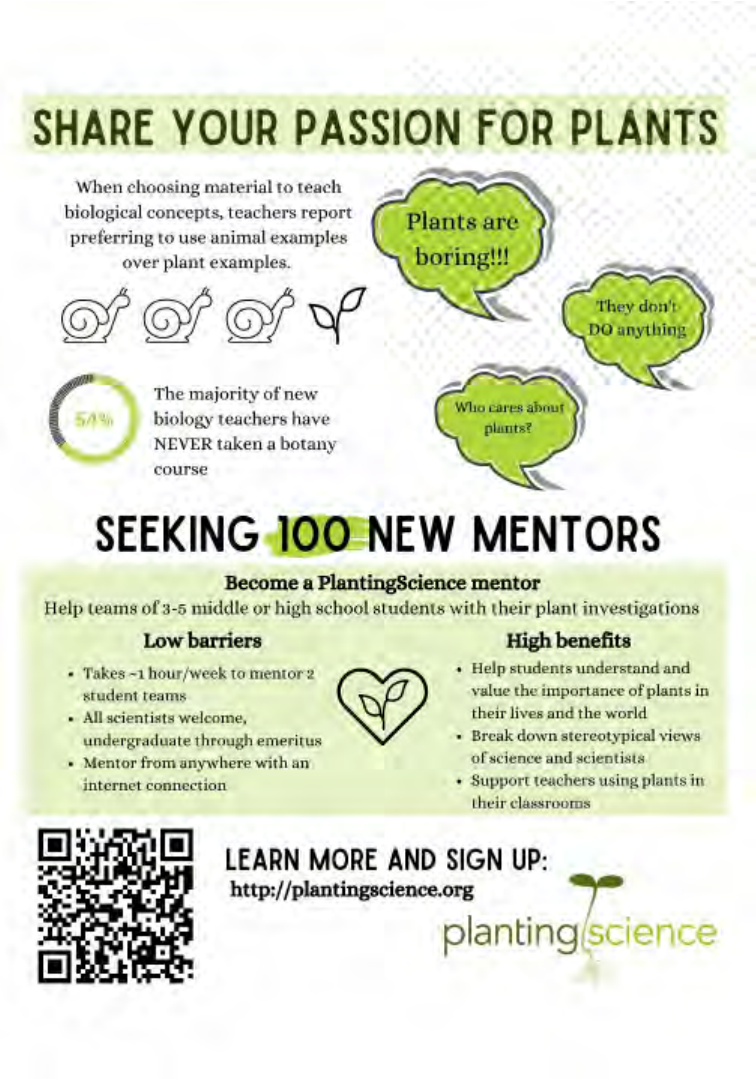
Please plan to mentor a
team or two with
PlantingScience in the Fall!
PSB 69 (1) 2023
31
PSB 69 (1) 2023
32
LIFE DISCOVERY
CONFERENCE
The eighth Life Discovery – Doing Science
Biology Education Conference was held
March 23-25, 2023 at Florida A&M University
in Tallahassee, Florida. This small (~100
attendees) stand-alone education conference
is co-sponsored by BSA along with the
Ecological Society of America and the Society
for the Study of Evolution, and includes
networking sessions, a share-fair/peer working
group format for discussing lesson plans or
activities at any stage of development, as well
as more traditional hands-on workshop and
short presentations.
The theme of this year’s conference was
“Variants in Biology Education: What can we
learn from pandemics?” with three subthemes:
“How have pandemics influenced education
and has teaching and learning evolved and/
or adapted to meet this challenge?”, “How do
we prepare our students for a fast-evolving
scientific phenomenon and perhaps and
even faster ‘viral’ spread of divergent sources
of information that resist the scientific base
for evolution and science in general?”, and
“Where are the jobs and careers in our field
headed over the next 5-10 years, considering
reliance on government sources of funding?
How are educators preparing our students in
an evolving job market?”
On Friday of the conference, Dr. Victor
Ibeaenusi, Founder and Director of
the EnergyWaterFoodNexus (EWFN)
International Summits and Dean School of
the Environment at Florida A&M University,
delivered a keynote talk about the impact
of global climate change on access to safe
water, procurement of sustainable energy
and food security, and how the EWFN open
science approach aims at disruptive and
accelerated transformations to sustainable
development. On Saturday, Dr. Heather
Lanthorn, Co-Director of the Mercury Project
at the Social Science Research Council,
gave a keynote talk on “Science Information
amid Misinformation.” A keynote panel
featured Dr. Brenda Spencer, Director of the
Undergraduate Student Success Center at
Florida A&M University, and Dr. Tamara
Basham, Professor of Environmental Science at
the Collin County Community College Plano
Campus. BSA’s Education staff, Catrina Adams
and Jennifer Hartley, attended and presented
about PlantingScience and our ongoing
education research into the program’s efficacy,
while highlighting one of PlantingScience’s
newest investigation themes: “Tree-mendous
Benefits of Trees” module (co-developed with
the American Society of Phytopathology).
The Life Discovery conferences are held
approximately every 18 months, and the
next conference will be in Fall 2024. Please
consider attending this conference in the
future. There are typically awards for travel
and dependent-care support available to
encourage community college, tribal college
and university, and other minority-serving
institution faculty to attend, as well as educators
who are from communities underrepresented
in the ecological sciences. It’s an excellent
place to network with other biology educators,
get feedback on teaching materials under
development, and present your teaching and
outreach efforts! You can read more about the
Life Discovery Conferences at: https://www.
esa.org/ldc/travel-awards/.
33
STUDENT SECTION
We were excited to lead a Botany360 webinar earlier this year on “How to be a Successful
BSA Student Representative.” If you missed it and would like to access the slides from the
presentation, go to https://bit.ly/40IrhdB, and be sure to email us at ianghel@ucla.edu and
elishartung@gmail.com if you have any questions. (For more information on the Botany360
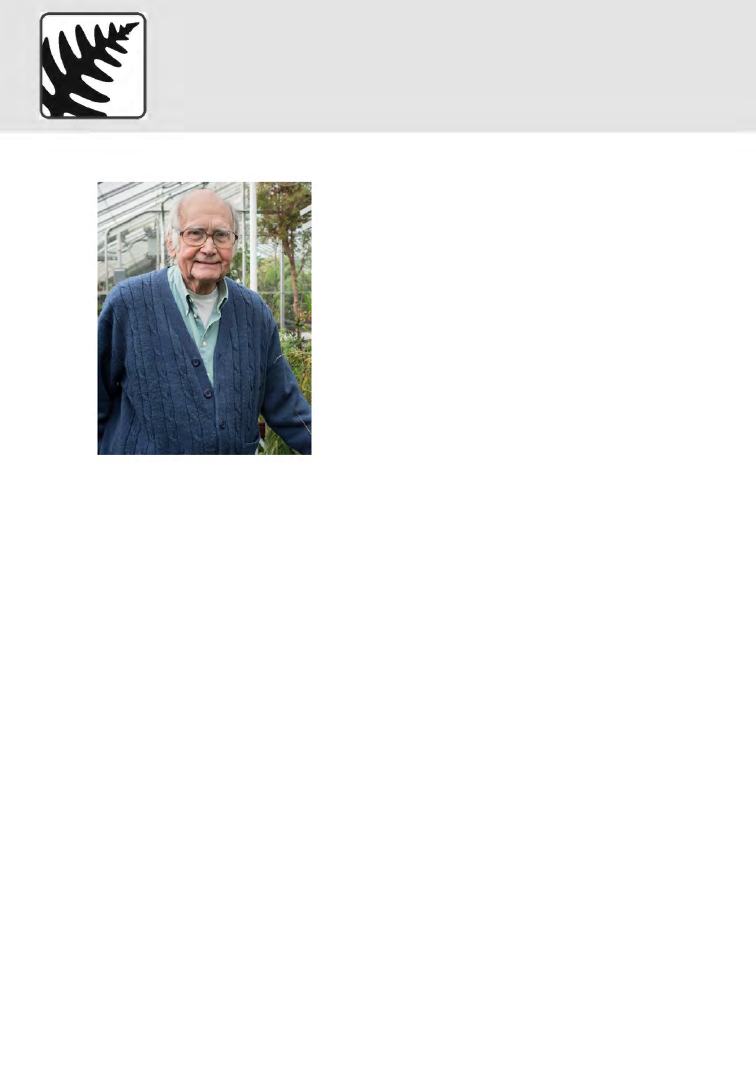
series, see the Membership article in this issue.)
BOTANY360 WEBINAR:
HOW TO BE A SUCCESSFUL BSA
STUDENT REPRESENTATIVE
BSA SPOTLIGHT SERIES
The BSA Spotlight Series highlights early-
career scientists in the BSA community and
shares both scientific goals and achievements,
as well as personal interests of the botanical
scientists, so you can get to know your BSA
community better.
Here are the Spotlights since the last PSB was
published—along with some advice from each
member for those starting their botanical
journey!
By Ioana Anghel and Eli Hartung
BSA Student Representatives
PSB 69 (1) 2023
34
Oluwatoyosi Adaramodu
Graduate Student, Biology
(School of Art and Sciences)
University of Pennsylvania
Stay curious: The field of botany is vast and
constantly evolving, so be sure to keep an
open mind and a thirst for knowledge. There
is always more to learn, so don’t be afraid to
ask questions and seek out new resources.
Josh Felton
Post-Baccalaureate
Colorado College
Organismal Biology and Ecology
While my journey has similarly just begun,
looking back at the past couple of years, I
would say I would not feel as connected to the
botanical community if I was not following
so many cool botanists on Twitter. It has been
a great space to see what botanists are up to
in their personal and work lives. Botanical
Twitter has also allowed me to get a sneak peek
into what graduate students and postdocs
are up to that I would not otherwise get to
see coming from a liberal arts institution. I
also recommend not being afraid to reach
out to anybody whose research is interesting
to you. It is often the case that whoever you
are reaching out to will be joyous to geek out
about plants.
Oluwatobi Oso
Graduate Student,
Ecology and Evolutionary Biology
Yale University
Botany is not all lab!!! Actively look for
opportunities to grow, join a community of
people passionate about similar interests, ask
questions, and be open to learning. And like
every journey, it helps to ‘plant-science’ one
day at a time.
PSB 69 (1) 2023
35
Johan David Reyes
Graduate Student
Bioscience,
Edge Hill University
World Museum Liverpool
Never be afraid of contacting someone you
admire! It harbours amazing collaboration
opportunities. As Gerald Holton once said ‘…
we are now uniquely privileged to sit side-by-
side with the giants on whose shoulders we
stand’. Collaboration and putting yourself out
there are important to achieve whatever you
envision. In addition, surround yourself with
kind people that will help you in your journey,
but do not be afraid to move somewhere new
if you feel it will lead to great personal and
professional growth. At the end, each journey
is different.
Min Ya
Postdoctoral Fellow,
Department of Ecology and Evolutionary
Biology,
University of Connecticut
If it’s possible, take your time to find out
what you’re passionate about, and don’t
be afraid of exploring unknown fields.
Surround yourself with good people. Good
mentors, good peer supporting groups,
and good communities are about the most
important things in your scientific journey.
Learn about yourself, recognize signs of
burn out and practice self-care. Try your
best to always make time for your hobbies.
Would you like to nominate yourself
or an early career scientist to be in
the Spotlight Series? Fill out this form:
https://forms.gle/vivajCaCaqQrDL648.
36
ANNOUNCEMENTS
IN MEMORIAM
CARL JOHN BURK
(1935–2022)
Carl John Burk, a beloved botany professor
at Smith College, passed away July 2022 in
Northampton, Massachusetts. Generations
of Smith students benefited from his warm,
enthusiastic, and genuinely caring personality
as he introduced them to the fascinating
world of plants and their environments. John
is remembered by all who knew him as being
upbeat, optimistic, and always positive.
John was born in 1935 in Troy, Ohio; “the
other Troy” he was fond of saying, referring
to the ancient city. He received his B.A.
(1957) from Miami University in Ohio
and his M.A. (1959) and Ph.D. (1961) at
the University of North Carolina-Chapel
Hill. His doctoral research was a floristic
study of the Outer Banks of North Carolina.
In 1961 John joined the faculty of what was
then the Botany Department, and became the
Department of Biological Sciences, at Smith
College, starting what would become a long
and rich teaching and research career. John
served the department for over four decades,
retiring in 2009 as Elsie Damon Simonds
Professor in the Life Sciences, Emeritus.
“Retired from teaching,” he would emphasize.
He pursued professional and research
activities well into his post-retirement years.
For decades John taught plant systematics
and plant ecology in addition to courses
in biogeography and conservation. He
maintained the college herbarium and
was deeply involved in shaping the plant
collections in the Lyman Plant House and
Botanical Gardens at Smith. Former students
recall John as a favorite professor, a teacher
who nourished a love for learning, and for
walking really fast on field trips.
John’s research areas included the botany,
biogeography, and ecology of coastal areas
and freshwater wetlands, as well as historical
studies including botanical gardens and
botanical illustration. Local sites including
the Mill River and Arcadia Wildlife Sanctuary
in Easthampton (MA) became his laboratory,
where he and many of his undergraduate and
graduate research students carried out floristic
projects and long-term ecological studies.
Notably, John never questioned the ability
or appropriateness of his primarily female
students doing rigorous field work. John
was elected as an AAAS Fellow in 1995. In
more recent years John worked with German
colleagues on comparative studies of plants
in New England and in Northern Germany.
His most recent paper, published in 2020 in
the Proceedings of the National Academy of
PSB 69 (1) 2023
37
Sciences, “Forest and woodland replacement
patterns following drought-related mortality,”
is co-authored by 37 scientists from different
parts of the world. After retirement, John
continued as associate editor of the Journal
of the Torrey Botanical Society. He enjoyed
his editorial duties that helped him stay
connected with colleagues and with current
research in his field.
Appreciating his own undergraduate liberal
arts background, John believed strongly in
integrating diverse disciplines within the
sciences and with the humanities. He enjoyed
interacting and co-teaching with his colleagues
in and outside his department, appreciated
their expertise in their fields, and valued their
friendships. He was an avid bird watcher and
led the annual bird walk on campus for many
years. Generous with his time, he was always
happy to share his rich botanical knowledge
with others.
Contributing to the community was
important to John. He served on the Sanctuary
Committee of Arcadia Wildlife Sanctuary
in Easthampton (MA) for many years and
oversaw the permanent conservation of family
property in Hatfield (MA), now a popular
hiking destination for the community. In talks
to general audiences, he was capable of making
science accessible to non-scientists. In 1987–
88, he gave the College’s annual Katharine
Asher Engel Lecture, pleased to be talking
about his research on the changing landscapes
of New England to a wider audience. He
was frequently called upon to identify some
mystery plant; this he did with great pleasure
and enjoyed advising colleagues and friends
on botanical questions. John also loved nature
at his home, and the appearance of a rabbit
around the flower beds did not upset him. His
philosophy was “live and let live.” Indoors,
he was proud of his heirloom African violet
collection.
John met his wife Lâle in 1962 when she
arrived from Istanbul to start graduate studies
in chemistry. They got married in 1966 and
had two sons, John Seljuk and Nicholas
Murat. Lâle eventually became a faculty
member in Chemistry at Smith College, and
the two of them were mutually supportive of
their careers.
John was an informed traveler with a rich
knowledge of history. He was grateful for trips
to the Amazon and to East Africa before these
vulnerable places became more endangered.
Later trips included travels to Turkey. An
untiring hiker, he walked daily around the
periphery of Büyükada, the largest of the
Princes’ Islands off of Istanbul where Lâle’s
parents summered. His bird watching there
contributed to local bird count data and
papers on bird migration patterns. Another
favorite site in Turkey was near ancient Troy,
the ruins on the hill in Assos that overlook
the nearby island of Lesbos and home of
Theophrastus, “the father of botany.” Other
memorable travels were trips to botanical
gardens in Hawaii, to English gardens, to
tulip fields in the Netherlands, and to many
historic gardens in Europe. During his last
trip in the fall of 2019, he visited one of the
oldest botanic gardens in the world, Hortus
Botanicus in Amsterdam.
John had a deep interest in art and in music. He
was a constant visitor to the College’s libraries
and the local public library, and he visited the
College’s art museum frequently. He enjoyed
opera trips to New York and to the Hamburg
Opera and Ballet. Special also were excursions
in the summer to the Clark Art Institute in
Williamstown (MA) where he and Lâle went
PSB 69 (1) 2023
38
on their first date, and to Tanglewood, where
he was delighted by the occasional bird song
contributing to the music in the “Shed.” He
was funny with a keen sense of humor. He
appreciated life’s ironies and could see the
big picture, separating what was important
from what was not. He will be missed.
[Portions of this article were modified from the
family obituary of Carl John Burk, used with
permission.]
CHRIS DAVIDSON
BOTANIST OF IDAHO,
AND THE WHOLE WORLD
(1944–2022)
Christopher Robert Davidson was the proud
scion of generations of Idahoans, who applied
his passion for plants to the world’s flora.
Although Chris considered Idaho the center
of the world, he viewed the world as his study
site and garden, and the entire vascular flora
as his study organisms. He found wonder in
all parts of the natural world, in each of its
plants, and in all cultivated gardens, and he
delighted in biological diversity at any scale
and in every bit of time spent in the field.
Chris did leave Idaho (although not the West)
for undergrad studies at Whitman College in
the adjacent state of Washington, where he
aimed to study geology but quickly pivoted to
botany. He followed this academic stint with
Ph.D. studies at Claremont College in southern
California, working with Robert Thorne and
Sherwin Carlquist and exploring widely the
botany southern California. Here he focused
his academic work on the Datiscaceae (Liston
et al., 1973), and began his life-long interest in
disjunct plant distributions. Chris finished in
1972 and took his shiny new botany doctorate
to a curatorial appointment at the Los
Angeles Natural History Museum. He spent
1975–1979 there and conducted an active
program of tropical botanical exploration.
He made a number of field expeditions from
there, collecting ~10,700 specimen numbers
in Guatemala, Costa Rica, Panama, Bolivia,
Brazil, and Peru—at a time when tropical
logistics were much less convenient than
today, and knowledge of the tropical flora
much more limited than now.
PSB 69 (1) 2023
39
In 1980 Chris returned to Boise for his
beloved daughter Sara’s arrival into his life,
to raise the next Davidson generation in the
family homeland. Here he also began a new
phase of his botanical work focused on living
collections in Boise and in McCall, in west-
central Idaho. Here during 1980–1985 he also
edited part or all of Madroño volumes 28–31.
In 1984 he started the Idaho Botanical Garden
in Boise, assembling a board of local civic
leaders, arranging the lease of a plot of land, and
overseeing the Garden’s development during
its early years. Here he met Sharon Christoph
(Figure 1), who became his wife and his long-
term close botanical collaborator. During
that time, Chris also took over managing and
significantly developing the family-owned
Charlie’s Garden in McCall (Figure 1), a
green wonderland that was the pet project
of his step-father, Charlie Davidson. Chris
expanded and developed Charlie’s Garden,
keeping it open to informal public access,
and he also developed an extensive private
garden for himself on his family’s estate in
Boise. Charlie’s Garden is still open to the
public and much appreciated locally, and
both of these Idaho gardens contain a diverse
collection of botanically notable Asian and
North American species.
In 2002 Chris began yet another phase of his
botanical work when he and Sharon started
traveling around the world to find various
plant families with limited distributions. This
became the formal Flora of the World.org
project in 2008, with the development of a
website registered as https://floraoftheworld.
org/
and the plan formulated for organized
botanical exploration and support for
capacity development in tropical botany.
Flora of the World.org aims to document all
the flowering plant families and genera, with
vouchered photos of living plants in their
habitats. To date, this project has more than
230,000 images corresponding to around
13,000 voucher collections. The plants were
photographed in the field by Chris, Sharon,
and a few colleagues across the world, in
collaboration with local botanists worldwide.
This project aims to fill a gap in knowledge
of the world’s plants by systematically
documenting with digital images the living
morphology of all flowering plant diversity.
The project was fully mapped out and well
underway toward coverage of all the world’s
plant families, with the champagne chilled for
the completion celebration, when the deeply
revised new APG II classification of the
flowering plants was published (Angiosperm
Phylogeny Group II, 2003) and the finish line
was suddenly pushed way, way into the future
by the multiplication of plant families: from
~200 to 430. But Chris and Sharon accepted
the expanded challenge, flew around the
world to 45 countries, drove and walked many
a mile, had too many adventures to count, and
were only eight families short of completion
when he died.
Figure 1. Chris Davidson and Sharon Christoph
in Charlie’s Garden in McCall, Idaho, in 2012.
(Photo courtesy of Barbara Ertter.)
PSB 69 (1) 2023
40
Chris’s support for botanical activities also
took the form of his personal counsel and
support, as well as financial contributions.
He funded travel for his colleagues, both
when accompanying him and for their own
work, as well as infrastructure improvements
in many of the places he visited. He also
provided critical longer-term support for field
exploration programs in some target areas,
including the Republic of Georgia, Chiapas
in southern Mexico, and the Andes of central
Peru, and he helped botanical garden efforts
in various countries with advice and support.
His attention to all this did not replace
attention for his beloved Idaho, though, and
he also made his home base at the Snake River
Plains Herbarium at Boise State University
and explored and collected all across the state.
His focus on world plant diversity also did not
eclipse his attention to study of his own group
of interest, the tropical family Piperaceae,
and he collaborated in these studies with
various colleagues in several countries. And
apart from all these groups, 10 new tropical
vascular plant species were named to honor
him, based on his specimen collections and/
or collaborations (Figure 2).
Chris was a well-loved husband, father, and
grandfather, and he was also a very valued
colleague and friend to many people around
the world. His influences on our botanical
field have been quiet and collaborative but
no less significant for that. He was North
American in having his own animal totem,
the hedgehog, and he regarded himself as a
correspondingly spiny personality but was
nothing like that. He was notable personally
for his gentle manner, sly wit, broad botanical
knowledge, generosity in all things, and love
of both plants and champagne; for being a
thoroughly good man; and for his endless,
pure sense of wonder.
REFERENCES
Angiosperm Phylogeny Group. 2003. An update of the
Angiosperm Phylogeny Group classification for the or-
ders and families of flowering plants: APG II. Botani-
cal Journal of the Linnean Society 141: 399–436.
Liston, A., L. H. Rieseberg, and T. S. Elias. 1990. Mor-
phological stasis abd[sic] molecular divergence in the
intercontinental disjunct denus Datisca (Datiscaceae).
Aliso 8: 49–110.
-Charlotte M. Taylor
1
, Roy E. Gereau
1
, W.
Douglas Stevens
1
, Barbara Ertter
2
,
Sven Buerki
3
, Olga Martha Montiel
4
, and
Sharon Christoph
2
1
Missouri Botanical Garden, St. Louis, Missouri USA
2
Boise, Idaho USA
3
Boise State University, Boise, Idaho USA
4
Wildwood, Missouri USA
Figure 2. Left to right, Chris Davidson, Mar-
tin Callmander, and Sven Buerki in New
Caledonia in 2011, standing in front of the
tree from which the type collection was made
of Podonephelium davidsonii Munzinger,
Lowry, Callm. & Buerki (Sapindaceae). (Pho-
to courtesy of Porter P. Lowry, II.)
PSB 69 (1) 2023
41
David W. Lee, a BSA Distinguished Botanist
and member of the BSA for more than 40
years, died in Crestone, CO on December
13, 2022. David was a botanist of amazing
breadth, excelling in his research and outreach
to both professional and lay communities. He
grew up in eastern Washington state, studying
science and getting his undergraduate degree
at Pacific Lutheran University in Tacoma, WA.
He took a year off during his undergraduate
studies to travel in the south Pacific, which
initiated a life-long love for traveling and
botany. David earned his MSc and PhD in
Botany (1970) at Rutgers University, using
electrophoretic techniques to understand
cattail (Typha) phylogeny under Dr. David
David and his wife Carol at their home in
Crestone, CO, October, 2014. [Photo credit:
John Palenchar.]
DAVID W. LEE
(1942–2022)
Fairbrothers. After two years in a post-doc
at Ohio State University (where he met and
married Carol Rotsinger, his life-long wife),
he became a lecturer at the University of
Malaya for four years (1973–1977), where he
grounded himself in tropical botany. He then
worked on tree architecture with Dr. Francis
Halle in Montpelier, France (1977–78). In
1980 he was hired as the only botanist in the
Department of Biological Sciences at Florida
International University (FIU), the young and
growing public university in Miami, FL.
David spent most of the rest of his professional
career at FIU, where he worked to expand
botanical research and education, with a
special focus on tropical plants. During his
career, he published 71 referred articles and
15 book chapters. He did pioneering work
on the basis for plant adaption to low-light
environments of tropical forests, including
discovering the structural basis for blue color
in leaves and fruits lacking blue pigments,
methods to experimentally simulate the
spectral changes of canopy shade, as well as
the basis for red color in flushing leaves and
during autumn senescence. Early in his time
at FIU, he convinced the University that
botany is especially important at FIU and
in Miami, given its location in a subtropical
environment with ready access to the New
World tropics. David created a certificate
program in tropical commercial botany to
serve the nursery and agricultural community
and educated journalists like Georgia
Tasker about tropical botany. He developed
professional relationships with researchers
at Fairchild Tropical Botanic Garden
(FTBG), which he worked to formalize in
a cooperative agreement between the two
institutions with the goal of advancing both
research and education in tropical botany.
Later (2007–2008), he became Director of
PSB 69 (1) 2023
42
the Kampong, part of the National Tropical
Botanical Garden, where he helped to lay the
groundwork for the International Center for
Tropical Botany, a research and education
collaboration between FIU and the National
Tropical Botanical Garden.
David generously served the FIU Biological
Sciences Department and the University. He
was on the departmental Graduate Committee,
the Faculty Senate, the Faculty Senate
Environment Committee, Faculty Senate
Strategic Planning Committee and College
Tenure and Promotion Committee, to name
a few. He also served as the inaugural chair
of the Department of Environmental Studies
and as Chair of the Department of Biological
Sciences. He even chaired the search for the
FIU men’s basketball coach in 1995. David
played basketball as an undergraduate at
Pacific Lutheran and continued to play pickup
games on campus with team members of FIU
men’s and women’s basketball throughout his
time at FIU.
He also worked to expand the botanical faculty
at FIU and to develop undergraduate and
graduate curricula in plant sciences. Initially
he taught Plant Physiology but expanded to
Tropical Botany and later developed a non-
majors course that became very popular:
Introductory Botany. Students in this course
would not only grow plants under lights in the
lab, but each group had a garden bed where
they grew vegetables and herbs, a formative
experience for many who would recall that
activity as their favorite. He also taught
“Functional Ecology of Tropical Plants”
to students in the Landscape Architecture
program and developed a course called “The
Meaning of the Garden” for the FIU Liberal
Studies program, in which students would
do weekly physical gardening and then learn
about all the kinds of gardens in Miami and the
world. David was deeply involved in graduate
training, mentoring five Ph.D. and seven MSc
students to completion as major professor. In
part for his educational innovations, David
received the BSA’s Bessey Award for teaching
in 2006.
David’s educational efforts extended beyond
the university; he wrote books ranging from
local plant identification books (Wayside
Trees of Miami, 2011; Trees of Gurudev
Siddha Peeth, India, 1985), books about
environmental problems (The Sinking Ark:
David leading a walk looking at Miami street
trees, both native and exotic, for a group of Mi-
ami artists, March 2016. [Photo credit: Naomi
R. Fisher.]
PSB 69 (1) 2023
43
Environmental Problems in Southeast Asia,
1980), historical books (editing The World
as Garden: The Life and Writings of David
Fairchild, 2013), and books making botanical
knowledge and research accessible to the
public (Nature’s Palette: The Science of Plant
Color, 2007; Nature’s Fabric: Leaves in Science
and Culture, 2017). Nature’s Palette won the
Best of Biology and Life Sciences Award from
the Association of American Publishers,
whereas Nature’s Fabric won the Choice
Magazine: CHOICE Outstanding Academic
Title Award. Most recently, David worked
with Dr. Peter Ashton to take the information
on their research and experience in southeast
Asian tropical forests and make it accessible
to both researchers and the educated public
in Trees and Forests of Tropical Asia: Exploring
Tapovan (2022). In 2019, the BSA recognized
David’s contributions to the plant sciences
by awarding him the Distinguished Fellow
Award, which is the highest honor the Society
can bestow.
In his retirement, David continued his
scientific writing but also set up an art studio
at his new home, located at 7900 ft. in Creston,
CO. There, he enthusiastically expanded his
artistic side by making paper from native plant
fibers and dried flowers. His creations sold in
a local gallery in Crestone. He greatly enjoyed
returning to the temperate environment and
plants of his youth, writing articles about the
Colorado flora for the local newspaper.
As a person, David was generous, caring,
and fundamentally aware of, sensitive to, and
a proponent for the spirituality of nature.
He could not think poorly of anyone and
was always looking for and promoting the
positive aspects of people he knew, be they
students, faculty, local/national/international
colleagues and collaborators, administrators,
or laypeople.
Before he died, and as part of the botanical
outreach that characterized his life, he left a
website that explains how and why he became
a botanist, what that entailed and what that
enabled, accompanied by illustrations of the
plants, people, and places that he cared about.
His passion for the wonders of it all comes
through: https://www.davidleebotanist.com/.
-Jennifer Richards (FIU), Suzanne Koptur
(FIU), Steve Oberbauer (FIU), and Jack Fisher
(FTBG)
PSB 69 (1) 2023
44
DAVID MICHAEL SPOONER
(1949–2022)
Spooner. “Spooner-Dooner,” as we sometimes
called him. He was a hard-working student,
colleague, friend, and a character. There
were many parts of Dave’s personality that
one remembers, and all fondly so. He was a
kind person, unassuming, ready to laugh,
and nearly always smiling. He liked people,
manifested by his collaborations with more
than 200 colleagues during his career. He was
tall and lanky, good-spirited, and always game
for more field work in the mountains from
Mexico to Argentina and in many other parts
of the world.
David Michael Spooner was born on 1
November 1949 in Downey, California, the son
of David Spooner and Ann (Jordan) Spooner.
He began his academic education at Miami
University (Ohio) in 1967, earning a B.A. in
1971. Subsequently he served in the Army, but
he took advantage of his geographic posting
to enroll in botany courses at the University
of Maryland. In 1974 he entered the graduate
program at Ohio University (Athens), working
under the supervision of Prof. Robert Lloyd
on a reproductive biological study in Dentaria
laciniata and D. diphylla (Spooner, 1984),
earning an M.S. in 1976. He took a break
from academic studies and began working for
the Ohio Department of Natural Resources,
investigating rare and endangered species of
the state, as well as the influence of the ancient
Teays River system on plant distributions in
southeastern Ohio. In the Fall of 1982, he
entered the Ph.D. program in the Department
of Botany at Ohio State University, working
in the laboratory of Tod Stuessy, and focusing
on evolutionary monography of the genus
Simsia (Compositae). As this was a Latin
American plant group, Dave plunged into
learning Spanish to aid his fieldwork (totaling
five months). This was the beginning of a
long career of plant investigations in Latin
America.
After graduation from Ohio State in
1987, Dave took a job at the University of
Wisconsin, Madison, in a split position as
Assistant Professor in the Department of
Horticulture and as Botanist in the Vegetable
Crops Research Unit of the USDA on campus.
His research interests focused on crop plants,
initially on the potato and its wild relatives,
and later turning to carrots. This dual-posting
arrangement might have seemed intimidating
to some academics, but it suited Dave because
it provided scheduling flexibility for the field
studies that he loved and did so well. The
Latin American countries Dave visited over
his career included Nicaragua (1986), Mexico
(1988, 1997), Chile (1989, 1990), Argentina
(1990), Ecuador (1991), Colombia (1992),
Venezuela (1992), Bolivia (1993, 1994),
Guatemala (1995), Costa Rica (1996), Peru
PSB 69 (1) 2023
45
(1998, 1999), Honduras (2000), and Panama
(2000). He also collected in the western U.S.
(2010), Nepal (1995), Morocco (2012, 2013),
and Spain (2016). In total, he spent 30 months
in the field.
Collecting potato germplasm in Peru in 1999
with Alberto Salas (specialist with the Interna-
tional Potato Center, Lima). Photo by Alejandro
Balaguer (USDA Image Number K9020-20).
As Dave’s research developed, he worked
in parallel on systematic monography and
molecular phylogenetics and evolution. This
is not the place for an in-depth analysis of his
research productivity and impact, but by any
reckoning it was impressive, encompassing
more than 220 articles dealing with
systematics, biogeography, genetics, genomics,
phylogenetic reconstruction, phylogeography,
and crop improvement, among others,
and in well-known journals such as PNAS,
Nature Genetics, American Journal of Botany,
Systematic Botany, Evolution, Theoretical and
Applied Genetics, and Taxon. His doctoral
thesis on Simsia appeared in Systematic
Botany Monographs (1990), but over the years
there were four additional monographs in this
prestigious monographic series on Solanum
(Spooner et al., 2004, 2016, 2019; Peralta
et al., 2008), plus a comprehensive review
(Spooner et al., 2014), totaling 1040 pages! He
published 19 papers in the American Journal
of Botany on potatoes, tomatoes, carrots,
and evolutionary topics (e.g., Hijmans and
Spooner, 2001; Peralta and Spooner, 2001;
Spooner et al., 1993, 2001), with the article
in 1993 of particular significance where he
and colleagues demonstrated that potatoes
and tomatoes belong more appropriately
to the same genus. He authored a paper in
PNAS showing a single domestication for the
potato based on AFLP genotyping (Spooner
et al., 2005). His recent research focused on
the origin of the cultivated carrot (Daucus
carota; e.g., Spooner et al., 2017), including
participating in assembly of the entire genome
(Iorizzo et al., 2016).
Dave was the perfect match for the crop
science initiatives within the USDA. He had
a strong grounding in botanical monography
and experience in fieldwork, which allowed
him to address issues relating to species
concepts, ecology, and speciation, and he
gained proficiency in molecular methods to
infer more precise estimates of relationships.
With all of this information, he was able to
contribute toward improvements of potatoes
and carrots. He was a dedicated collaborator,
enthusiastic about interactions with people
from diverse cultures, especially from the
United States, Latin America, and Europe.
He was successful in obtaining substantial
grant support for his field and laboratory
studies. The field work was often supported
from the USDA Plant Genetic Resources
System, but he garnered numerous other
sources of funding including major support
from NSF under the Plant Biotic Inventories
on the genus Solanum (with Lynn Bohs, Sandra
Knapp, and Michael Nee). Other funding
came from the USDA National Research
Initiative Competitive Grants Program and
the University of Wisconsin.
PSB 69 (1) 2023
46
Dave was active in several professional
societies: the Society for Economic Botany;
the Potato Association of America; and the
Botanical Society of America, serving as
Secretary (2003–2006), Council Member
(2007–2008), Program Director (2009–2011),
and Chair of the Economic Botany Section
(2002–2008). He was a board member of the
William L. Brown Center at the Missouri
Botanical Garden and the Calvin Sperling
Biodiversity Committee in the Crop Science
Society of America. He also served on
numerous committees in the Department
of Horticulture at Madison, as well as in the
USDA.
He received several honors and recognitions:
The Edmund H. Fulling Award for the best
paper presented at the 1990 Annual Meeting
of the Society for Economic Botany; a
Centennial Award (2007) from the Botanical
Society of America; outstanding paper awards
at the Crop Science Society of America (2007,
2009); USDA Midwest Area Senior Scientist
of the Year Award (2008); Honorary Fellow of
the Scottish Crop Research Institute (Dundee;
2006-2009); and an elected Fellow of the
AAAS (2009).
In June of 2019, Dave was diagnosed with a
multiple myeloma, a bone/blood cancer that
affected the bone marrow and had numerous
other adverse effects on his back and liver.
Dave accepted this physical setback, and
he continued research with an abbreviated
schedule. A man of faith, he faced his
imminent demise with an open heart and
a conviction that something better was
awaiting him. He passed away on 7 June 2022
in Janesville, Wisconsin. He is survived by
his two children—a daughter, Lisa Spooner
Lauren, and a son, Danny Spooner—and
seven siblings.
At heart, Dave was a dedicated field biologist,
pure and simple. “As a child I almost lived in
the woods, and all I ever wanted to be was
a botanist. I dreamt of traveling in remote
mountainous areas, driving a jeep, collecting
plants, and meeting indigenous peoples. I
can still recall the unbelievable feeling of
adventure and energy of my first field trips
in Mexico and Central America, living out a
dream I held all my life.” (Spooner, 2011, pp.
30–31). We like to think that our friend and
colleague, Spooner-Dooner, is no longer with
us because he is just off again on another field
trip—extending his dream for eternity.
REFERENCES
Hijmans, R. J., and D. M. Spooner. 2001. Geographic
distribution of wild potato species. American Journal
of Botany 88: 2101-2112.
Iorizzo, M., S. Ellison, D. Senalik, P. Zeng, P. Satapoo-
min, J. Huang, M. Bowman, et al. 2016. A high-quality
carrot genome assembly reveals new insights into ca-
rotenoid accumulation and Asterid genome evolution.
Nature Genetics 48: 657-666.
Peralta, I. E., and D. M. Spooner. 2001. GBSSI phy-
logeny of wild tomatoes (Solanum L. section Lycoper-
sicon [Mill.] Wettst. Subsection Lycopersicon). Ameri-
can Journal of Botany 88: 1888-1902.
Peralta, I. E., D. M. Spooner, and S. Knapp. 2008. The
taxonomy of tomatoes: A revision of wild tomatoes
(Solanum section Lycopersicon) and their outgroup
relatives in sections Juglandifolium and Lycopersicoi-
des. Systematic Botany Monographs 84: 1-186.
Spooner, D. M. 1984. Reproductive features of Den-
taria laciniata and D. diphylla (Cruciferae), and the
implications in the taxonomy of the eastern North
American Dentaria complex. American Journal of
Botany 71: 999-1005.
Spooner, D. M. 1990. Systematics of Simsia (Compos-
itae-Heliantheae). Systematic Botany Monographs 30:
1-90.
Spooner, D. M. 2011. The significance of fieldwork
in monographic studies. In: Stuessy, T. F., and H. W.
Lack (eds.), Monographic plant systematics: Funda-
mental assessment of plant biodiversity, 25-32. A. R.
G. Gantner: Ruggell.
PSB 69 (1) 2023
47
Spooner, D. M., N. Álvarez, I. E. Peralta, and A. M.
Clausen. 2016. Taxonomy of wild potatoes and their
relatives in southern South America (Solanum sects.
Petota and Etuberosum). Systematic Botany Mono-
graphs 100: 1-240.
Spooner, D. M., G. J. Anderson, and R. K. Jansen.
1993. Chloroplast DNA evidence for the interrelation-
ships of tomatoes, potatoes, and pepinos (Solanaceae).
American Journal of Botany 80: 676-688.
Spooner, D. M., M. Ghislain, R. Simon, S. H. Jansky,
and T. Gavrilenko. 2014. Systematics, diversity, genet-
ics, and evolution of wild and cultivated potatoes. Bo-
tanical Review 80: 283-383.
Spooner, D. M., S. Jansky, F. Rodríguez, P. Simon, M.
Ames, D. Fajardo, and R. O. Castillo. 2019. Taxonomy
of wild potatoes in northern South America (Solanum
section Petota). Systematic Botany Monographs 108:
1-305.
Spooner, D. M., K. McLean, G. Ramsay, R. Waugh,
and G. J. Bryan. 2005. A single domestication for po-
tato based on multilocus ALFP genotyping. Proceed-
ings of the National Academy of Sciences 102: 14694-
14699.
Spooner, D. M., H. Ruess, M. Iorizzo, D. Senalik, and
P. Simon. 2017. Entire plastid phylogeny of the carrot
genus (Daucus, Apiaceae): Concordance with nuclear
data and mitochondrial and nuclear DNA insertions to
the plastid. American Journal of Botany 104: 296-312.
Spooner, D. M., R. G. van den Berg, and J. T. Miller.
2001. Species and series boundaries of Solanum series
Longipedicellata (Solanaceae) and phenetically simi-
lar species in ser. Demissa and ser. Tuberosa: implica-
tions for a practical taxonomy of sect. Petota. Ameri-
can Journal of Botany 88: 113-130.
Spooner, D. M., R. G. van den Berg, A. Rodríguez, J.
Bamberg, R. J. Hijmans, and S. I. Lara-Cabrera. 2004.
Wild potatoes (Solanum section Petota) of North and
Central America. Systematic Botany Monographs 68:
1-209.
-Tod F. Stuessy, Herbarium and Department
of Evolution, Ecology, and Organismal Biol-
ogy, The Ohio State University, Columbus, and
the Department of Botany and Biodiversity
Research, University of Vienna, Austria
Daniel J. Crawford, Department of Ecology
and Evolutionary Biology and the Biodiversity
Institute, University of Kansas, Lawrence
Gregory J. Anderson, Department of Ecology
and Evolutionary Biology, University of Con-
necticut, Storrs.
PSB 69 (1) 2023
48
Eagle Hill is right on the coast of Eastern
Maine, between Acadia National Park and
Petit Manan National Wildlife Refuge (https://
www.eaglehill.us/index.shtml). We would like
to share our Summer Field Seminar Calendar
(https://www.eaglehill.us/programs/sems-
weeklong/calendar-weeklong.shtml) and
invite you to explore the many options offered.
Selected Highlights
• July 2-8 - Grasses and Sedges as a
Way to Read the Landscape - Brett
Engstrom and Jerry Jenkins
• July 9-15 - Wetland Identification,
Delineation, and Ecology - Rick Van
de Poll and Joseph Homer
• July 9-15 - Grass Identification: An
In-depth Review - Dennis Magee
• July 23-29 - Ericaceous Heaths and
the Ericaceae - Paul Manos and José
Meireles
• Jul 30-Aug 5 - Field Botany of the
Maine Coast: Learning to Network
with the iNaturalist Community -
Robert Wernerehl
• Aug 6-12 - Submersed and Emergent
Aquatic Flowering Plant - C. Barre
Hellquist
• Aug 27-Sept 2 - Identification of
Trees and Woody Plants of the
Northern Forest: A Wholistic Ap-
proach - Erika Mitchell
EAGLE HILL INSTITUTE’S 2023 VASCULAR PLANT
AND RELATED SUMMER SEMINARS
For general information, the registration form,
seminar flyers, and a complete calendar, see:
https://eaglehill.us/programs/sems-
weeklong/calendar-weeklong.shtml
If you have any questions about the content of
the seminar, please reach out to the seminar
instructor(s), whose contact info can be
found on the seminar flyer. If a seminar you
are interested in is full, and you would like
to be put on the waitlist, please fill out the
application form.
If you have any questions about registering
for the seminar, please contact us at office@</a>
eaglehill.us.
49
BOOK REVIEWS
Atlas of Perfumed Botany
Elderflora: A Modern History of Ancient Trees.
In the Name of Plants: From Attenborough to Washington, the People behind Plant Names.
Learn to Love Those Latin Names: a straightforward guide to botanical nomenclature
Rescue and Revival: New York Botanical Garden 1989-2018
A Systematic Vademecum to the Vascular Plants of Saba
Trees: from Root to Leaf
Atlas of Perfumed
Botany
Jean-Claude Ellena (Karin
Doering-Froger, illustrator; Erik
Butler, translator)
2022. ISBN: 978-0-262046732
US$29.95 (Hardcover); 165 pp.
MIT Press, Cambridge MA,
London, England
A new volume by Jean-Claude Ellena, a
superstar in the world of perfumery for
luxury brands Hermès and Bulgari, presents
a memoir of his journeys to sources where
some of his most valued perfume plants are
harvested and processed.
Released in French
in 2020, this English language translation
presents a memoir of his travels, often to
fragile conflict areas not in the news. His
personal encounters provide insight into the
plant ingredients that go into making perfume.
He tracks raw materials, reveals the history of
their use in perfumes, and tells stories about
how he was introduced to these plants.
Ellena, the “nose” of the luxury brand Hermès
for 14 years, has been the Creative Director of
Fragrance at the perfume house Le Couvent
since 2019; he was designated Hermès’ first
“perfumeur exclusive” in 2004. He works
near Grasse, France, and designs scents at his
studio in Cabris. This Atlas follows his 2011
book, Perfume: The Alchemy of Scent.
These brief accounts about key botanicals
used in perfumery could be viewed as
encyclopedia entries, presenting well-written
highlights. Comprising just one to two pages,
the essays are not comprehensive, but instead
memorable notes about each species related
to
his personal experiences, advancing insight
into a renowned perfumer’s world
.
Author and translator both must be
congratulated for the superb writing style,
told in a personal, conversational manner,
e.g., perfumers as sorcerers (p. 35); “olfactory
cathedral” (p. 36); “while landscape tells a
story, scent makes a proclamation” (p. 60).
Ellena’s references include some titles perhaps
not readily accessible to U.S. readers, including
one published in French, by Michael Edwards,
an author who identifies as a poet, and whose
six books about perfume are all out of print.
The title term “Atlas,” a book of maps, was
puzzling, because no maps are included.
However, further search for information about
illustrator Karin Doering-Froger, a faculty
member at the Atelier de Sèvres, led to a book
series she illustrated, united as ‘Imaginary
Cartographies’, meeting a broad definition of
the term “Atlas”: “a bound volume of charts,
plates, or tables illustrating any subject.” These
include Atlas der Verlorenen Städte, Atlas des
PSB 69 (1) 2023
50
Paradis Perdus (with Gilles Lapouge, to whom
the author dedicates this book, “in fond
memory of our meeting and the resulting
project”), Atlas des Terres Sauvages, Atlas
des Contrées Rêves, and Atlas des Fortunes
du Mer. Under that loose definition, these
illustrations, while attractive and creative,
do not always provide a road map to the
plant named. Some, with more literal minds,
might be disappointed that they provide an
impressionistic view of a species instead,
reminiscent of the work of Arts and Crafts era
British textile designer William Morris, rather
than scientific botanical illustrations.
Chapters are arranged thematically by
part used: Woods and barks (
sandalwood,
cinnamon, red cedar, oakmoss)
; leaves
(
labdanum, absinthe and artemisia, basil and
tarragon, rose geranium, patchouli, violet
);
flowers (
jasmine, lavender, mimosa, narcissus,
bitter or bigarade orange, tea olive, Rose,
tuberose, ylang-ylang
);
fruits (bergamot,
black currant buds, lemon, sweet orange);
gums and resins (
benzoin, galbanum,
myrrh, frankincense
); seeds (
ambrette,
green cardamom, carrot, nutmeg and mace,
peppers, tonka, vanilla
); and roots (
garden
angelica, iris, vetiver
).
Ellena views aspects of the industry through
an economic lens, e.g., Reunion is the
leading producer of rose geranium; whereas
“NY buyers seek lowest price, French
Parisians follow their noses” (p. 41); decries
performance vs. economy – amount yielded
(p. 53). Islam prohibits selling scents too
dear, and exorbitant prices are prohibited,
nor are buyers allowed to haggle; instead,
oil-based pure Attars are prepared without
alcohol, which is unobtainable (p. 85). Page
80 mentions scent extraction by enfleurage,
but omits the innovative use of sesame seeds,
whereby rose petals are spread over trays
coated with a layer of fat, or alternatively, a
bed of sesame seeds that become saturated
with rose essential oils by diffusion (Groom,
1992; Bedigian, 2011; Sharifi-Rad et al., 2017).
Depleted petals are replaced repeatedly with
fresh ones; those augmented sesame seeds are
crushed with mortar and pestle to obtain high-
quality concentrates, forming rose absolute.
Significant in the entry about benzoin (p. 108)
is its attention to Papier d’Arménie™, a room
deodorizer made of sheets of paper coated
with the dried sap of styrax trees sourced
from Laos. While on a 19th-century trip to
Armenia, chemist Auguste Ponsot discovered
the resin’s disinfecting qualities (Grigoryan,
2010) and determined to introduce it to
France. Renowned since ancient times for its
antiseptic, healing, and expectorant properties,
benzoin balm has been traditionally applied
externally to treat asthma, coughs, and
hoarseness. Ponsot adapted a technique,
assisted by pharmacist Henri Rivier, whereby
benzoin resin was dissolved in alcohol, then
infused onto a blotting paper support to
deliver a lasting fragrance. Papier d’Arménie
became a huge success with the emerging
importance of hygiene circa 1888-1889 and
has been steadily produced in Montrouge,
France since 1885. A Papier d’Arménie booklet
contains detachable strips of brown perfumed
paper. Typically, a strip is torn from the
booklet, folded accordion-style, and placed
on a heat-resistant support. The strip is lit
and blown on gently, until the paper begins to
glow, to slowly release scent. Environmentally
friendly, Papier d’Arménie does not use
any propellants and causes no harm to the
ozone layer. The absorbent paper used to
manufacture Papier d’Arménie is certified
by the Forest Stewardship Council, an
independent international organization to
promote the responsible management of the
world's forests.
PSB 69 (1) 2023
51
MIT Press is commended for preparing
a carefully edited volume; I spotted just
one typographical error: spelling the Latin
binomial as Rose damascene (p. 81). This
would be an excellent addition to public and
school libraries, for a joyful respite, and as
a vastly informative book. Readers seeking
academic, in-depth coverage about the
chemical constituents of perfume plants as
well as their ethnobotany may explore the
superb review by Sharifi-Rad et al. (2017).
REFERENCES
Bedigian, D. 2011. Introduction. History of the cultiva-
tion and use of sesame. In: D. Bedigian [ed.], Sesame:
the genus Sesamum. Medicinal and Aromatic Plants -
Industrial Profiles series, 1-31. CRC Press, Taylor &
Francis Group, Boca Raton, FL.
Grigoryan, S. 2010. Papier d’Arménie: French phar-
macists transform traditional Armenian disinfec-
tant into brand name room freshener. The Armenian
Mirror-Spectator January 9. https://mirrorspectator.
com/2010/01/09/papier-darmenie-french-pharmacists-
transform-traditional-armenian-disinfectant-into-
brand-name-room-freshener/
Groom, N. 1992. The Perfume Handbook. Chapman &
Hall, London.
Sharifi-Rad, J., A. Sureda, G. C. Tenore, M. Daglia, M.
Sharifi-Rad, M. Valussi, R. Tundis, et al. 2017. Biolog-
ical activities of essential oils: from plant chemoecol-
ogy to traditional healing systems. Molecules 22: 70.
–Dorothea Bedigian, Research Associate, Mis-
souri Botanical Garden, St. Louis, Missouri,
USA
Elderflora: A Modern
History of Ancient Trees
Jared Farmer
2022. ISBN 9780465097845
(hardback), 9780465097852
(epub)
US$35.00; 432 pp.
Basic Books, Hachette Book
Group, New York
Farmer, an environmental historian at
the University of Pennsylvania, presents a
complex interweaving of culture, history, and
biology in relating the interactions between
humans and trees. He succinctly summarizes
this 400+-page volume in two sentences on
the first page of the introduction. “People
cherish big trees, old trees, and especially big
old trees. Except for when they don’t.”
Farmer documents the importance of
ancient trees through the myths and writings
associated with most religions and civilizations
throughout history, and he describes the
impact of science and capitalism on changing
human values regarding old growth forests.
Originally age and size were relational—for
instance, oldest, older than, and bigger than—
and they were often related to a particular
place. For instance, the “Oak of Mamre”
(“Abraham’s Oak”) was revered by the three
Abrahamic religions as growing since creation,
in multiple Palestinian locations, for over 4000
years. Only in 1706 did John Evelyn’s concept
of “solar revolutions, or circles” inscribed in
the trunk of a tree give rise to the concept of
“cambial age” allowing a direct quantification
of tree age. From that point on, with colonial
expansion well underway, it was now possible
to evaluate local myths and compare rival
claims about ancient and giant trees from
around the world.
Through eight chapters, based on common
themes, Farmer relates the stories of some
PSB 69 (1) 2023
52
20 notable elderflora species, discussing
their biological, geographical, historical, and
cultural details. Appropriately, he begins with
some of the most familiar venerable species,
long-lived trees that were objects of reverence
in local cultures. These include: Cedar of
Lebanon, Olive, Ginkgo, Pipal (Ficus religiosa),
and Baobab. Farmer’s story of Cedar begins
with “The Epic of Gilgamesh,” originally an
oral poem like the Iliad and the Odyssey, which
serves as a parable for the entire book. The
king wants to make a monument to himself at
the summit of the Cedar Mountains, the home
of the gods. The trees are thick and fragrant
with resin, but to achieve the king’s goal, the
forest is laid waste to provide the needed
timber. The gods are angry; Gilgamesh is
punished; but no trees are left. Similar stories
are repeated for many of the other elderflora:
the Montezuma Cypress (Taxodium) in
Mexico, the Kauri (Agathis) in New Zealand,
the Alerce (Fitzroya) in Chile, the redwoods
and sequoias of California, and Japanese and
Taiwanese cedars. In each location forests of
giant trees are first venerated, then subject to
colonial exploitation and eventual destruction.
In each case, Farmer explains the ecological
adaptations, and limitations, that promote old,
and often large, growth for a particular species
and then provides historical details of the
exploitation that not only decreased potential
seed stock but modified the environment,
making regeneration difficult or impossible in
the original native range.
Ironically, as European colonial empires
expanded abroad, concerns about the loss
of native tree species and sustainability in
England, France, and Germany gave rise to
the development of scientific silviculture and
horticulture. Plantation forestry in France,
and especially Germany, promoted managed
plantings of non-native species, optimized
for fast growth and sustained-yield rotations.
At the same time, “remarkable trees” were set
aside as “monuments of nature.” The growth
drill (Zuwachsbohrer) designed in Dresden
became an essential tool for German forest
engineers. (According to Farmer, Americans
know this tool as a Swedish increment borer
because a Swedish manufacturer captured
the American market.) In England, private
gardens and arboreta graced the properties
of private landowners, including the crown,
displaying exotic trees imported from around
the world.
Chapter 6, “The Oldest Known,” focuses
primarily on Bristlecone Pine, its role in the
development of the field of dendrochronology,
and the use of the increment borer in tree ring
analysis. Farmer provides a brief biographical
background to Andrew Douglas and Edmund
Schulman emphasizing their complex
mentor/mentee relationship which led to the
establishment of the renowned University of
Arizona Laboratory of Tree-Ring Research
(LTRR) and ultimately identification of
the “Methuselah” tree. Successive LTRR
researchers, and contemporary forest service
policy makers, fill out this intriguing chapter.
Farmer summarizes: “Whereas Edmund
Schulman drove up the mountain without
local prohibitions or premodern fears about
felling elderflora, visitors in his tracks bring
global anxieties” (p. 266).
In the penultimate chapter, Farmer comes
back around to what it means to be the oldest
and how to become oldest. “In a biosphere
dominated by Homo sapiens, a fire-starting
and a tree-felling species, elderflora achieve
longest life by being as remote as possible
from the depredations of people, or as close
as possible to their care … preadapted to long
living and also fortunate in time and place (p.
268).” Life-extending sites include: adjacence
to shrines or temples (Yew or Ginkgo);
PSB 69 (1) 2023
53
submarginal sites (Bristlecones and Pinyons);
productive environments dominated by
old growth (Mexican and Bald Cypress);
productive environments where dominant
young growth overshadows subdominant
old growth (black gum); or in situ semi-
domestication (Brazil nut in the Amazon). A
few, like the Ginkgo, are also monotypic living
fossils (Metasequoia and Wollemia). The final
considerations in this chapter explain clonal
organisms, such as the so-called Huon pine of
Tasmania and the clonal aspens, like “Pando,”
in North America. These require a new
definition of “an organism.”
The final chapter, “Time to Mourn,” adds the
environmental factor of climate change to
longevity of many of the elderflora species
discussed in the text. In the end, Farmer is
hopeful: “They [elderflora] have a firmer grasp
on earthly time than Homo sapiens.” (p. 347).
In the “Prologue: WPN-114,” Farmer recalls
that as a teenager he climbed Wheeler Peak
in Great Basin National Park and signed the
notebook at the summit. Twenty years later,
he returned to the park while researching
this book, but his interest was now in the
Bristlecone pines. “Prior to drafting a
manuscript on ancient trees, I wanted to pay
respects” (p. 1). But, he didn’t go searching for
“the stump”; he was a professional historian
and “the stump” was simply a “cultural fetish.”
Nevertheless, a year later, while writing the
manuscript, he returned to Wheeler Peak to
see and touch the remains of WPN-114. My
marginal annotation on page 2 is, “Wasn’t this
Currey’s stump?”
Three hundred fifty pages later, I had my answer
in the Epilogue. Here is the most complete
account I have read about the circumstances
surrounding the felling, and disposition, of
WPN-114, the “Promethius” tree, by Graduate
Student Donald Currey in 1964. With a ring
count of 4844, it remains the oldest living
tree yet discovered. Unfortunately, with all of
his increment borers now broken, Curry had
permission to cut down the tree to make this
determination from the cut stump.
I thoroughly enjoyed the challenge of reading
this book, both because of the author’s
breadth of treatment and his command of
the English language. It is a scholarly treatise
of environmental history with a detailed
bibliography of relevant books and articles
for every main topic of each chapter as well as
extensive end notes organized by chapter. He
includes a taxonomic index. This was quite
a challenge not only because of historical
taxonomic revisions but also because it
includes multiple translations of endemic
ethnic and common names for each the species
examined. The main index is complete, with
bold font for entries of names included in the
taxonomic Index.
Elderflora would be a good book for an upper-
division undergraduate/graduate reading
seminar. I would also consider it for my
(former) introductory honors biology course
where some of my best students came from
economics, English, and history, as well as
biology and chemistry. It would also be a
good read for any sophisticated reader with
an interest in trees.
REFERENCES
Evelyn, J. 1706. Sylva, or a Discourse of Forest Trees,
and the Propagation of Timber in His Majesty’s Domin-
ions. 4th ed. Printed for Robert Scott. In: Book III,
Dendrologia; Chapter III, Of the Age, Stature, and
Felling of Trees, p. 216.
-Marshall D. Sundberg, Roe R. Cross Professor
of Biology, Emeritus. Emporia State Universi-
ty, Kansas; email: marshalldsundberg@gmail.
com

PSB 69 (1) 2023
54
In the Name of Plants:
From Attenborough to

Washington, the People
behind Plant Names
Sandra Knapp
2022; ISBN 13: 978-0-226-
82430-7 (cloth) ISBN 13: 978-0-
226-82431-4 (e-book)
US$25.00, 192 pp.
The University of Chicago Press
During the pandemic I had the opportunity to
watch and listen to Sandy on a near-monthly
basis in her Presidential role of welcoming
attendees to streamed Linnean Society
lectures and presentations. Somewhere in this
introduction, she would usually say, “Did you
know….” This was the signal that we were in
for some botanical treat: an anecdote, an event,
or some personal stories about the topic or
presenter we were about to enjoy. This small,
handsomely illustrated book is peppered
with “did you knows” about 30 vascular
plant genera, named after individuals, with a
chapter devoted to each. Sandy has targeted a
very broad audience—anyone with an interest
in plants—and she has hit the mark.
The chapters are arranged alphabetically
by genus, beginning with Adansonia and
moving through Wuacanthus. In every
chapter, Knapp includes a clearly written
explanation of some major botanical concept
or characteristic of doing botany associated
with that genus and goes on to provide some
relevant history leading to the name. It may be
to incorporate a mini-biography of the person
being honored or some historical incidents
associated with the discovery of the plant or
the naming process. Virtually every chapter
included some interesting tidbits I did not
know but was happy to learn.
She begins the first chapter with an
introduction to Willi Hennig’s concept of
cladistics, where lineages are defined by
shared derived characters, not simply by
similarities. Michael Adenson, a student of
Bernard de Jussieu, was the first European to
see and describe the Baobab in nature, and
for this Linnaeus named the genus after him.
Unlike many of his contemporaries, Adenson
believed that many characters should be used
in classification, but that some characters are
better than others even in natural families.
He saw only the African species, Adensonia
digitata, which had peculiar flowers with the
filaments of stamens fused to form a short
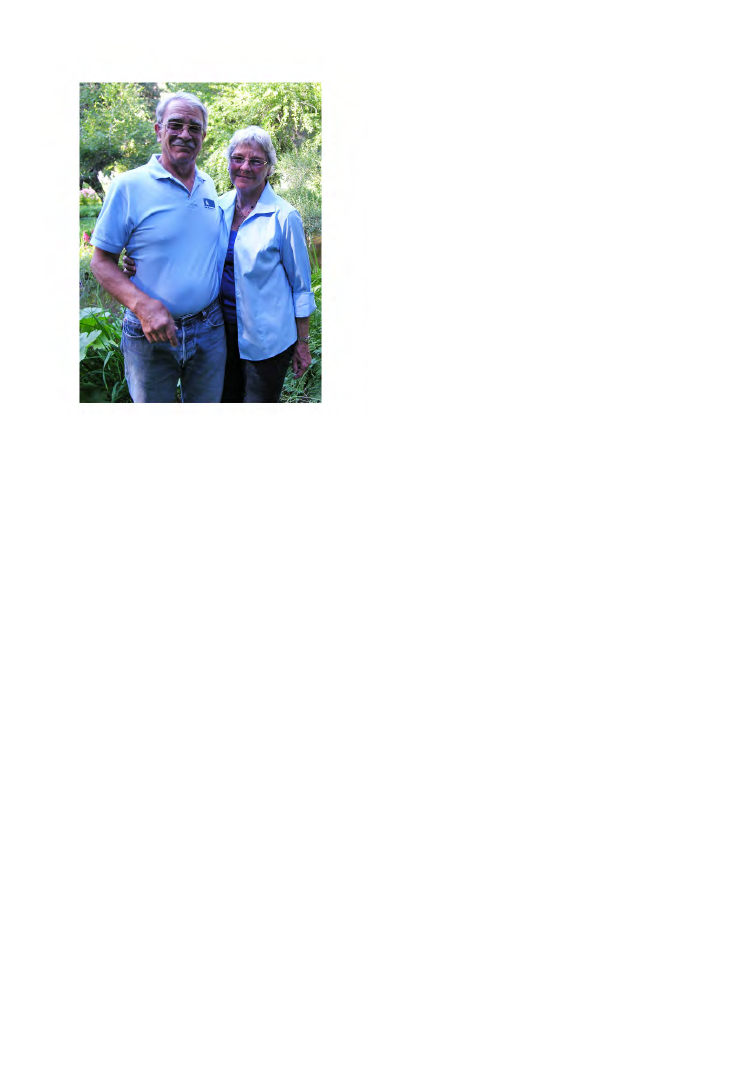
tube through which the style and stigma of
the pistil protruded. Later it was discovered
that two of the six Madagascar species shared
this character, but the staminal tubes of the
other three island species were much longer
and more similar to those of the Australian
species. It seemed like two natural groupings.
Today, applying molecular evidence, we
know that the Madagascar species are most
closely related to each other with independent
evolution of the shorter tube in the originally
described African species.
The concepts of polyphyly and monophyly
and lumping and splitting are illustrated
in several additional genera. A common
character relates to red flower coloration,
typically due to anthocyanin pigments.
However, in Bougainvillia and Esterhuysenia
(both Caryophyllales), the red/pink is due to
betalains, and in Streletsia and Takhtajania it is
bilirubins. But what about personal histories?
Louis Antoine Compte de Bougainville had
quite a career. Aide-de-camp to General
Montcalm during the French and Indian
War, he later led a French circumnavitation
for which he convinced the king to pay
for a professional naturalist, Philibert de
PSB 69 (1) 2023
55
Commerson, to accompany the expedition
(later copied by other European monarchs).
It was not until they arrived in Tahiti that
Commerson’s cabin boy assistant, Jean
Baret, was discovered to be a woman (and
Commerson’s lover). The two had collected
Bougainvillea in Brazil, and Baret apparently
suggested naming it after Bougainville, but the
deed was not done until later when Antoine
de Jussieu formalized the name.
Esterhuysenia’s namesake is Elsie Esterhuysen,
a South African botanist who in the 1930s was
kept from collecting because “in those days
the very prospect of a female doing botanical
survey work in the remoter parts of the South
African bush was unthinkable!” Luckily, she
connected with Louisa Bolus, who managed
the Bolus Herbarium (for her husband)
in Cape Town and worked through the
herbarium for most of her career. According
to Knapp, Bolus “…holds the record for
being the woman who has described the
most plant species ever.” She recognized that
some of “Mesembryanthemum” collections
made by Esterhuysen were distinct and
named them Esterhuysenia in the original
description. Knapp says Esterhuysen’s nearly
40,000 collected specimens ranks her as “the
most prolific collector for the Cape floristic
region, and in the top three for South Africa
overall….”
Strelitzia, another genus native to South
Africa, was first collected by Francis Masson,
“Kew’s first plant hunter,” in 1773. Living
plants were sent back to England where the
one in Joseph Banks’ garden bloomed and was
first illustrated in 1777. Ten years later Banks
commissioned another illustration of his plant
by botanical illustrator James Sowerby, from
which an engraving was made to produce
colored prints that Banks could distribute.
The name on the print was Strelitzia reginae,
“unusually making this privately circulated
illustration the place of publication of the
generic name!” Banks named the plant in
honor of Queen Charlotte (of Mecklenberg-
Strelitz), wife of George III, “…herself a keen
botanist and great supporter of the gardens at
Kew….”
Armen Takhtajan, the namesake of the
monotypic red-flowered Takhtajania
perrieri, was born in the disputed region
between Armenia and Azerbaijan. In 2021
the region gained independence as Artsakh,
and Takhtajan and a sprig of Tahtajania are
commemorated on one of their first postage
stamps. A member of the Winteraceae, and
considered a ‘living fossil,’ Knapp uses its
distribution to describe plate tectonics and its
role in explaining vicariance biogeography.
Red pigmentation has a role in each of the
four previous examples.
The “winning” chapter for most botanical
concepts introduced goes to Rafflesia, which
includes the world’s largest flower, R. arnoldii.
From specimens sent back by Thomas Raffles,
Robert Brown was able to determine that
Rafflesia was unisexual (staminate). A decade
later a pistillate plant was discovered. He also
realized that the plant is a parasite on the roots
of its host plant, the woody vine Tetrastigma
rafflesia. Knapp goes on to explain that
technically Raphlisia is a holoparasite and its
host is obligate. This relationship leads to the
concept of horizontal gene transfer and the
genomes of mitochondria and chloroplasts.
Many of Raphlisia’s nuclear genes, and a
third of its mitochondrial genes, originated in
Tetrastigma.
Some of the other interesting tidbits I found
most interesting were in the chapters Victoria,
Megacorax, Vickia, and Gaga. Victoria regia
was first described in letters and sketches
PSB 69 (1) 2023
56
from explorer Robert Schomburgk from
southern British Guyana in 1837. The name
went viral in the British botanical press for
10 years before it was realized that another
giant water lily growing in Brazil was already
described by a German as Euryale amazonica.
A bit of national pride was involved with
German, French, and British botanists all
having their champions in the naming war.
Final resolution came in the mid 20th century.
Euryale is a monotypic Indian genus, most
closely related to Victoria, so the queen’s genus
can be retained, but amazonica has priority
over regia.
“The name Megacorax does not immediately
call to mind an individual, but it is indeed
named for a person.” Megacorax is Greek
for great raven, honoring Peter Raven. It is a
monotypic member of the Onagraceae (the
focus of much of Peter’s botanical work)
and was immediately recognized as unique
when it was collected. Found so far in just
two small populations, it is an appropriate
species to recognize Raven’s conservation
efforts and commitment to link science and
sustainability. Here Knapp notes that today
about a quarter of new species are described
based on herbarium collections made 50 or
more years ago—hence the excitement over
this field discovery.
The classic example of the role of herbaria in
naming new species is another monotypic
genus, Vickia, named after the synantherologist
Vicki Funk (“Synantherologist” is one
who studies plants with fused anthers [the
composites]; this was new to me). The species
was first described as Gochnatia rotundifolia
in the 1800s. Recent work on the family
demonstrated that genera in subfamily
Gochnatioideae were not monophyletic
and “Gochnatia in particular was a mess.”
Gochnatia rotundifolia, which has only been
collected 23 times, all from an area around
Sao Paulo, now Brazil’s largest city. The most
recent collection was in 1965 and, despite
extensive searching, it has not been seen since.
“It is ironic in a way that the genus named
for Vicki, a person so full of life, is probably
already extinct.”
Finally, there is Gaga—yes, named after
the innovative and showy pop diva. Knapp
quotes the naming taxonomists' expansive
justification for their choice (you’ll have to
get the book to read it), but the last sentence
includes a unique “GAGA” sequence in the
matK gene. Gaga is a fern genus, so Knapp
uses the opportunity to provide a lot of fern
biology, including alternation of generations
and asexual apogamy. About half of the 18
species of Gaga are apogamous. I was most
surprised by the last sentence in the chapter,
which suggests the pop star has learned quite a
bit about her namesake genus. In a 2014 online
Reddit session, she was asked about having a
fern genus named after her. Lady Gaga replied
“It’s pretty cool, especially since it’s [an]asexual
fern; there are 19 species contained within the
genus. All sexless, judgeless. How cool. How I
wish to be.”
Every chapter was a delightful, and
educational, read, and it’s written at a level
both accessible to high school students and
informative to professional and academic
botanists. Well done!
-Marshall D. Sundberg, Roe R. Cross Professor
of Biology, Emeritus. Emporia State University,
Kansas; email: marshalldsundberg@gmail.com
PSB 69 (1) 2023
57
Learn to Love Those Latin
Names: a Straightforward
Guide to Botanical
Nomenclature
Ann Willyard
2022. ISBN 979-8417817434.
US$12.95 (Paperback), 73 pp.
Independently published
The scientific naming process can be
intimidating to beginners, amateurs, or casual
enthusiasts, yet an understanding of these
names can lend a greater context for all of these
individuals to understand the breadth and
diversity of plants. “Learn to Love Those Latin
Names: A Straightforward Guide to Botanical
Nomenclature” by Ann Willyard guides
readers through the entire process of naming
plants. Willyard is an associate professor
at Hendrix College in Arkansas, where she
teaches a wide variety of courses in botany and
plant systematics, with a research focus on the
phylogeography of ponderosa pine. This book
is divided into 20 very brief chapters (just a
handful of pages each) touching on many
aspects of botanical nomenclature, from why,
to what, how, who, and how.
The first three chapters cover information
about common versus scientific names, for
instance detailing why we should learn names
and the difficulties of common names versus
the benefits of using scientific names. Each
of these points is demonstrated with figures,
photographs, and useful examples. Chapters
4 through 11 detail the different components
of scientific names, from the binomial
nomenclature, to epithets, infraspecific ranks,
authors, pronunciations, and interesting
cases, like hybrids. The author then dives into
the history of botanical nomenclature and
places taxonomy into an evolutionary context
and levels of organization above the species
in Chapters 12 through 15. Chapters 16 and
17 discuss the naming of new species and the
changing of scientific names. Finally, the book
addresses interesting cases, like cultivated
plants and weeds in Chapters 18 and 19,
ending with a brief summary on the number
and breakdown of vascular plants. The back
of the book also includes additional resources
(books and websites) as well as a glossary of
useful terms.
This short guide (73 pages) does an excellent
job of walking readers through the important
components of botanical nomenclature.
Willyard writes in a way that is very clear
and informative. The figures, pictures, and
examples illustrate the information beautifully
and aid the reader’s comprehension. The
modern take on additional resources (mostly
websites) is also very useful for accessing up-
to-date tools, especially in regard to plants
found in North America.
This book presents information in a very
accessible way and is thus perfect for those
who are interested in plants and want to
understand more. This is also a great resource
for anyone teaching plant taxonomy or plant
systematics, as Willyard explains many very
useful examples that can be incorporated
into course materials. Overall, this book is a
great way to understand and contextualize
botanical nomenclature both in the broader
context of systematics and in emphasizing
concepts using specific and helpful examples.
-Nora Mitchell, Department of Biology, Uni-
versity of Wisconsin – Eau Claire, Eau Claire,
Wisconsin, USA
PSB 69 (1) 2023
58
Rescue and Revival: New
York Botanical Garden
1989-2018
Gregory Long
2022; ISBN: 978-1-952620-37-9
US $28.00 (Cloth). 208 pp.
Library of American Landscape
History, Amherst, MA
The subtle artistry woven through Mr. Gregory
Long’s career memoir, Rescue and Revival:
New York Botanical Garden 1989-2018, is its
defining feature. Though Long’s language is
expressive, and his stories filled with brilliant
detail, the artistry to which I refer is that of
observing the master at work, commanding
his medium with a familiarity and deftness
that is inseparable from the final piece. In this
case, the masterwork is the reimagining and
modernization of a New York City cultural
institution, and the medium is the social
fabric into which Long interlaces the Garden’s
past, present, and near future using the warm
colors of human relationships and aspirations.
Without this not-quite-visible tapestry
supporting the entire endeavor, there would
not be the more apparent features for which
the Garden is treasured: Haupt Conservatory,
Edible Academy, Thain Family Forest, and so
much more.
Long bounds his memoir by the years he
spent as President and CEO of the New York
Botanical Garden (NYBG) and describes in
great detail the elements of his position as
they relate to the task for which he was hired,
“to breathe new life and meaning into an
organization that in some important respects
had lost its way and was misunderstood by
most of the people of New York City.” It also
provides a valuable addition to the landscape
history of NYBG, the sociopolitical history of
the city, and America’s ongoing conversation
about civic responsibility. Yet this beautiful
little book—with 50 glossy photographs of
the people, plants, and architecture of NYBG,
a helpful list of further reading, and an
appendix titled “Our Planning Process”—is
largely intended as practical guidance. Long’s
message is primarily directed toward “people
who care … volunteers, philanthropists, and
professionals of all stripes” in hopes that
“they will benefit not only from the lessons
embedded in these chapters but also from the
enthusiasm for a seemingly impossible task
accomplished against all odds.”
Though I am certainly one who cares about
great places such as NYBG, I also fit another
demographic that is present throughout
Long’s memoir but only indirectly addressed:
the researchers and conservation scientists
who daily utilize herbariums, arboretums,
botanical gardens, and specialized libraries
to study the plants of the world. Most of us
are not the staff scientists who contributed
to Long’s planning process but are deeply
appreciative users of the materials and
publications that his organization produces
and disseminates. A hidden strength of Rescue
and Revival is the appreciation it generates
for the donors, managers, and operations
staff who orchestrate the enormous financial
resources and visionary management tasks
that complement the work of scientists
and educators and, in fact, fuel our career
aspirations by demonstrating the reach of
botanical art and science. Long gracefully
achieves his purpose by writing not so
much as a strategist but as a wholehearted
participant. “[W]e were all fairly young and
wildly determined,” he recalls, and through
friendships and perseverance, galas and golf
cart tours, “[w]e restored the spirit and dignity
of the place.”
Rescue and Revival is arranged chronologically
and somewhat thematically. The threads
PSB 69 (1) 2023
59
of institutional planning from which Long
weaves a backdrop for the infrastructural and
horticultural changes needed to modernize
NYBG are initially presented in a colorful
jumble that does not resemble a practical
handbook. But, through stories about events
such as hiring head of security Bob Heinisch
to teach visitors how to behave, crossing a
raging river in Belize with ethnobotanist
Michael Balick, and arranging a symposium
with Tom Lovejoy and E.O. Wilson to try to
prevent the secession of the Cary Arboretum
(now Cary Institute of Ecosystem Studies), we
gain a sense of Long’s priorities and challenges.
By the middle of the book, Long’s experiences
begin to coalesce into a professional journey
characterized by relationship-building,
revisioning of organizational identity, and
a deep historical sensitivity. It becomes
clear that friendships with figures such
as philanthropist Enid Annenberg Haupt
and Royal Horticultural Society leaders
Robin Herbert and Philip Browse, festivities
featuring the talents of opera diva Jessye
Norman and actress Sigourney Weaver, and
meetings with Governor George Pataki and
Congressman Ritchie Torres are not incidental
to Long’s success. His social grace and ability
to understand his donors’ values and interests
is central to the process of democratizing a
formerly elite cultural institution that remains
proud of its history and influence. Thus, the
appeal of NYBG could be broadened while its
founding mission—“to study the plants of the
world and to share our knowledge with the
public”—remained intact.
The image of strategic planning that Long
ultimately evokes is not so much a series of
steps or a procedure to imitate but rather, a
thoughtful and inspiring reflection placed
beautifully into an historical context. Rescue
and Revival links America’s Gilded Age to the
present and provides a glimpse of what civic
philanthropy can do. It describes how public-
private partnerships function at their best and
highlights the importance of horticulture to
urban landscapes. It suggests that motivated
curators and directors can transform their own
organizations through energized fundraising
and programmatic change. In the book’s final
chapter, Long reviews his accomplishments
and, importantly, explains why an outgoing
leader might want to leave the final phase of
a strategic plan for his successor to complete.
Long’s memoir uniquely achieves its explicit
purpose of incorporating practical insights
into the narrative of his journey at the helm of
the New York Botanical Garden. For the reader
who was hoping for a diagram or schematic,
Long includes an appendix outlining the
“exhilarating” bottom-up process that he
invented with his mentors Vartar Gregorian
and Mrs. Brooke Astor at the New York Public
Library and later repeated at NYBG. The details
of financial planning, renovation timelines,
and personnel requirements, however, must
be gleaned from the stories themselves. I
highly suggest reading the material in the
order presented, savoring Long’s artistry as
he brings his intended image into focus. The
reader can thus journey with him, imagining
herself as likewise capable of integrating a
fresh perspective into an existing fabric with
poise and panache rather than disruption.
-Andrea G. Kornbluh
PSB 69 (1) 2023
60
A Systematic Vadem-
ecum to the Vascular
Plants of Saba
Franklin Axelrod
2020. ISBN-13: 978-1-889878-
58-40
US$25.00 US (soft cover);
122 pp.
Botanical Research Institute of
Texas Press, Fort Worth, Texas 76107, USA
The book A Systematic Vademecum to the
Vascular Plants of Saba by Franklin Axelrod,
Curator of the University of Puerto Rico-Rio
Piedras herbarium, is a welcome addition
to floristic works of the Caribbean. A rocky
volcanic island located between the British
Virgin Islands and Saint Eustatius, Saba is
politically part of the Netherlands and has
around 2000 full-time inhabitants. A synoptic
flora, the book includes two topographical
maps, a list of villages, special collecting
areas, descriptions of principal trails, and a
detailed review of historical collections made
on the island by various collectors (principally
Urban, Boldingh, Stoffer, and Howard). The
checklist itself is based on both a review by
Axelrod of collections from Saba located at
multiple herbaria (National Herbarium of
the Netherlands, Gray Herbarium of Harvard
University, and the New York Botanical
Garden herbarium) and a recent set of
collections of over 1000 specimens made by
Dr. Axelrod over a six-year period (2013-
2019). Comprising only 13 square kilometers,
the vascular flora is diverse with 772 species.
Both native (554 species) and persistent
introduced flora (218) are included in the
Vademecum.
The list is broken down by “Fern Allies,”
“Ferns,” and “Vascular Plants.” One endemic
species, the fern Amauropelta sabaensis F.S.
Axelrod and A.R. Sm, is described and the
impact of introduced invasive species is
noted on the remaining native vegetation
where the fern occurs. Each species in the
Vademecum has a list of synonyms, the plant
growth habit, geographic localities, altitude
or altitude range, phenology, citation of
specimens and herbarium codes, broader
geographic distribution, and English names.
An index of scientific names is also provided
for all past and present names used for the
Saba flora. For some families, there are three
sections at the end that provide additional
information: (1) taxa not recently collected
(post 1965) are noted if relevant, which may
be useful for future studies of the Saba flora,
(2) taxa collected only under cultivation, and
(3) taxa of dubious status or occurrence. For
example, in the Fabaceae-Caesalpinioidea
(Leguminosae-Caesalpinioidea), nine species
are listed as currently occurring on Saba,
including four native and five introduced.
Three taxa have not been recently collected
(three native), one introduced taxa is found
under cultivation, and two taxa (both native)
are of dubious status or occurrence.
The Vademecum will be very useful for
botanical and ecological studies of Saba,
adjacent Caribbean islands, or for the
botanically oriented tourist. It is not a field
guide, however, and another text will be
needed to key out species. Axelrod provides
a list of online sources for images of taxa
that could be used in conjunction with the
Vademecum to assist with identification.
-John B. Pascarella, Department of Biologi-
cal Sciences, Sam Houston State University,
Huntsville, Texas USA 77381; email: jbpas-
carella@shsu.edu
PSB 69 (1) 2023
61
Trees: from Root to Leaf
Paul Smith
2022;
ISBN 13: 978-0-226-82417-8
(cloth)
US$49.95. 319 pp.
University of Chicago Press,
Chicago
This is a beautiful art book, combined with
informative yet succinct descriptions, that I
will display in my library. This is exactly the
kind of book I would expect from the Secretary
General of Botanic Gardens Conservation
International, a group dedicated to promoting
public education about plants. There are
nine chapters covering seeds, leaves, form,
bark, wood, flowers, fruits, symbiosis, and
economic importance. Each chapter begins
with an 8- to 10-page introductory essay that
explains the basic botany of that character
with interesting asides. For instance, the fire
brigade soaking of the British Natural History
Museum, following an incendiary bombing
during the WWII Blitz of London, stimulated
seeds on 170-year-old Nelumbo herbarium
sheets to germinate. This leads to a description
of 2000-year-old date seeds germinating
from a 1963 archaeological excavation from
Masada (Israel) and 32,000-year-old Siberian
Silene seeds germinating after recovery from
permafrost in 2011.
Following the introduction in each chapter
are eight well-illustrated sections highlighting
specific themes related to the chapter topic. Art
and Architecture are common themes found
in every chapter, with many full-page high-
quality photos and artistic illustrations. The
latter are particularly effective for illustrating
size and scale, as well as geometric patterns.
Some of the most striking photos are of the
Durian fruit-inspired Esplanade Theatres and
tree-inspired cooling towers in the Gardens
by the Bay, both in Singapore, and the Palm-
inspired solar panel/misters of the Oasys
public space in Abu Dhabi. The room-size
plywood sculptures of Henrique Oliveira in
the Galerie Vallois and Palais de Tokyo, both
in Paris, are room-size sculptures resembling
reinforced concrete posts and spans that
suddenly transform into giant twisted vines
or tangled thickets of branches.
Another common theme, found in all but
one chapter, is Economic Use. Food, shelter,
and medicine are the most obvious uses, but
Smith provides interesting additions to what
is commonly known (or taught). For instance,
the 750 species of figs are eaten by more
different species of birds and mammals than
any other genus of fruits. The book graphically
illustrates the surprising dominance of
bananas and watermelons, in terms of
production, coming in at 117 and 100 million
metric tons, respectively (25% and 13%
more than apples, the third-most abundantly
produced fruit). Smith also explains the loss
of genetic, and flavor, diversity with breeding
and selection primarily for production and
post-harvest characteristics.
The third most common theme is special
adaptations—those structural, ecological,
and evolutionary modifications that are the
natural “hooks” for capturing public interest
(and for teachers to attract student interest!).
Here again, excellent illustrations, graphics,
and photos catch the eye and reinforce
descriptions. My favorites are a succession of
four two-page graphics in the Form chapter.
The first illustrates tree crown mapping and
its use in landscape planting. The second
compares seven notable “elderflora” (Farmer,
2022), which dramatically counter the
common misconception that the biggest
trees are the oldest trees. The third illustrates
PSB 69 (1) 2023
62
12 common forms of Bonsai, and finally,
a schematic comparison of root and shoot
architecture of 12 species from different
habitats.
Who should have this book? Everyone
should have access to it. Recommend it to
your school public libraries! (Over most of
my professional career I had forgotten and
ignored the role of the public library in the
community, but I now realize they appreciate
purchase recommendations, and this is a great
way to promote plants to the public.) Put it
on your list of possible gifts for 2023. The
recipients will appreciate it. It will go a long
way in expanding “fur and feather” lovers into
plant lovers and is an excellent prescription
for curing plant blindness.
REFERENCES
Farmer, J. 2022. Elderflora: A modern history of an-
cient trees. Basic Books, New York.
-Marshall D. Sundberg, Professor Emeritus,
Emporia State University.
The Botanical Society of
America is a membership soci-
ety whose mission is to: pro-
mote botany, the field of basic
science dealing with the study
& inquiry into the form, func-
tion, development, diversity,
reproduction, evolution, & uses
of plants & their interactions
within the biosphere.
ISSN 0032-0919
Published 3 times a year by
Botanical Society of America, Inc.
4475 Castleman Avenue
St. Louis, MO 63166-0299
Periodicals postage is paid at
St. Louis, MO & additional
mailing offices.
POSTMASTER:
Send address changes to:
Botanical Society of America
Business Office
P.O. Box 299
St. Louis, MO 63166-0299
bsa-manager@botany.org
The yearly subscription rate
of $15 is included
in the membership
Address Editorial Matters (only) to:
Mackenzie Taylor, Editor
Department of Biology
Creighton University
2500 California Plaza
Omaha, NE 68178
Phone 402-280-2157
psb@botany.org
Plant Science Bulletin
Spring 2023 Volume 69 Number 1
Plant Science Bulletin
PSB 69 (1) 2023
64
The LI-600 performs rapid stomatal
conductance measurements in am-
bient conditions, while the LI-6800
measures carbon assimilation and
other parameters under controlled
conditions. Combined, the LI-600
and the LI-6800 provide a more
complete picture of photosynth-
esis than either instrument alone.
Pair the LI-600 Porometer/
Fluorometer with the LI-6800
Portable Photosynthesis System
• Rapidly survey a population, then
focus on individual plants.
• Improve accuracy and efficiency
in data collection.
• Add leaf angle and GPS data
with the LI-600.
Complementary
photosynthesis data
LI-COR is a registered trademark of LI-COR, Inc. in the United States
and other countries. All other trademarks belong to their respective
owners. For patent information, visit
www.licor.com/patents.
ISO 9001:2015 certified
Read the app note:
licor.com/complementary
© 2022 LI-COR, Inc.