69
Table of Contents
Society News
Merit Award: Dr. Michael Donoghue; Dr. Jeff Doyle; Dr. James Doyle ..........................70
Charles E. Bessey Award: Dr. Bruce Kirchoff .................................................................72
Young Investigator Award: Dr. Stacey Smith ...................................................................72
The second annual BSA Public Policy Award, BESC Congressional Visits Day 2014 ...77
American Journal of Botany continues Centennial Celebration throughout 2014 ...........81
Whitney R. Reyes Student Travel Award provides funds for to attend Botany 2014 .....87
BSA Science Education News and Notes ......................................................
88
Announcements
Meet the new Editors ........................................................................................................91
Up close with Theresa Culley ...........................................................................................92
Triarch “Botanical Images” Student Travel Awards .........................................................96
Missouri Botanical Garden Herbarium ...........................................................................98
Editor’s Choice ..............................................................................................
99
Reports
Geocaching as a means to teach botany to the public. ...................................................100
Book Reviews
Ecological .......................................................................................................................104
Economic Botany ...........................................................................................................105
Systematics ....................................................................................................................108
Books Received ...........................................................................................
111
Botany 2014 Invited Speakers ......................................................................
112
July 26 - 30 2014 - The Boise Centre - Boise, Idaho
www.botanyconference.org
70
Society News
The Botanical Society of America’s
2014 Merit Award Winners
Congratulations!
The Botanical Society of America Merit Award is the highest honor our Society bestows. Each year, the
Merit Award Committee solicits nominations, evaluates candidates, and selects those to receive an award.
Awardees are chosen based on their outstanding contributions to the mission of our scientific Society. The
committee identifies recipients who have demonstrated excellence in basic research, education, and public
policy, or who have provided exceptional service to the professional botanical community, or who may
have made contributions to a combination of these categories. Based on these stringent criteria, the 2014
BSA Merit Award recipients are listed in the following pages.
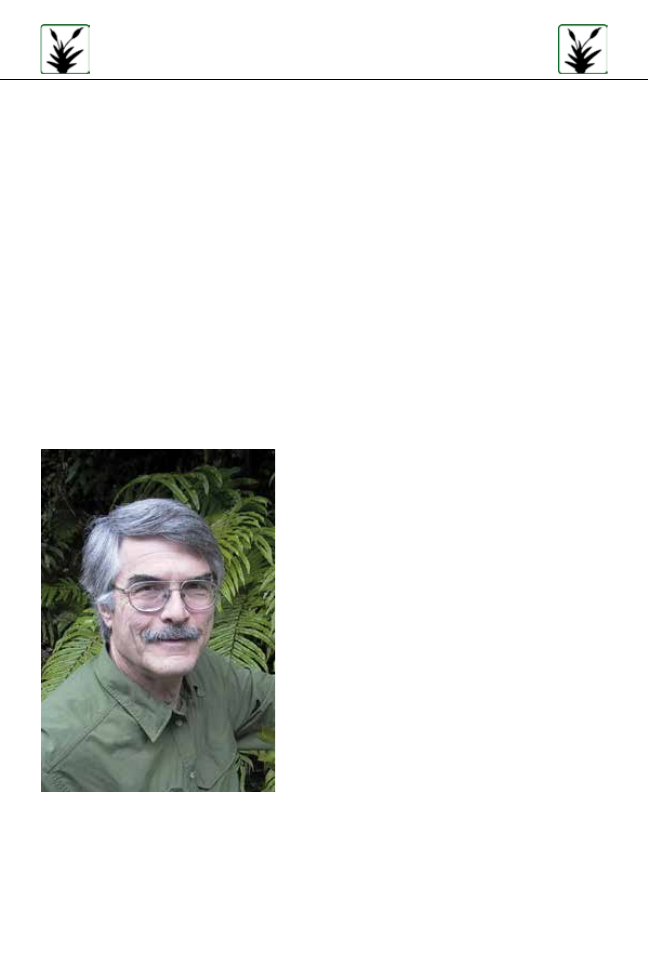
Dr. James Doyle
University of
California - Davis
Professor James A. (Jim) Doyle is recognized for
his many distinguished contributions to paleobotany,
particularly palynology, and to the understanding
of angiosperm phylogeny. Doyle and his associates
demonstrated that, worldwide, the Cretaceous fossil
record shows the primary adaptive radiation events of
early angiosperm evolution. One of his most valuable
insights, derived from both cladistic analysis and
stratigraphy, was the observation that angiosperms with
tricolpate and tricolpate-derived pollen corresponded to
a clade of angiosperms that included the vast majority of
living flowering plants. The existence of such a clade, the
eudicots, has subsequently been strongly supported by
molecular analyses, and the concept has made its way into
modern botany and biology textbooks. Throughout his
career and continuing into retirement, Prof. Doyle has shown himself to be an outstanding and inspiring
teacher, at both the undergraduate and graduate level. His lectures are meticulously organized, expertly
delivered, and focused on principles yet packed with details. His quirky sense of humor emerges and
students are left amazed by how much they learned. Prof. Doyle trained nine graduate students over his
career and mentored innumerable other graduate students, postdocs, and faculty colleagues.
71
Plant Science Bulletin 60(2) 2014
Dr. Michael Donoghue is a world-renowned botanist
and a tireless champion of phylogenetics, evolution,
and biodiversity research. He is an elected Fellow of the
National Academy of Sciences (2005) and the American
Academy of Arts and Sciences (2008), and most recently
was awarded the prestigious Dahlgren Prize in Botany
from the Royal Physiographic Society of Sweden
(2011). Donoghue has consistently been ahead of his
time—an intellectual leader in the development of new
theory and approaches in systematics, species concepts,
character evolution, historical biogeography, lineage
diversification, and phylogenetic nomenclature. His ideas
are always provocative; he has consistently rocked the
boat, inspired debate, and moved all of us toward more
rigorous thought.
His prodigious research career (he has published
hundreds of papers) is matched by his inspired, continual
service to our community, including many years in the
Directorships of the Harvard University Herbaria and the Yale Peabody Museum. He has also trained and
mentored dozens of students and post-doctoral associates, many of whom are now leaders themselves.
All of his nomination letters make special note of how naturally Michael inspires his colleagues—and the
botanical community at large—with his ideas and creativity, his enthusiasm, and his enormous generosity.
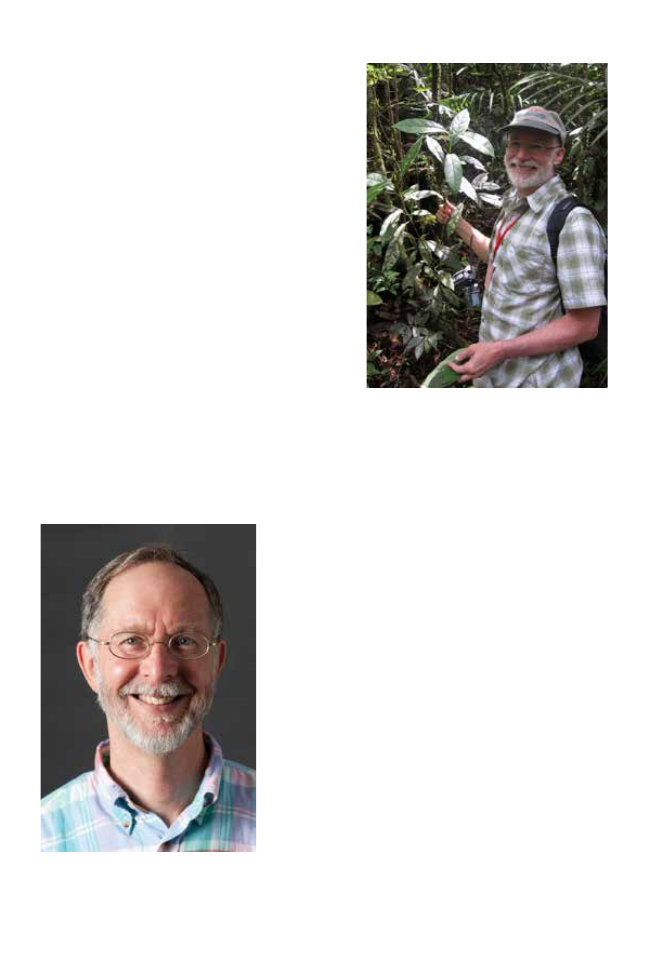
Dr. Michael Donoghue
Yale University
Dr. Jeffrey Doyle
Cornell University
Dr. Jeffrey Doyle is an internationally recognized leader
in the fields of theoretical and phylogenetic plant molecular
systematics and molecular evolution. Over the past several
decades he has consistently been at the forefront of the
field of molecular plant systematics, contributing not only
innovative methods, but also conceptual advances, as well
as new empirical findings that have led to an improved
understanding of plant diversity. One letter-writer notes
that Dr. Doyle has “an astonishing…record of insightful and
sustained scientific achievement and has an immense impact
on the direction of our field.” Dr. Doyle has made major
contributions to clarifying evolutionary relationships among
the legumes, the evolution of nodulation and also on the significance of polyploidy. Importantly, one letter-
writer notes that Dr. Doyle’s “commitment to undergraduate education is every bit as impressive as his
research and scholarship.” Dr. Doyle was not only an effective undergraduate teacher but also held a major
administrative position at Cornell, Director of the Office of Undergraduate Biology,

72
Plant Science Bulletin 60(2) 2014
BRUCE K. KIRCHOFF RECEIVES THE 2014
CHARLES E. BESSEY AWARD
The 2014 recipient of the Bessey Award is Professor Bruce K. Kirchoff
(University of North Carolina, Greensboro). Dr. Kirchoff has been on the
faculty at Greensboro since 1986 where he has distinguished himself as a
plant morphologist and botanical educator. He is a former member of the
BSA Education Committee and served as chair in 1993-94. His botanical
education research on image recognition is a direct outgrowth of his
morphological studies.
Dr. Kirchoff is transforming the way that students learn through the
creation of active, visual learning programs and mobile applications. He
has created, validated, and is in the process of distributing groundbreaking
software that helps students more easily master complex subjects. Furthermore, he has collaborated not
only with scientists in the U.S., but also Europe and Australia, to adapt his visual learning software to local
problems such as helping Australian veterinary students recognize poisonous plants and providing visual
identification keys for tropical African woods.
In 2007 he was the BSA Education Booth Competition winner for Image Quiz: A new approach to
teaching plant identification through visual learning and his work was showcased in the Education Booth
at the Botany & Plant Biology 2007 Joint Congress in Chicago. In 2013 he was the inaugural recipient of
the American Society of Plant Taxonomists (ASPT) Innovations in Plant Systematics Education Prize and
this year he was recognized with the University of North Carolina System Board of Governors award for
Excellence in Teaching.
Stacey Smith Receives Inaugural BSA
Emerging Leader Award
Dr. Stacey Smith is an accomplished researcher with a true commitment
to education and outreach and a willingness to step into leadership roles. She
is currently an assistant professor at the University of Colorado, Boulder.
Smith did her undergraduate work at Virginia Tech, earned a Master’s on
a Marshall Fellowship at the Universities of Reading and Birmingham, and
then obtained a PhD in Botany from the University of Wisconsin in 2008.
After doing a post-doc at Duke University, and spending 3 years on the
faculty at the University of Nebraska, she took her current position in 2013.
Over that time Dr. Smith has proven herself to be a prolific researcher,
with more than 25 publications, including co-authorship of the book, Tree
Thinking: An Introduction to Phylogenetic Biology.
Dr. Smith is best known for her work on Iochrominae (Solanaceae),
a clade that she has turned into a spectacular model system for bridging
ecological studies of pollination biology with genetic studies of the biochemical and genetic basis of
floral diversity. In addition, she has collaborated on diverse evolutionary studies and has made important
contributions in phylogenetic theory. However, as noted by her nominator, “Stacey is not just a great
researcher, but also a committed educator.” She has been active in traditional university courses, diverse
outreach activities especially in a K-12 setting, and as a resource instructor for the OTS Tropical Plant
Systematics course. She has also played an important role in identifying the challenge of teaching tree
thinking and in providing resources to help teachers overcome those challenges. Finally, it has been noted
that Dr. Smith is “a generous and supportive person who leads by example and draws along many other
junior (and senior) colleagues in her wake.” Given all these contributions to botany, Dr. Smith is a very
fitting recipient of the inaugural BSA Emerging Leader Award.

73
Plant Science Bulletin 60(2) 2014
BSA Public Policy Award
The Public Policy Award was established
in 2012 to support the development of
tomorrow’s leaders and a better understanding
of this critical area. The 2014 recipients are:
Megan Philpott, University of Cincinnati and the
Cincinnati Zoo & Botanical Garden, and Steven
Callen, Saint Louis University.
The BSA Graduate Student
Research Award
including the J. S. Karling
Award
The BSA Graduate Student Research Awards
support graduate student research and are made
on the basis of research proposals and letters of
recommendations. Within the award group is the
J. S. Karling Graduate Student Research Award.
This award was instituted by the Society in 1997
with funds derived through a generous gift from
the estate of the eminent mycologist, John Sidney
Karling (1897-1994), and supports and promotes
graduate student research in the botanical sciences.
J. S. Karling Graduate
Student Research Award
Catherine Rushworth, Duke University -
Advisor, Dr. Thomas Mitchell-Olds, Insights into the
origin and persistence of apomixis in the Boechera
holboellii species complex
BSA Graduate Student
Research Awards
Jason Berg, University of Maryland - Advisor,
Dr. Elizabeth Zimmer, A molecular assessment
of the potentially invasive plant species, Mimulus
guttatus DC: Estimating genetic divergence,
migration rates, and selfing rates for naturalized and
invasive populations in North America and Europe
Andrew A. Crowl, University of Florida and the
Florida Museum of Natural History - Advisor, Dr.
Nico Cellinese, Integrating morphology, cytology,
niche modeling, and phylogenetics to understand the
evolutionary history of endemic Campanula Species
in the Mediterranean
Jessamine Finch, Northwestern University
and Chicago Botanic Garden - Advisor, Dr. Kayri
Havens-Young, The effects of climate change on plant
regeneration: linking neighborhood size, tolerance
range, and species responses
Elliot Gardner, Northwestern University
and Chicago Botanic Garden - Advisor,
Dr. Nyree Zerega, Pollination biology of
domesticated artocarpus J.R. Forst. & G. Forst.
(Moraceae)
Alannie-Grace Grant, University of Pittsburgh -
Advisor, Dr. Susan Kalisz, Testing the preemptive selfing
hypothesis—Does self-pollination limit hybridization
in co-flowering related species?
Kimberly Hansen, Northern Arizona University -
Advisor, Dr. Tina J Ayers, Reconstructing the evolutionary
history of Campanulaceae with NextGen sequencing
Carla J. Harper, University of Kansas - Advisor,
Dr. Thomas N. Taylor, Fungal diversity during the
Permian and Triassic of Antarctica
Karolina Heyduk, University of Georgia -
Advisor, Dr. Jim Leebens-Mack, Physiology and
evolutionary genomics of CAM photosynthesis
in Yucca (Asparagaceae)
Brian Hoven, Miami University - Advisor, Dr.
David L. Gorchov, The effect of emerald ash borer-
caused canopy gaps on understory invasive shrubs
and forest regeneration
Kelly Ksiazek, Northwestern University and
Chicago Botanic Garden - Advisor, Dr. Krissa
Skogen, Pollen movement on urban green roofs
Emily Lewis, Northwestern University and
Chicago Botanic Garden - Advisor, Dr. Krissa
Skogen, Using pollinator foraging distance to
predict genetic differentiation in hawkmoth and bee-
pollinated Oenothera species
Shih-Hui Liu, Saint Louis University and the
Missouri Botanical Garden - Advisor, Dr. Jan
Barber, Phylogeny of Ludwigia and polyploid
evolution in section Macrocarpon (Onagraceae)
Blaine Marchant, University of Florida and the
Florida Museum of Natural History - Advisors,
Drs. Douglas and Pamela Soltis, Investigations into
the fern genome: filling the missing link in land plant
genome evolution
Renee Petipas, Cornell University - Advisor, Dr.
Monica Geber, The contribution of root-associated
microbes to plant local adaptation
Clayton Visger, University of Florida and the
Florida Museum of Natural History - Advisors, Drs.
Douglas and Pamela Soltis, Genomic consequences
of autopolyploidy: Gene expression in diploid and
autopolyploid Tolmiea (Saxifragaceae)

74
Plant Science Bulletin 60(2) 2014
Emily Warschefsky, Florida International
University and the Fairchild Tropical Botanic
Garden - Advisor, Dr. Eric J. B. von Wettberg, Next-
generation domestication genetics of the mango (m.
indica l.)
Keir Wefferling, University of Wisconsin -
Milwaukee - Advisor, Dr. Sara Hoot, Speciation
and hybridization in Caltha leptosepala s.l.
(Ranunculaceae): Disentangling the subalpine
marsh-marigold species complex
Kevin Weitemier, Oregon State University - Advisor,
Dr. Aaron Liston, Genome-enabled phylogeography
of a Great Basin milkweed, Asclepias cryptoceras
Brett Younginger, Portland State University -
Advisor, Dr. Daniel Ballhorn, The diversity and
functional role of foliar endophytes in stress-tolerant
plants
Vernon I. Cheadle Student
Travel Awards
(BSA in association with the
Developmental and Structural
Section)
This award was named in honor of the memory
and work of Dr. Vernon I. Cheadle.
Carla Harper, University of Kansas - Advisor,
Dr. Thomas N. Taylor - for the Botany 2014
presentation: “Foliar fossil fungi: Leaf–fungal
interactions from the Permian and Triassic of
Antarctica” Co-authors: Thomas N. Taylor, Michael
Krings and Edith L. Taylor
Rebecca Koll, University of Florida, Florida
Museum of Natural History - Advisor, Dr. Steven
Manchester - for the Botany 2014 presentation:
“Taxonomic relationships of early and middle
Permian gigantopterid seed plants in western
Pangea” Co-author: Steven Manchester
Meghan McKeown, University of Vermont
- Advisor, Dr. Jill Preston - for the Botany 2014
presentation: “The Evolution of vernalization
responsiveness in temperate Pooideae” Co-author:
Jill Preston
Triarch “Botanical Images”
Student Travel Awards
This award provides acknowledgement and travel
support to BSA meetings for outstanding student
work coupling digital images (botanical) with
scientific explanations/descriptions designed for
the general public. See the July American Journal of
Botany for all submissions.
Daniel McNair, University of Southern
Mississippi - 1st Place, Graceful aging, $500 Botany
2014 Student Travel Award
Daniel McNair, University of Southern
Mississippi - 2nd Place, Last of the longleaf
Abby Glauser, University of Kansas -
3rd Place, Resilience, $250 Botany 2014 Student
Travel Award
Carla Harper, University of Kansas -
3rd Place, 260 million year old (Permian)
mycorrhizal fungi from Antarctica, $250 Botany
2014 Student Travel Award
The BSA Undergraduate
Student Research Awards
The BSA Undergraduate Student Research
Awards support undergraduate student research
and are made on the basis of research proposals
and letters of recommendation. The 2014 award
recipients are:
Meredith R. Breeden, Fort Lewis College -
Advisor, Dr. Ross A. McCauley, Pollination biology
of the narrow endemic Ipomopsis ramosa, in
Roaring Fork Canyon, CO
Alice Butler, Bucknell University - Advisor,
Dr. Chris Martine, Floral development in solanum
sejunctum and solanum asymmetriphyllum
Matthew Galliart, Kansas State University
- Advisor, Dr. Loretta Johnson, Long-term field
selection of big bluestem ecotypes in reciprocal
gardens planted across the Great Plains precipitation
gradient
Ian Gilman, Bucknell University - Advisor, Dr.
Chris Martine, Field botany and population genetics
of Draba L. (Brassicaceae) in the Rocky Mountains
Morgan Roche, Bucknell University - Advisor,
Dr. Chris Martine, Genetic diversity within and
among species of dioecious Australian solanum

75
Plant Science Bulletin 60(2) 2014
Dylan D. Sedmak, Ohio State University -
Advisor, Dr. John Freudenstein, Fungal variability
and habitat correspondence in the North American
orchid Cypripedium acaule ait.
Kayla Ventura, University of Florida - Advisor,
Dr. Pamela Soltis, Identifying the cellular component
of flower size differences in Gilia (Polemoniaceae)
associated with changes in pollinators
Developmental & Structural
Section Student Travel Awards
Italo Antonio Cotta Coutinho, Universidade
Federal de Vicosa - Advisor, Renata Maria Strozi
Alves Meira - for the Botany 2014 presentation:
“Diversity of secretory structures in Urena
lobata L.: ontogenesis, anatomy and biology of the
secretion” Co-authors: Sara Akemi Ponce Otuki,
Valéria Ferreira Fernandes, Renata Maria Strozi
Alves Meira
Roux Florian, INRA - Advisor, Jana Dlouhá - for
the Botany 2014 presentation: “Flexible juveniles or
why trees produce ‘low quality’ wood?” Co-authors:
Jana Dlouhá, Tancrède Almeras, Meriem Fournier
Rebecca Povilus, Harvard University -
Advisor, William Friedman - for the Botany
2014 presentation: “Pre-fertilization reproductive
development and floral biology in the remarkable
water lily, nymphaea thermarum” Co-authors: Juan
M. Losada, William E. Friedman
Beck Powers, University of Vermont - Advisor,
Jill Preston - for the Botany 2014 presentation:
“Evolution of asterid HANABA TARANU-like genes
and their role in petal fusion” Co-author: Jill Preston
Ecology Section Student
Travel Awards
Rachel Germain, University Of Toronto -
Advisor, Dr. Benjamin Gilbert - for the Botany 2014
presentation: “Hidden responses to environmental
variation: maternal effects reveal species niche
dimensions” Co-author: Benjamin Gilbert
Jessica Peebles Spencer, Miami University -
Advisor, Dr. David L. Gorchov - for the Botany
2014 presentation: “Effects of the Invasive Shrub,
Lonicera maackii, and a Generalist Herbivore,
White-tailed Deer, on Forest Floor Plant Community
Composition” Co-author: David L. Gorchov
Genetics Section Student
Research Awards
Genetics Section Student Research Awards
provide $500 for research funding and an additional
$500 for attendance at a future BSA meeting.
Kevin Weitemier, Oregon State University-
Graduate Student Award - Advisors: Dr. Aaron
Liston, for the proposal titled “Genome-enabled
phylogeography of a Great Basin milkweed, Asclepias
cryptoceras”
Kimberly Hansen,
Northern Arizona
University- Masters Student Award - Advisor: Dr.
Tina Ayers, for the proposal titled “Reconstructing
the evolutionary history of Campanulaceae with
NextGen sequencing”
Pteridological Section &
American Fern Society Student
Travel Awards
Alyssa Cochran, University of North Carolina,
Wilmington - Advisor, Dr. Eric Schuettpelz - for
the Botany 2014 presentation: “Tryonia, a new
taenitidoid fern genus segregated from Jamesonia
and Eriosorus (Pteridaceae)” Co-authors: Jefferson
Prado and Eric Schuettpelz
Jordan Metzgar , University of Alaska, Fairbanks
- Advisor, Dr. Stefanie Ickert-Bond - for the Botany
2014 presentation: “From eastern Asia to North
America: historical biogeography of the parsley ferns
(Cryptogramma)” Co-author: Stefanie Ickert-Bond
Jerald Pinson, University of North Carolina,
Wilmington - Advisor, Dr. Eric Schuettpelz - for
the Botany 2014 presentation: “Origin of Vittaria
appalachiana, the “Appalachian gametophyte”” Co-
author: Eric Schuettpelz
Sally Stevens, Purdue University - Advisor, Dr.
Nancy C. Emery - for the Botany 2014 presentation:
“Home is Where the Heat Is? Temperature and
Humidity Responses in a Fern Gametophytex” Co-
author: Nancy C. Emery

76
Plant Science Bulletin 60(2) 2014
The BSA Young Botanist
Awards
The purpose of these awards is to offer individual
recognition to outstanding graduating seniors
in the plant sciences and to encourage their
participation in the Botanical Society of America.
The 2014 “Certificate of Special Achievement”
award recipients are:
Theresa Barosh, Willamette University, Advisor:
Dr. Susan Kephart
Allison Bronson, Humboldt State University,
Advisor: Dr. Alexandru M. Tomescu
Jamie Burnett, Humboldt State University,
Advisor: Dr. Alexandru M. Tomescu
Katherine Chapel, Miami University, Advisor:
Dr. Michael A. Vincent
Nels Christensen, Connecticut College, Advisor:
Dr. T. Page Owen, Jr.
Gemma Dugan, Bucknell University, Advisor:
Dr. Chris Martine
Vince Fasanello, Bucknell University, Advisor:
Dr. Chris Martine
Leila Fletcher, Barnard College, Columbia
University, Advisor: Dr. Hilary Callahan
Anna Freundlich, Bucknell University, Advisor:
Dr. Chris Martine
Maria Friedman, Humboldt State University,
Advisor: Dr. Alexandru M. Tomescu
Blake Geraci, University of Florida, Advisor: Dr.
Pamela S. Soltis
Grace Glynn, Connecticut College, Advisor: Dr.
T. Page Owen, Jr.
Cody Groen, College of St. Benedict/St. John’s
University, Advisor: Dr. Stephen G. Saupe, Ph.D.
Anna Herzberger, Eastern Illinois University,
Advisor: Dr. Scott J. Meiners, Ph.D
Julia Hull, Weber State University, Advisor: Dr.
Ron Deckert, Ph.D.
Emily Keil, Ohio University, Advisor: Dr. Sarah
E. Wyatt
Michael LeDuc, Connecticut College, Advisor:
Dr. T. Page Owen, Jr.
Jessica Mikenas, Oberlin College, Advisor: Dr.
Michael J. Moore
Luis Mourino, University of Florida, Advisor:
Dr. Pamela S. Soltis
Taylor J. Nelson, Weber State University,
Advisor: Dr. Sue Harley
Chelsea Obrebski, Miami University, Advisor:
Dr. Michael A. Vincent
Rhys Ormond, Willamette University, Advisor:
Dr. Susan Kephart
Kelsey Phipps, Eastern Illinois University,
Advisor: Dr. Scott J. Meiners, Ph.D.
Molly Sutton, Weber State University, Advisor:
Dr. Barb Wachocki
Amanda Thornton, Campbell University,
Advisor: Dr. Chris Havran
Drew Walters, Fort Lewis College, Advisor: Dr.
Ross A. McCauley, Ph.D.
The BSA PLANTS Grant Recipients
The PLANTS (Preparing Leaders and Nurturing
Tomorrow’s Scientists) program recognizes outstanding
undergraduates from diverse backgrounds and provides
travel grants and mentoring for these students.
Marilyn Creer, Alabama A&M University,
Advisor: Dr. Tatiana Kukhtareva
Gemma Dugan, Bucknell University, Advisor:
Dr. Chris Martine
Shawna Faulkner, Humboldt University,
Advisor: Dr. Alexandru Tomescu
Michelle Garcia, University of Texas-El Paso,
Advisor: Dr. Michael Moody
Aidee Guzman, University of Wisconsin-
Madison, Advisor: Dr. Eve Emshwiller
Timothy Hieger, University of Kansas, Advisor:
Dr. Thomas N. Taylor
Shayla Hobbs, University of Illinois, Advisor:
Dr. Tina M. Knox
Michelle Jackson, Smith College, Advisor: Dr.
Jesse Bellemare
Claudia Christine Marin, University of
California Riverside, Advisor: Dr. Milton McGiffen
Sean Pena, Florida International University,
Advisor: Dr. Suzanne Koptur
David Pozo Garces, Central Michigan State
University, Advisor: Dr. Anna Monfils
Yisu Santamarina, Florida International
University, Advisor: Dr. Bradley Bennett
Samuel Torpey, University of Idaho, Advisor:
Dr. David Tank

77
Plant Science Bulletin 60(2) 2014
BSA students participate in
Congressional Visits Day 2014
BSA Public Policy Award offers
unique and personal experience in
Washington, DC
On April 9-10, BSA graduate student members
Megan Philpott (University of Cincinnati), Steven
Callen (Saint Louis University), and Morgan Gostel
(George Mason University) met with members
of Congress to discuss the importance of funding
for basic scientific research through the National
Science Foundation (NSF). This was the third year
that BSA student members have participated in this
annual event, organized by the American Institute
of Biological Sciences (AIBS) and the Biological and
Ecological Science Coalition (BESC) for biologists
to meet with members of congress.
As a bit of background, this year President
Obama’s budget proposal requested $7.255 billion in
appropriations for the National Science Foundation.
This is 1.2% more than last year’s request. Recently,
appropriations request letters were submitted to
House (Representative Butterfield, D–MA) and
Senate (Senator Markey, D–NC) appropriations
committees, requesting this amount be increased
to $7.5 billion for FY 2015, which helps to mitigate
net losses due to inflation and maintains support
for important NSF programs.
Megan and Steven are recipients of the second
annual BSA Public Policy Award and have
described their experience below.
Megan’s experience
Fellow BSA Public Policy Award winner Steven
Callen and I met with BSA student representative,
Morgan Gostel, the day before the festivities
started to get oriented. April 9 kicked off with a
meeting between the first-time Congressional
Visits attendees and members of the scientific
community with extensive experience in public
policy. It was a candid look into the day-to-
day world of communicating science to policy-
makers. Afterward, we got a run-down of the
political climate in Congress right now regarding
science policy and research, the proposed budgets
for various scientific research agencies for 2015,
and how exactly to communicate effectively with
policy-makers regarding our requests.
April 10 was the big day to meet with our
Congress people. I was in a group with two other
graduate students representing Michigan and
Pennsylvania, led by Brian Wee, Chief of Strategic
Alliances for the National Ecological Observatory
Network. We each met with the offices of our two
state senators and state representative, and I led
the meetings with my Ohio congressmen, Sen.
Sherrod Brown, Sen. Rob Portman, and Rep. Steve
Chabot. Our main request was a modest increase
for the NSF budget in FY2015 to $7.5 billion, up
from the proposed budget of $7.255 billion. Most
of the offices we met with seemed very supportive
of funding basic scientific research in their state,
but time and time again, legislative staff stressed
the difficulty of passing any budget increases
given the current political climate. According to
the AIBS, several of the Senator’s offices that CVD
participants met with signed a “Dear Colleague”
letter circulated in support of an increased NSF
budget, so hopefully our meetings had a positive
impact.
All in all, my involvement with CVD was an
eye-opening and educational experience. It’s easy
to get discouraged as a citizen when it feels like
your elected officials don’t share your priorities,
but actually going to Capitol Hill and meeting
Megan Philpott, University of Cincinnati (right),
with two other graduate students during Congres-
sional Visits Day 2014.
78
Plant Science Bulletin 60(2) 2014
with congressional offices showed that we citizens
can have a little more impact than just going to
the polls on Election Day. I feel inspired to stay
involved with science advocacy and public policy
at the federal level, and I’m currently trying to
get involved at the state level as well. In all, I’m
incredibly grateful to the BSA for allowing me to
have such a great experience.
Steven’s experience
Until my visit to the U.S. Embassy in Beijing
last summer during my 2013 NSF East Asian
and Pacific Summer Institute Fellowship, I had
never considered, or even thought about, how
important science policy and policymakers are
in directing the landscape of scientific research
and development in the United States and in
supporting my own research. Inspired by that
embassy visit, I subsequently began to increase
my awareness and understanding of issues in
science policy and actively started to find avenues
for student participation in policy that would
consequently give me the chance to have an impact
on the current state and future direction of science
R&D. Thanks to the Botanical Society of America,
I was able to take a significant step in that direction
by immersing myself in part of the science policy
process by attending CVD this year.
Our group was lead by Richelle Weihe,
Governmental Grants and Contracts Coordinator
at the Missouri Botanical Garden, and also
included Chris Lorentz (from Thomas More
College in Kentucky) and Don Natvig (from the
University of New Mexico). Since there were four
of us representing three states, we were tasked
with having conversations with Senate and House
members (or their staff) from Missouri (Sen.
McCaskill, Sen. Blunt, and Rep. Clay), Kentucky
(Sen. Paul, Sen. McConnell, and Rep. Massie), and
New Mexico (Sen. Udall, Sen. Heinrich, and Rep.
Lujan Grishman).
What was particularly unique about this group
of Senators and Representatives was the diversity
of their backgrounds: five are Democrats and four
are Republicans; two are women; one is African-
American; collectively they come from six different
religious backgrounds; and, while most are in their
first term, they have different levels of experience
in Congress (up to seven terms)! As a result, it
was interesting seeing first-hand the different
ways that each of their offices operated, their levels
of understanding how science works, and their
individual perspectives on federal funding for
science R&D.
For instance, while the office of Sen. McCaskill
(D-MO) expressed support for federally supported
science research, though her policy is to generally
not sign letters of support for any issue, Sen. Rand
Paul’s (R-KY) office bluntly suggested that the best
we could hope for, since this is an election year,
is to maintain status quo until some time in the
following year, but that his office is generally in
favor of across-the-board budget cuts (not just to
the sciences). Alternatively, the office of Sen. Wm.
Lacy Clay (D-MO) was uniquely transparent in
their complete support of increased federal funding
to science research, which actually was evident
before our meeting, as he had, just days before,
signed the Butterfield-McKinley Dear Colleague
Letter in support of a $7.5 million budget for
NSF for fiscal year 2015 ($245 million more than
currently proposed by Pres. Obama).
While the entire day was full of excitement and
“teachable moments” for me, my experience at
CVD both began and ended with my two biggest
highlights. As residents of Missouri, Richelle
and I were both able to attend Sen. McCaskill’s
constituent coffee hour (along with vacationers
and groups advocating for different issues). It was
a little intimidating meeting with a member of
Congress for the first time, but I was quickly put
at ease by Sen. McCaskill’s sense of humor and
straightforward demeanor. After listening to her
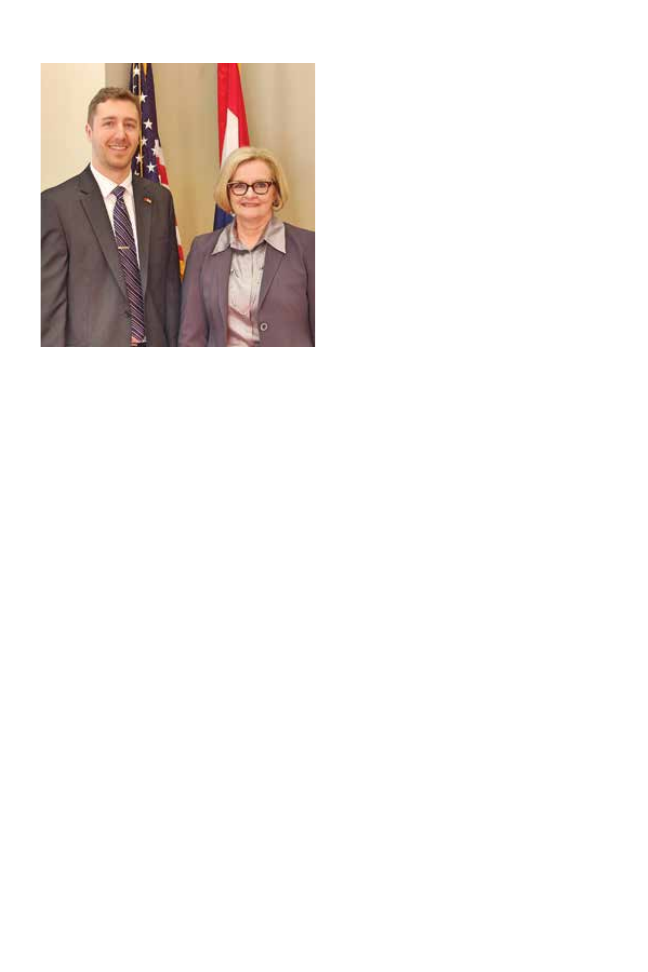
Steve Callen, Saint Louis University, meets with
Senator Claire McCaskill (D-MO) during Congres-
sional Visits Day 2014

79
Plant Science Bulletin 60(2) 2014
tell us about the current state of things in the Senate
and then having our photo taken with her, we met
with one of her policy analysts in the hallway and
were able to get into more detail about the need for
federal funding for science, how it has been used
to support our own work, and other ways in which
federal funding has benefitted science R&D and
STEM training in Missouri. Our message was well-
received, and, just before we left, I offered myself as
an eager source of advice on future science policy
issues.
Toward the end of the day, our group had a
meeting with Rep. Clay. We were not planning on
meeting with him, but, to our surprise, he was in
his office and quickly stepped out to greet us and
say “hello” before he had to run off to vote. A bit
mystified by his unexpected appearance, I collected
myself and was directed into a room to speak
with one of his legislative assistants, Ms. Noelle
Lindsay. The two of us bonded immediately as a
result of some common ground. After I explained
how federal funding is helping to support my
dissertation project on an invasive plant species,
she told me how her dad struggles to remove the
same plant from his backyard year after year! As
Richelle and I were leaving the office, Ms. Lindsay,
laughing, mentioned she was going to text her dad
that she met someone whose research might help to
relieve some of his backache.
Overall, I greatly enjoyed CVD, and it has helped
to solidify my interests in continuing to have a role
in science policy. While we did our best to get our
message across during each of our brief 15-minute
meetings, this is really just the start. As I was told
in a panel discussion the day before at the ESA,
the best way to ensure you have a long-term
impact on science policy is to form relationships
with the members of Congress and their staff by
communicating with them clearly and frequently
and by explaining the ways in which science
issues are relevant to them and the states they
represent. I plan to cultivate the relationships
I started at this 2014 CVD by writing follow-up
emails and letters, sending messages to members
of Congress on social media such as Facebook and
Twitter, and returning to participate in more CVDs.
I am most appreciative to the BSA for sponsoring
my visit; to the ESA, BESC, and AIBS for organizing
it; and to Morgan for coordinating my trip and
showing Megan and me around DC.
Morgan’s experience
This year I led a team, which was markedly
different from my experiences in 2012 and 2013.
Because this was my third time at the CVD, I was
able to share my experience from previous years
with new participants. My team included two other
graduate students from Arizona State University
and the University of Delaware. Our team met
with legislative aides and coordinators from seven
congressional offices, including both senators from
Arizona and Delaware, as well as Representatives
Carney (Delaware) and Sinema (Arizona, 9th).
I also met with a legislative correspondent from
Senator Mark Warner’s office (Virginia). The
week following our meetings, I heard back from
the legislative correspondent I met with that both
Virginia Senators (along with 19 other senators,
including both from Delaware as well) had signed
the Markey “Dear Colleague” letter requesting
increased appropriations for the NSF—it makes me
wonder if our meetings helped make this difference!
The most dramatic difference between the BESC
this year from my previous two years was the overall
nature of the meetings. Last year, the President’s
budget was released on the same day of the event,
so few members of Congress were familiar with the
specificity of the appropriations requests. Rhetoric
surrounding budget priorities was very heated and
the word “funding” had somewhat of a palpable air
of intrigue and suspicion surrounding it. This year I
detected much more of a need to communicate and
cooperate on the budget and a sense of urgency.
Among the legislative staffers our team met with,
all were specialists on science and technology
policy and included a former post-doctoral AAAS
Congressional Fellow. We were able to share stories
about how our work has touched the lives of not
only a local constituency, but also improves our
fundamental understanding of biological systems
at a global scale.
Despite the challenges and opportunities
observed during the CVD, it is satisfying
to realize the underlying support for basic
research and level of understanding among
many congressional offices that basic research
is not a partisan issue. What is most shocking is
the perspective I have gleaned over the past three
years as a participant in the CVD and how radically
attitudes toward funding for basic research can
shift from one year to the next. Despite the shifting
policy climate, the salience of our message remains
the same: basic research supports education
80
Plant Science Bulletin 60(2) 2014
and innovation priorities that help develop
our nation both uni- and multilaterally as a
leader in science and technology. A continued
commitment is necessary to maintain a leadership
role in basic research and it is our job, as botanists,
to communicate the importance of this role, its
breadth, and the interconnectedness we share with
both the biotic and abiotic features of the planet
that botanical research helps us better understand.
Already in the few weeks following the 2014
CVD, we have observed some positive response
to our message, including support in the Senate
for the Senator Markey “Dear Colleague”
appropriations letter and just two weeks ago,
the House voted to pass a bill supporting $7.4
billion for the National Science Foundation—not
quite the amount requested by CVD participants
($7.5 billion), but an increase of $154 million
from President Obama’s request for 2015.
What can you do?
Write to your congressional representatives, sign
up for Public Policy Reports from the American
Institute of Biological Sciences (AIBS, http://
www.aibs.org/public-policy-reports/), and become
involved! If you can’t make it to Washington, D.C.,
the AIBS organizes an annual event in August called
the Biological Sciences Congressional District Visits,
which gives scientists an opportunity to meet locally
with their representatives and senators to discuss the
importance of the work you do and federal funding
that supports it. Registration for the event is free and
should be opening soon! If you can’t attend in
person, remember that you can always write your
representatives and senators to ask for their support
and/or thank them if they already have supported
policy that is important to you!
Finally, if you are a graduate student or post-
doc, be sure to keep an eye out for these important
opportunities to engage in public policy, sponsored
by the BSA and our Public Policy Committee
(become a member!) You can expect a call for
proposals for the 2015 BSA Public Policy Award in
Fall 2014!
With deep gratitude to the BSA membership
for supporting important botanical education and
outreach, as well as the Public Policy Committee’s
commitment to improving opportunities for public
policy action,
—Megan Philpott, Steven Callen, and Morgan
Gostel

81
Plant Science Bulletin 60(2) 2014
The
American Journal of Botany continues Centennial
Celebration throughout 2014
The celebration of the first 100 years of the American Journal of Botany continues! The last issue of the
PSB featured interviews with some of the AJB’s most prolific authors over the years: Karl Niklas, Pam and
Doug Soltis, and Mark Chase. This issue features interviews with more members of this elite group, as the
following pages show.
The AJB’s unique Centennial Review papers have also been attracting a lot of attention and positive
comments. These papers take a look at key research from the AJB’s past and re-examines and updates
the research to find where the field stands now and into the future. The following AJB Centennial Review
articles are already available and can be accessed for free:
• “Plant evolution at the interface of paleontology and developmental biology: An organism-centered
paradigm” by Gar W. Rothwell, Sarah E. Wyatt, and Alexandru M. F. Tomescu [101(6):899, 2014]
• “Is gene flow the most important evolutionary force in plants?” by Norman C. Ellstrand [101(5):757, 2014]
• “Repeated evolution of tricellular (and bicellular) pollen” by Joseph H. Williams, Mackenzie L. Taylor,
and Brian C. O’Meara [101(4):559, 2014]
• “The voice of American botanists: The founding and establishment of the American Journal of Botany,
‘American botany,’ and the Great War (1906-1935)” by Vassiliki Betty Smocovitis [101(3):389, 2014]
• “The nature of serpentine endemism” by Brian L. Anacker [101(2):219, 2014]
• “The evolutionary-developmental origins of multicellularity” by Karl J. Niklas [101(1):6, 2014]
• “The American Journal of Botany: Into the Second Century of Publication” by Judy Jernstedt
[101(1):1, 2014]
These articles are also hosted at botany.org/ajb100, and the site also hosts other free content---
nearly 1000 articles from the history of the AJB, as written by the journal’s top 25 contributors!
The AJB is one of the few surviving plant science publications published by a non-profit scientific society.
The journal, and its authors, reviewers, editors, readers, and subscribers, are at the heart of the Botanical
Society of America, and the strength of this connection makes the AJB stand out from many other journals.
82
Plant Science Bulletin 60(2) 2014
uniform floral development. Ann found mutants
of Melilotus alba that were non-papilionoid and
hence interesting to both of us; I supplied the SEM
work on it.
Why have you chosen AJB as one of the
journals in which you’ve published throughout
your career?
AJB has always been the premier American
journal in botany, in my opinion. I have had good
relations and help from all its editors from Norman
Boke (1970-1974) onward, mostly fair reviews,
and straightforward procedures toward publication.
The fact that the journal is so widely distributed
worldwide is also very important, since my areas
of research are practiced worldwide.
Shirley’s complete list of AJB publications, which
are free for viewing throughout 2014, can be found at
https://botany.org/ajb100/stucker.php.
Shirley Tucker, University of
California–Santa Barbara
Shirley Tucker has not only published 55 articles
in the American Journal of Botany over 55 years,
but has served as BSA President (1986-1987) and
Program Director (1978). She also won the BSA’s
highest honor, the BSA Merit Award, in 1989. We
asked Shirley to look back over her career and some
of the key research she published in AJB over the
years.
The first article you published in AJB was
“Ontogeny of the Floral Apex of Michelia fuscata”
in 1960. Take us back to that period—where were
you, what were you doing, and what were you
studying/most interested in at the time?
I was a Research Associate in the Botany
Department at the University of Minnesota,
supported halftime on my first NSF research
grant, which was on floral development in
Magnoliaceae. I had completed my PhD at the
University of California (Davis) and moved to
Minnesota with my husband Ken, where he
obtained a position in Entomology. Fortunately
I could work in the laboratory of Dr. Ernst Abbe,
with whom I had done an MS degree working on
Zea mays seedling development. Living material
of Magnoliaceae was scarce in St. Paul, but a small
tree of Michelia fuscata in a public greenhouse was
sufficient to produce four publications (all in AJB)
describing its vegetative and floral development as
well as its odd phyllotaxy. Meanwhile I was also
preparing my PhD work, on floral ontogeny in
Drimys winteri, for publication.
Your most recent article in the AJB was “An
open-flower mutant of Melilotus alba: Potential
for floral-dip transformation of a papilionoid
legume with a short life cycle?” in 2010. How
has the thread of your research changed over
time?
About 1983, my research interest turned
to legume flowers, at first investigating the
developmental distinctions among the three
subfamilies. Fifty-three publications on leguminous
floral ontogeny resulted, 26 of which were in the
AJB. Subfamily Caesalpinieae proved most diverse
in floral ontogeny, and I was fortunate in receiving
material for this work from west African tropics
from systematists. This paper by Ann Hirsch and
her students was among the few papers I published
on subfamily Papilionoideae, which had relative
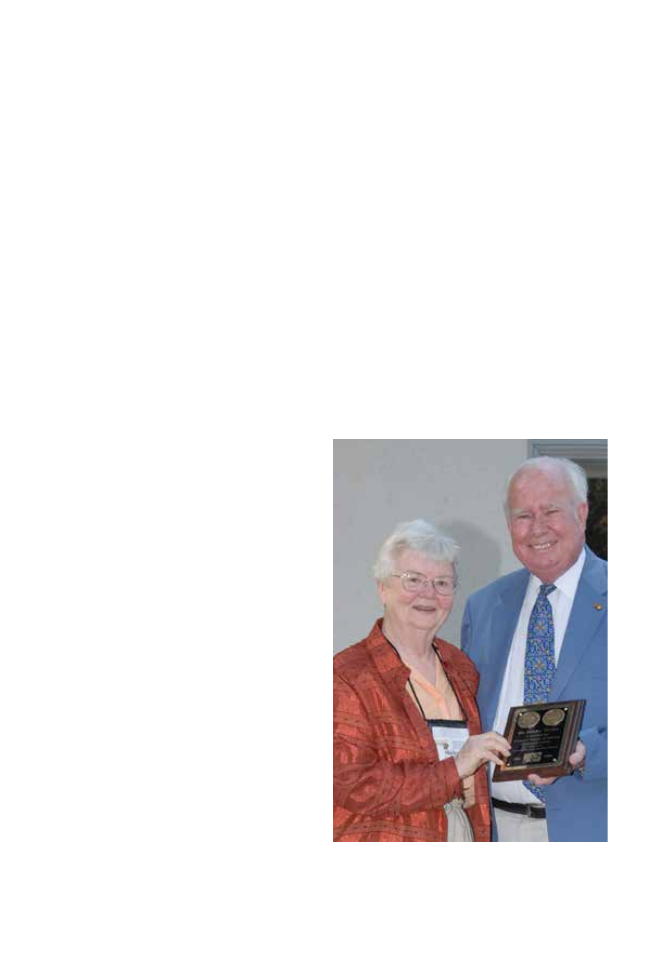
Shirley Tucker, accepting the BSA’s Centennial Award
in 2006 from Dr. Peter Raven. The award acknowl-
edged and honored outstanding service to the plant
sciences and the Society.

83
Plant Science Bulletin 60(2) 2014
and phylogeny from an organismal perspective,
and have employed development as a major focus
throughout. However, I did not ever expect to be
able to include information from molecular biology
and developmental genetics (no such thing for the
first 20-25 years) in my studies.
In looking back at all of the articles you’ve
published in AJB, which stand out and why?
This forces me to look back and remember what I
was thinking when each of the papers was accepted
for publication. I’ll choose my first paper, “Ontogeny
of the Paleozoic Ovule Callospermarion pusillum,”
because it allowed me to develop a new approach for
integrating developmental studies of extinct plants
with similar studies of living plants. It also was the
first project I conceived and implemented entirely on
my own (only one edit by Tom Taylor), and it gave
me confidence in my ability to do what I loved doing
for the rest of my life.
For the same reasons (and to emphasize that it
wasn’t all downhill from the first), I also really like
the 2005 article “Evidence of polar auxin flow in
375 million-year-old fossil wood” with Simcha
Lev-Yadun, which allowed us to begin inferring
the role of regulatory genetics in the growth and
evolution of extinct plants.
Why have you chosen the AJB as one of the
journals in which you’ve published throughout
your career?
The Botanical Society of America is my
organizational scholastic “home,” and the widely
read “house journal” is a natural for the audience
I wish to reach.
To delve deeper into Gar’s extensive research in the
AJB, please see his full list of articles at botany.
org/ajb100/grothwell.php
Gar Rothwell
Ohio State University and
Oregon State University
Gar Rothwell has been a prominent member of
the BSA for more than 45 years, and over that time,
he has published nearly 50 articles in the American
Journal of Botany---including his just-released AJB
Centennial Review article in the June 2014 issue. He
shared his thoughts about his research.
The first article you published in AJB
was “Ontogeny of the Paleozoic Ovule,
Callospermarion pusillum” in 1971. Take us
back to that period; where were you, what were
you doing, and what were you studying/most
interested in at the time?
I did that paper in the summer between my MS
and PhD studies at the University of Illinois at
Chicago when I had a short window of time to do
a study that others thought unlikely, but that I was
convinced could succeed.
Your most recent research article in the AJB
was “Seed cone anatomy of Cheirolepidiaceae
(Coniferales): Reinterpreting Pararaucaria
patagonica Wieland” in 2012. How has the thread
of your research changed over time?
The scope of my studies has broadened from
Pennsylvanian age, anatomically preserved fossil
plant structure, development, and evolution,
to fossil and living plants of all ages and modes
of preservation from around the world—but
otherwise it maintains the same basic emphasis.
In looking back over the course of your
research, what areas have you consistently
explored? What areas did you not expect to
explore?
I have consistently explored plant evolution
Gar Rothwell and his spouse, Ruth Stockey, fol-
lowing Gar’s American Journal of Botany Special
Lecture at BOTANY 2012.
Gar Rothwell at the 1975 Botany meeting.
84
Plant Science Bulletin 60(2) 2014
Daniel Crawford
University of Kansas
Dr. Daniel Crawford, who has served as BSA
President in 1996 and received the prestigious BSA
Merit Award, has been publishing in the American
Journal of Botany for nearly 45 years. He shared his
thoughts about publishing his systematics work most
prominently in the AJB over the years.
Your most recent article in the AJB was
“Invasive congeners are unlikely to hybridize with
native Hawaiian Bidens (Asteraceae)” in 2013.
Tell us a little about how systematics research
has changed since your first AJB article in 1971
(“Systematics of the Coreopsis petrophiloides-
Lucida-Teotepecensis Complex”).
One driver of change has been the availability
of new methods for generating data. In initial
studies in the ’60s and ’70s, the “new” data were
comparative secondary chemistry, with enzyme
electrophoresis and DNA not in the “tool kit” of the
plant systematist. New methods drove the direction
of research and the kinds of questions that could
be addressed. Of course, explicit methods of
phylogenetic analysis changed the thread of
research.
How has the thread of your own research
changed over this time?
Two constant themes have been studies of a
particular group of Asteraceae, tribe Coreopsideae,
and especially the genus Coreopsis, and the origin
and evolution of island plants. During my first eight
years on the faculty at the University of Wyoming, I
did not even contemplate studying plants of oceanic
islands, but interactions with Tod Stuessy following
the move to Ohio State initiated and nurtured a
long-standing interest in island plants.
In looking back at all of the articles you’ve
published in AJB, which stand out and why?
While it is difficult to select among articles
published in AJB, the two papers summarizing
allozyme diversity in native and endemic plants of
the Canary and Juan
Fernández Islands published in
2000 and 2001 are especially rewarding (
Francisco-
Ortega et al. “Plant genetic diversity in the Canary
Islands: a conservation perspective” and Crawford
et al. “Allozyme diversity in the endemic flowering
plant species of the Juan Fernández Archipelago,
Chile: ecological and historical factors with
implications for conservation”). Both articles are
the products of collaborative efforts with long-time
colleagues and friends in the U.S., Chile, and the
Canaries
. Also, both papers have discussions of the
conservation of the floras of the two archipelagos.
Why have you chosen AJB as one of the
journals in which you’ve published throughout
your career?
Since 1971, a substantial number of new journals
have been established, thus providing more places
to submit papers. Yet, AJB and Systematic Botany
have always been my two “home” journals, as I am
basically a botanist and a systematist. Also, AJB has
stayed with the trends in making the journal visibly
more attractive and in incorporating features such
as special issues centered on topics of current and
general interest.
Dr. Crawford’s complete list of AJB publications,
which are free for viewing throughout 2014, can be
found at https://botany.org/ajb100/dcrawford.php
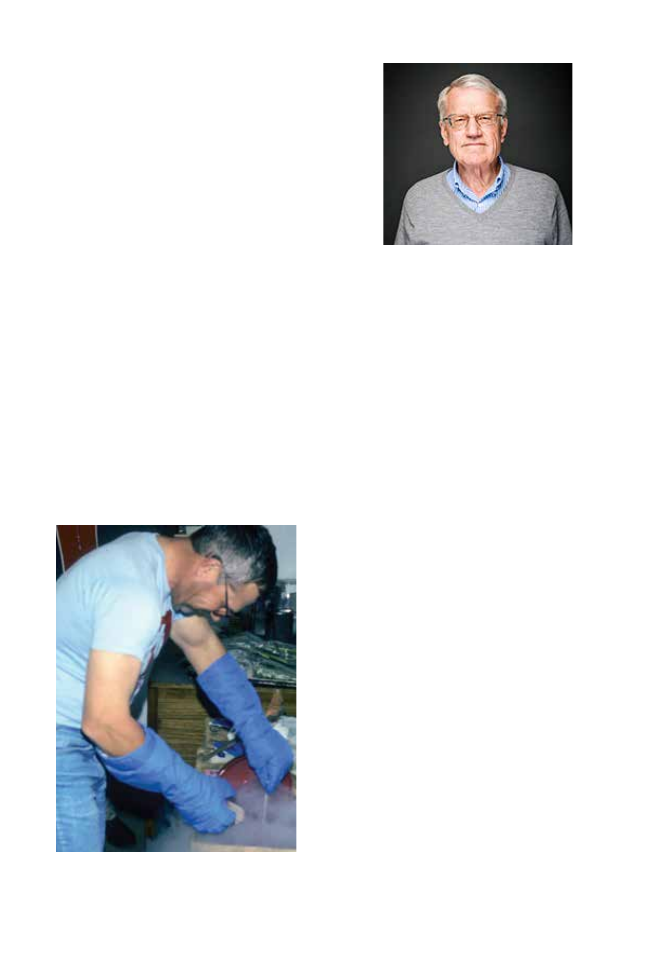
Daniel Crawford in the late 1980s from Juan
Fernandez (Robinson Crusoe) Islands, placing plant
material into liquid nitrogen for use in allozyme and
DNA studies.
Daniel Crawford, 2014, at the University of Kansas.

85
Plant Science Bulletin 60(2) 2014
Paul Mahlberg
Paul Mahlberg has been a member of the BSA
since 1951—an incredible 63 years! In that time, he
has published 37 articles between 1961 and 2004. He
recently expressed his thoughts about his work over
his career.
The first article you published in AJB was
“Embryogeny and Histogenesis in Nerium
oleander. II. Origin and Development of the
Non-articulated Laticifer” in 1961. Please take
us back to that period: what were you studying/
most interested in at the time?
I chose for my doctoral study the non-articulated
laticifer, a most unusual cell type present in a small
number of angiospermous families. I became
intrigued by this cell from previous knowledge of it
during my earlier graduate studies (Master’s degree
in Botany, University of Wisconsin) and readings
of the classical literature on this cell type. When
I entered the Botany Department, University of
California, Berkeley (1954), and discussed a thesis
topic with Professor Adriance Foster, I selected this
cell type for my dissertation. Because the Oleander
(Nerium oleander L.) and Euphorbia marginata
Pursh. were generally available in the area, I
selected them as models for my study.
Perhaps I was intrigued most by the broad
questions of how a body cell could evolve into
such an unusual form, and what physiological and/
or genetic phenomena gave rise to its intrusive
growth capability. These broad questions remain
unresolved, in part perhaps because the techniques
were not yet available to provide full answers to
them. We learned many details about its features
but, as we know, answerable questions only lead to
new questions. I certainly would like to continue
this quest especially with the new techniques only
recently available that could probe deeply into
the laticifer proteins and genes associated with it
growth and differentiation.
Your most recent article in the AJB was “A
Chemotaxonomic Analysis of Cannabinoid
Variation in Cannabis (Cannabaceae)” in 2004.
How did the thread of your research change over
time?
My broadened interests in lipopilic secretory
cells and structures placed emphasis upon secretory
glands such as those in Cannabis, also a laticifer-
bearing plant. Our gland studies would focus on
electron microscopic examination of glands during
development and chemical analyses of the contents
within the gland. The distinguishing characteristics
for such a study required an extremely abundant
number and localized density of glands to facilitate
their electron microscopic examination, and glands
of large size and great numbers to probe individual
glands as well as their concentration so as to aid
examination of their structure and contents. I also
acquired a large number of accessions, nearly 200, of
Cannabis to research as a model for gland character
and analyses of their specialized lipophilic chemical
contents. Our studies linked cannabinoid synthesis
to the gland with its accumulation in the specialized
secretory cavity rather than in cells of the gland,
and the genetically defined cannabinoid contents,
in particular, to strains of distinct geographical
origin and distribution.
In looking back at all of the articles you’ve
published in AJB, which ones stand out and why?
My very first article provided the perspective
of the long-term, perhaps elusive, goal to identify
those factors that control the differentiation of this
unique cell type. It was a consideration of many
early biologically oriented scientists as attested in
the surprisingly extensive historical literature on
this cell type. Those early students of laticifer study
were unable to define the nature of this cell type.
They were unable to place it into perspective with
other cell types as they defined them within the
plant body. And I, too, remain unsatisfied in my
quest to elucidate those subtle factors that must
define the origin and development of this cell
among all other cells of the plant body. Detection of
Paul Mahlberg from the mid-1960s, shorty after
completing his PhD, on the campus of University of
Pittsburgh.
86
Plant Science Bulletin 60(2) 2014
other cells of the plant body. Utilization of recently
developed cell and tissue probes involving protein
and gene techniques, not available during our
previous studies, may elucidate the origin and
relationship of this laticifer among other cells of the
plant body.
But I do wonder at times—how could I still be
a part of such studies of this cell type? Perhaps I
still haven’t left the laboratory. It reminds me of the
axiom; there is so much to learn, and so little time.
Why have you chosen AJB as one of the
journals in which you’ve published throughout
your career?
I chose the American Journal of Botany for many
of our publications because I consider it a leading
journal in the field of botanical sciences. It has an
international reputation for publishing manuscripts
of the highest quality. I consider myself to be a
part of the Journal. Our Journal is international
in scope and is read by botanists throughout the
world. It utilizes the highest quality materials for
preparation resulting in excellent reproduction of
illustrations provided by authors. These qualities
contribute to making our Journal one of the finest
of international science journals.
Dr. Mahlberg’s complete list of AJB publications,
which are free for viewing throughout 2014, can be
found at https://botany.org/ajb100/pmahlberg.php
the laticifer as fossil laticifer structures, dating back
perhaps 50 million years, indicate that it originated
early in the evolution of angiospermy, but is limited
in its distribution among these plants.
I remain enthused that further studies on
laticifers, particularly the non-articulated form,
will elucidate its phylogenetic relationship with
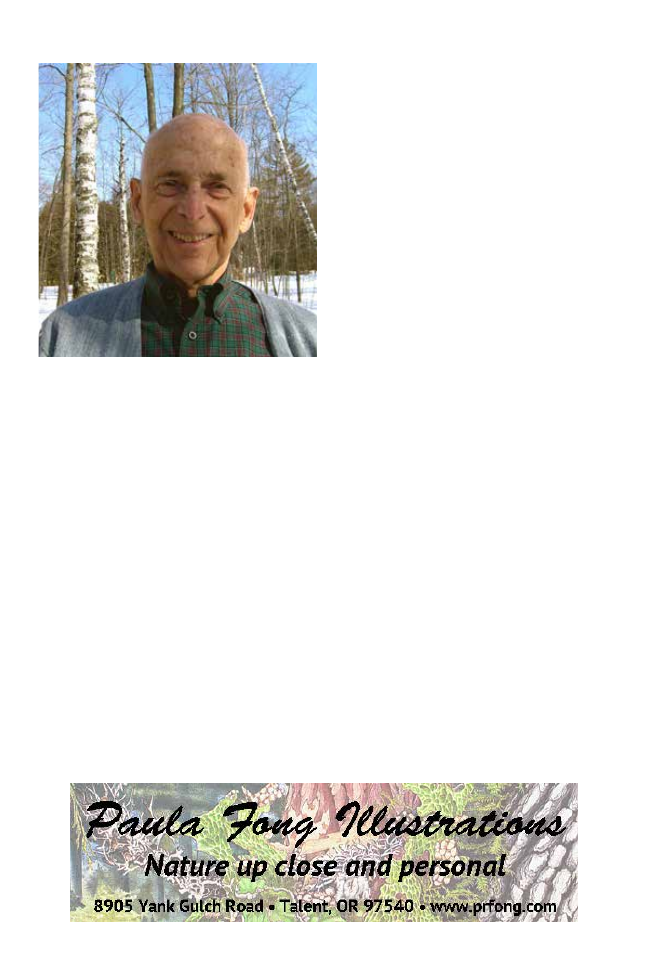
Paul Mahlberg, 2013, enjoying retirement in Door
County, WI.
87
Plant Science Bulletin 60(2) 2014
Whitney R. Reyes Student
Travel Award provides funds
for BSA Hawai‘i Student
Chapter members to attend
Botany 2014 in Boise, Idaho
Whitney Reyes was a bright young scientist
whose enthusiasm and passion for botany inspired
many. She studied a variety of plants and had field
experience in many different ecosystems in Hawai‘i,
but those who knew her know that her favorites
were ferns and fungi. Whitney graduated with a
Bachelor’s degree in Botany from the University
of Hawai‘i at Mānoa in 2012, with several years of
research experience in the field and laboratory. She
is the coauthor of two peer-reviewed publications
on the ecology and restoration of the endangered
fern ‘ihi‘ihi (Marsilea villosa), in American Journal
of Botany and Restoration Ecology. Whitney was
the recipient of a BSA PLANTS Grant in its
inaugural year (Botany 2010 in Providence, RI).
She also presented her undergraduate research
at Botany 2012 in Columbus, OH. Whitney was
the co-founder and president of the BSA Hawai‘i
Student Chapter, and in its first year (2011) she
raised thousands in grant funds to give away native
Hawaiian plants at local festivals as public outreach
and education events.
Whitney passed away unexpectedly in October
2012 and is dearly missed, but she leaves behind
a rich legacy of botanical science, conservation,
and outreach. The Botanical Society of America
was very much her extended family, so it is fitting
to honor her with a travel grant that provides
young Hawaiian botanists the opportunity to
attend Botany meetings in the future. Officers
and members of the BSA Hawai‘i Student Chapter
worked hard to raise funds for this grant, both
locally and at national meetings, beginning with
Botany 2013. Many generous donations from BSA
national members have helped to fund this grant in
Whitney’s memory.
The Hawai‘i Chapter is pleased to announce
the first winners of the Whitney R. Reyes Student
Travel Award: Monica Dittbern (Senior, Botany
Major) and Jason Cantley (PhD Candidate in
Botany). They will have domestic airfare and
accommodation expenses covered, up to $1500
total, to attend Botany 2014 in Boise, ID, where
they will gain valuable experience, knowledge, and
opportunities to network with other BSA members.
The awardees will also give a short presentation
on their Botany 2014 experience at the first
BSA Chapter meeting of fall 2014, sharing their
experience with potential future BSA members. The
Hawai‘i Chapter would like to sincerely thank the
BSA membership for their support in the success of
the Whitney R. Reyes Student Travel Award.
—Dr. Marian Chau, Chair, Whitney R. Reyes
Student Travel Award Committee
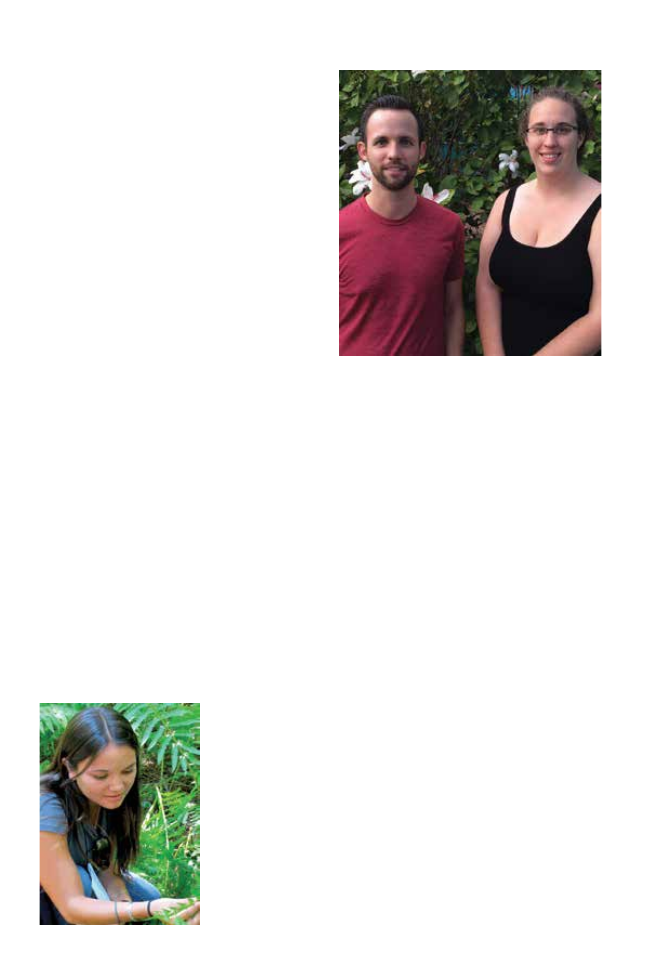
Whitney R. Reyes Student Travel Award winners:
Jason Cantley (PhD Candidate in Botany) and
Monica Dittbern (Senior, Botany Major). The
plants in the background are native Hawaiian hibis-
cus, koki’o ke’oke’o, Hibiscus arnottianus.
Photo by Marian Chau.
Whitney R. Reyes
88
BSA Science Education
News and Notes
BSA Science Education News and Notes is a quarterly update about the BSA’s education efforts and the
broader education scene. We invite you to submit news items or ideas for future features. Contact: Catrina
Adams, Acting Director of Education, at CAdams@botany.org or Marshall Sundberg, PSB Editor, at psb@
botany.org.
SOCIETY INITIATIVES AND
MEMBERS IN ACTION
USA SCIENCE AND ENGINEERING
FESTIVAL
BSA was well represented at the 2014 USA Science
and Engineering festival in Washington D.C. in
late April. The 3-day festival was enormous and
extremely well attended. Several thousand people,
including K-12 students and teachers, families, and
adults, stopped by our booth to learn about plants,
plant science careers, and PlantingScience.
Our volunteers entertained and educated an
almost constant stream of visitors, engaging them
with a choice of several activities. A “Guess the
Plant” scent-identification quiz was very popular.
(Cinnamon and coffee were the most recognized
plant scents, while rosemary stumped many!) Few
visitors were aware of plants’ use of chemicals
for defense against herbivores, and many were
surprised to learn how cinnamon bark is harvested.
Plastic fruits and vegetables were sorted hundreds
of times by visitors of all ages. Although visitors
often categorized tomatoes as fruits, bell peppers
and corn were very rarely placed in the same group.
Many visitors were shocked to learn how botanists
define fruits.
A plant evolution/phylogeny card sorting game
developed by Phil Gibson and Josh Cooper was
another popular activity used to teach very basic
plant evolution concepts. Sorting plant cards
by image, by a stylized representation of plants’
characteristics, and/or by a stylized molecular
code, visitors could experience how scientists
organize plants and construct phylogenies.
Fairhope Graphics (http://www.fairhopegraphics.
com), a neighboring booth offering a poster-sized
watercolor depiction of the phylogenetic “History
of Existing Life,” provided a serendipitous visual we
referred to often.
Chris Martine’s “Plants are Cool, Too” video
series was running on a screen for much of the
event, as well as a video series of “flashcards” for
identification of common plants of Manassas
National Battlefield Park courtesy of Greg Perrier.
We also gave some career advice and information
to students interested in botany, including a
parent of an undergraduate student considering
abandoning pre-med for a career in plant biology,
several high school students seeking college advice,
and a number of elementary-aged students who
were extremely enthusiastic about plants. The
PlantingScience program intrigued many K-12
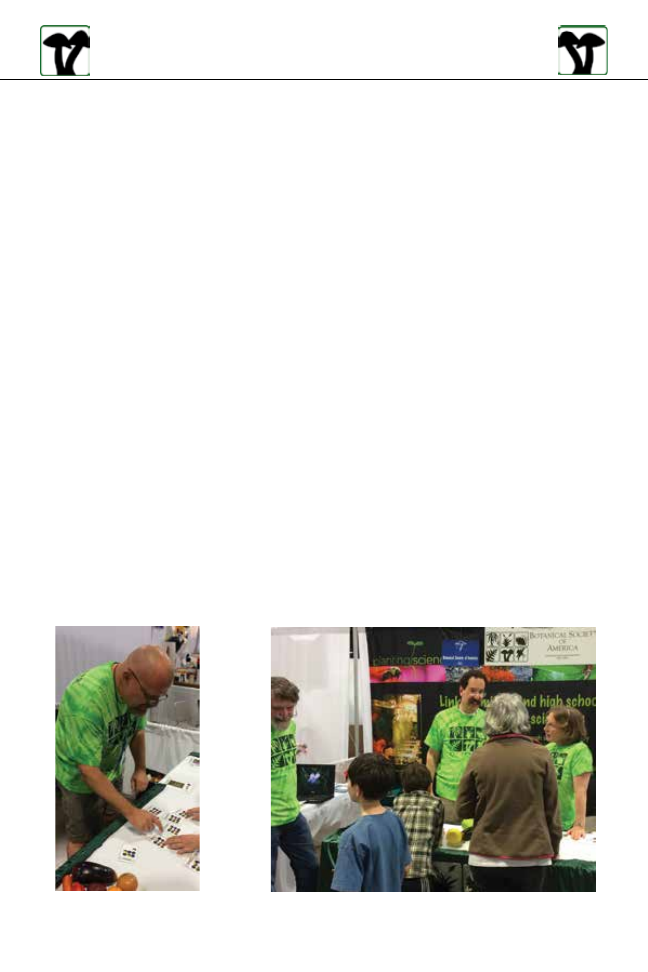
BSA members Phil Gibson, Greg Perrier, Owen Schwartz, and Linda Franklin sharing their love of plants
with thousands of visitors at the USA Science and Engineering Festival.

89
Plant Science Bulletin 60(2) 2014
teachers in attendance, and we hope to recruit some
new teachers to the program as a result of the event.
“Wow, thanks! I learned something new today!”
was a constant refrain from visitors leaving our
booth, adults and children alike.
The booth would not have been possible
without the help of volunteers Josh Cooper, Linda
Franklin, Phil Gibson, Morgan Gostel, Kristen
Hoefke, Ingrid Jordan-Thaden, Amy Litt, Greg
Perrier, and Owen Schwartz. We’d also like to thank
members of the Education Committee who helped
with early planning for the event. We learned a lot
about logistics that will help us improve our booth
and plan engaging activities for the future.
PLANTINGSCIENCE
The PlantingScience team would like to thank
the many scientists who volunteered their time to
share their excitement about plant science with
the 200+ teams participating in PlantingScience
this spring. It makes such a difference for students
to have the opportunity to work with and get to
know scientists as they design projects. Here are
some thanks students and teachers offered to their
scientist mentors:
STUDENT THANKS:
“
I would like to thank you for all of your advice
to me and my team. You were a great helper to us!
I must say, our final conclusion was satisfying in a
way that we didn’t get what we were expecting and
learned something new about the growth of spores.
I had a great time working on the lab and your
advice was always useful. Thank you VERY much
for everything.”-greenhorse (The Herbivores)
“To wrap up the project, I would like to say how
happy I am to have this experience and participate
in such a cool project. I never would have fathomed
I would communicate with you and the students in
the Netherlands. Thank you for all your help and
advice throughout our experiments! The whole
project was really fascinating and I would like
to do more things like it. Thanks again!”-Gabby
(The Wolf Pack)
TEACHER THANKS:
“The kids have really enjoyed working with
the scientists this year—some actually checked
their page on a daily basis to see if their scientist
communicated with them. For several students
this experience was a total transformation—one
of my kids who was reluctant to complete anything
has been communicating with his scientist and
researching what his scientist works on so he can
ask his scientist. He also is a perfect, tuned in,
interested student. His grades are up all around
and he will be in my AP Environmental next year. I
love Planting Science!” -Ms. Lauer
“Hi Mentors! I wanted to thank all of you for
working with my kids! I have two very diverse
groups, but they’ve all enjoyed their time working
on this project...It has been a great learning
experience for the kids and for me, as well! Who
knows, perhaps you have inspired some future
plant scientists!” -Mrs. Buzzell
“Thanks to all the Mentors, Liaisons, and the PS
Team for everything you are doing to make science
class come to life for my students! My colleagues
have told me that they’ve been hearing students
talk enthusiastically about their projects in the
halls or in other classes! If they’re talking science
when they don’t even have to be, that must mean
the PlantingScience program is making a definite
impact! :)”-Ms. Schraeder
Student teams developed many excellent and
ambitious projects this spring. Many teams have
produced videos to present their project results
this session. This spring’s star project winners are
featured on the homepage of www.plantingscience.
org, so please stop by to see what the students have
been up to.
Mr. de Graaf has put together a video of
highlights from this spring’s Netherlands/Florida
class videoconference, viewable on YouTube:
http://youtu.be/e-gvWHNj4Es
Inquiring About Plants
e-book now on sale
The e-book Inquiring About Plants: A Practical
Guide to Engaging Science Practices by Gordon Uno,
Marshall Sundberg, and Claire Hemingway is now
available. All proceeds from the sale of the $9.99
e-book will benefit the PlantingScience program.
http://www.amazon.com/Inquiring-About-Plants-
Practical-Practices-ebook/dp/B00KI2GVD0/
90
Plant Science Bulletin 60(2) 2014
DON’T MISS BOTANY 2014: NEW
FRONTIERS IN BOTANY
An exciting number of education, outreach, and
training offerings for you to consider:
Sunday
•
Workshops on genomics, the PlantED
digital library, visual learning, developing
a hands-on distance education botany
lab course, incorporating the plant fossil
record into your botany course, software for
teaching plant ID, preparing digital images
for publication, and more.
•
Professional Development workshops for
students: Graduate School: how to apply
and what to expect; Crafting an effective
elevator speech and communicating
broader impacts of your work; networking
workshop for students and postdocs.
•
Firewise! Botany-in-Action Service Project
Tuesday
•
Vision & Change in Undergraduate Botany
Education, organized by J. Phil Gibson
Also, don’t miss the Teaching Section presentations
and posters, and the PlantingScience mixer. Check
the website for schedule updates. http://www.2014.
botanyconference.org
CHARLES E. BESSEY AWARD
Our congratulations to Bruce Kirchoff,
University of North Carolina, Greensboro, who is
the 2014 recipient of the Charles E. Bessey Award.
Please see the separate announcement on page 72.
UPCOMING OPPORTUNITIES
TO ENHANCE TEACHING AND
LEARNING
Attend the Society for the Advancement of
Biology Education Research (SABER)2014 National
Meeting, July 17-20 at the University of Minnesota,
Twin Cities, MN. Learn more at http://saber-
biologyeducationresearch.wikispaces.com/
National+Meeting+2014.
Make plans to attend the 2nd Life Discovery –
Doing Science Education Conference, October 3-4 at
San Jose State University in San Jose, CA. The theme
for this year’s conference is “Realizing Vision and
Change, Preparing for Next Generation Biology.”
Learn more about this upcoming conference at
http://www.esa.org/ldc/.
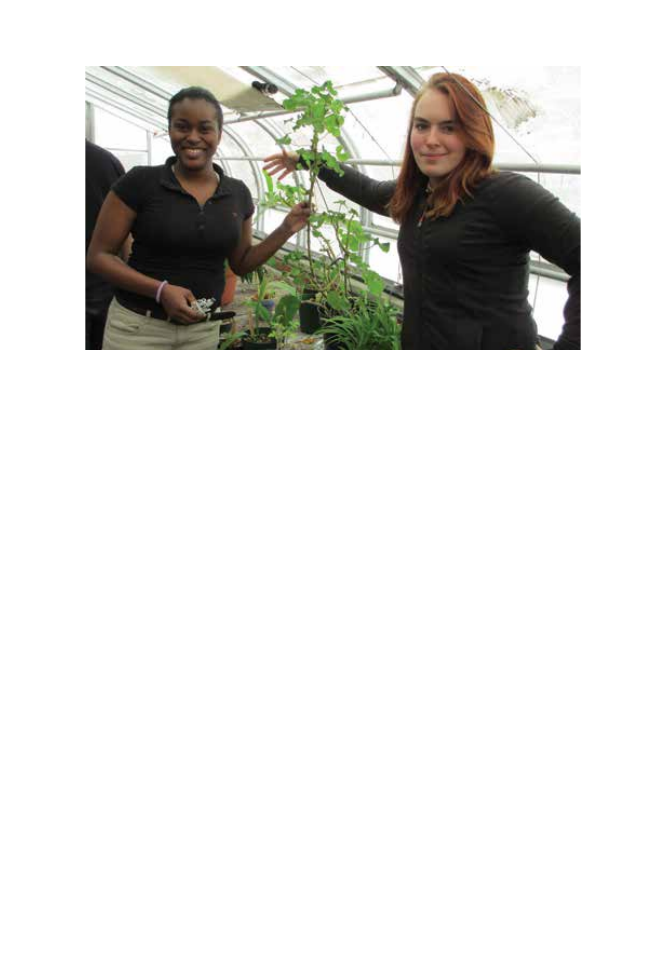
Team H2OMuchForYou from Springfield Central High School, one of 10 Star Project winning
teams of the Spring 2014 PlantingScience session.

91
Plant Science Bulletin 60(2) 2014
Mackenzie Taylor Named New Editor for
Plant Science Bulletin
Dr. Mackenzie Taylor (Creighton University) has agreed to assume the
editorship of the Plant Science Bulletin beginning in January 2015 with
Volume 61. Mackenzie has a strong connection to the Society, having
served on the Esau awards committee, the BSA investment committee,
the BSA strategic planning committee, and the AJB editor-in-chief search
committee. She also served as the first student representative to the BSA
executive committee.
Mackenzie is an excellent young researcher (PhD in 2011) with nine
published journal articles, including co-author of an AJB Centennial Review
article in the April American Journal of Botany, a book chapter and several education and outreach publications.
Dr. Taylor indicated that as a student she read every issue of Plant Science Bulletin “from cover to cover”
and continues to value it as a source of information about the Society and a resource for teaching. Her
vision for the future of the Bulletin is both as a vehicle for maintaining connections across different fields
of botany, including education and outreach, and as an access point for people outside the society. She
foresees strategies for expanding the reach of the PSB through social media, and the possible addition of
student- or postdoc-driven sections of the Bulletin while continuing to make sure that the Bulletin speaks
broadly for the society in terms of teaching, outreach, and research.
Pam Diggle named new Editor-in-Chief of
American Journal of Botany
The American Journal of Botany is pleased to announce that Pamela
Diggle (University of Connecticut) will serve as the new Editor-in-Chief for
the journal beginning in January 2015.
Pam is a plant evolutionary biologist who just recently (2014) became the
Associate Head of the Department of Ecology and Evolutionary Biology at
the University of Connecticut having come from the Department of Ecology
and Evolutionary Biology at the University of Colorado (1997-2013), and
being a Visiting Professor in the Department of Organismic and Evolutionary
Biology at Harvard University (2011-2013). Pam has an outstanding service
record for the Botanical Society of America. Her association with the society
began when she was a graduate student – in 1987 she won the Katherine
Esau Award, and she has since served the society in many capacities, from
being a member for a variety of committees to assuming leadership roles such as Chair of the Development and
Structure Section (2002-2004), Council Representative (2003-2007), Society Secretary (2009-2011) and, most
recently and most notably, as President of the Society (2013-2014).
Pam has had a very active research career for the past three decades, and she continues to pursue a wide array of
interests in plant biology. While focusing on plant development and evolution, Pam’s research touches on a broad
span of disciplines, from morphology, development, ecology, evolution, genetics, and floral development, as well
as a number of different plant species.
Her publications have been in high-profile, broad-based, and high-quality journals, such as Proceedings of the
National Academy of Sciences and New Phytologist, and of course the American Journal of Botany. In fact, as an
active researcher and prodigious author of 49 scientific papers, Pam has published 19 articles in the American
Journal of Botany since 1983 and her BSA presidential address from the 2013 Botany Meeting in New Orleans was
published in the Plant Science Bulletin (issue 59: 150-157).
Pam clearly understands the value of high quality research and will bring both the perspective of an author as
well as the experience as an editor to the table in the publication process. She has collaborated with many students,
post-docs, and colleagues in her research and publications and has served as editor for the Annals of Botany and
International Journal of Plant Sciences, making her an excellent fit to serve as Editor-in-Chief for the American
Journal of Botany.
Meet the new Editors!

92
Plant Science Bulletin 60(2) 2014
Up Close with Theresa
Culley: The Latest on the BSA’s
Newest Journal,
Applications
in Plant Sciences
The PSB’s Chris Martine catches up with Theresa
Culley, editor-in-chief of Applications in Plant
Sciences, to talk about the journal’s first year and a
half of publication and to find out what’s coming up.
CM: If most BSA members are like me, they’ve
heard a lot of buzz about APPS, but are not
100% certain how to define what it is. Can you
summarize what the mission of the journal is?
And explain why the BSA made the move to start
a new journal like it?
TC: I am really excited by APPS because it is a
great opportunity for plant scientists to share their
technological discoveries. The mission of APPS
is to disseminate newly developed, innovative
tools and protocols in the plant sciences—this
includes genetics as well as all other areas (such as
ecology and morphology), and also encompasses
the breadth of botany, from angiosperms and
gymnosperms to ferns, mosses, lichens, fungi, and
algae. As such, we are more inclusive than other
technique journals that focus on only a single
area of the plant sciences. The journal is also open
access, so that it is accessible without a subscription
to readers worldwide. I believe that this broader
coverage and accessibility makes APPS of interest
to many plant biologists, while still providing in-
depth detail within individual articles.
Why did the BSA start APPS? Although the
journal was officially launched in 2013, the idea
for it first came about years earlier when the BSA
Strategic Planning Committee recognized the need
for a new publishing outlet for innovative tools and
techniques. At that time, it was becoming difficult
to publish primer notes because of new restrictions
imposed by some journals. For example,
monomorphic primers were often excluded and
at least one journal began grouping primer notes
into summary articles instead of individual papers
(so authors had to transfer first authorship to a
journal consortium). Concerned about how this
might impact research and scientists, Pam Soltis,
Kent Holsinger, and I developed the basic concept
of a new publishing alternative during a cab ride to
the airport after the Strategic Planning meeting. It
first appeared in 2009 as an online-only section of
the American Journal of Botany, called Primer Notes
and Protocols in the Plant Sciences. It immediately
drew in a number of submissions, but over time we
realized the potential for the online section to be
much more than a repository for genetic markers.
In 2012, the BSA made the decision to spin off the
online section as APPS in part so that papers could
address all areas of the plant sciences. Although we
continue to welcome molecular biology and genetic
submissions and we still accept primer notes, we
have also purposely expanded into other areas of
the plant sciences. So if you have a new technique
that you would like to share, please let us know!
CM: You’ve been APPS’s editor-in-chief since
its first issue in January 2013. What excites you
both as an editor and as a reader of APPS?
TC: As an editor, it is incredibly exciting to see
the many different techniques, protocols, and ideas
that other researchers have developed and wish to
share with others. I am also amazed by the sense
of community that many authors have in wishing
to publish their work to assist others. On at least
one occasion, I heard a researcher mention that he
wanted to help others not make the same mistakes
he did. To me, this is the very essence of what APPS
is all about—to facilitate communication among
plant biologists in moving our respective fields
forward. I also greatly enjoy working with such a
wonderful group of Associate Editors, Reviewing
Editors, and of course, our excellent support staff,
including our Managing Editor, Beth Parada.

93
Plant Science Bulletin 60(2) 2014
As a reader of APPS, I am constantly looking for
new techniques and applications that I can use in
my own work, whether it be in genetics, pollination
biology, or ecophysiology. One of the best features
of APPS is that it is not specific to one field of plant
biology, but instead covers everything! In addition,
articles in APPS are especially bench- or field-
friendly. For example, protocol articles have step-
by-step, “tear-out”-ready instructions (including a
list of materials) that can be used immediately by
the reader, and in several cases, videos illustrate
difficult-to-describe techniques (just a click away).
CM: What kind of readership and distribution
is APPS currently receiving (i.e., number of
hits, and areas of the world where APPS is being
highly read)?
TC: As an online-only publication freely available
on BioOne, APPS has a worldwide distribution. For
example, APPS received 38,078 online hits during
2013, and in January 2014, received nearly 13,000
hits that month alone. During 2013, nearly half of
access to the full-text of articles came from within
the United States, followed by China, Canada,
Brazil, India, Japan, Germany, the United Kingdom,
and Australia; hits were also recorded from 111
other countries!
CM: Where is APPS currently indexed?
TC: In addition to being available through the
BioOne website, APPS is currently indexed in CAB
Abstracts, AGRICOLA, CrossRef, Google Scholar,
the Directory of Open Access Journals, and
WorldCat. I am pleased to report that the journal
was recently accepted for inclusion in PubMed
Central, where full-text articles will soon appear,
and abstracts will be available in PubMed itself by
June. We are also being evaluated for indexing by
the Science Citation Index/Web of Science (owned
by Thomson Reuters, which also provides journal
impact factors). The timeframe for selection in
SCI is longer than for most indexing services as
they take time to assess factors like timeliness of
publication, stature of authors publishing with
the journal, and the overall contribution that the
journal is making within the scientific community.
We are in regular contact with Thomson Reuters
and hope to have news this summer.
CM: What is the process of submission and
how likely is it that a paper may be accepted?
TC: It is relatively easy to submit a manuscript to
APPS, as described in the Instructions for Authors
[available at: http://botany.org/APPS/
APPS_Author_Instructions.html]. Manuscripts are
submitted online at our site on Editorial Manager
[http://www.editorialmanager.com/apps/] and
are assigned to an Associate Editor, who invites at
least two outside reviewers. In the case of Primer
Notes, a member of the APPS Reviewing Editor
Board is also involved with manuscript review.
Manuscripts are accepted following a positive
review and after authors have suitably addressed
all comments. Currently, our average time from
submission to first decision is four weeks, although
specially invited manuscripts are placed on a fast
track. Manuscripts move into the production stage
soon after acceptance and are available online at
BioOne after the galley proof is approved. Our
current acceptance rate of manuscripts is about
81%; we prescreen papers carefully, and have
clear instructions for authors, which helps authors
prepare acceptable papers.
CM: What articles stand out to you from the
first 18 issues of APPS? (As part of this, what do
you think makes a good APPS submission?)
TC: This is not easy to answer, as we have
published a number of really interesting papers
in our first year and a half of publication. But if I
had to pick, I enjoyed Gee’s article on microCT and
3D visualization of fossilized conifer seed cones
[Vol. 1, Issue 11]. This paper involves multiple
elements of what I consider a good article—it
addresses a concrete problem in plant biology (how
to look inside silicified conifer seed cones without
damaging them) and presents a reasonable and
well-written solution, complete with sample data
and accompanying videos. One of my other favorite
articles also appears to be popular with others—the
article from our second issue by Stull et al. [2013], “A
targeted enrichment strategy for massively parallel
sequencing of angiosperm plastid genomes,” is our
most frequently downloaded paper with nearly
3,400 hits. I also find it interesting that several of
our top 15 most-accessed articles include non-
genetic papers, such as using high-resolution time-
lapse photography for ecosystem research [Nichols
et al., 2013; Vol. 1, Issue 9], how to better measure
and quantify color variation [Smith, 2014; Vol. 2,
Issue 3], and using dendrometer bands to measure
growth in trees [Anemaet & Middleton, 2013; Vol.
1, Issue 9].
CM: What can readers look forward to in
upcoming issues?
TC: One of the perks of my job is that I know
what will be appearing shortly and I am especially

94
Plant Science Bulletin 60(2) 2014
many different journals and I can see where it can
be difficult to tell the respectable, peer-reviewed
journals apart from predatory journals with a
questionable track record. So I consider it essential
that we continue to spread the word that APPS is
a forward-thinking, peer-reviewed, online journal
with a solid publication record, backed by the BSA.
CM: What kinds of submissions are you
looking for at this point, and how do you see APPS
evolving over the next few years? (The perception
of some is that APPS is only for molecular-based
techniques. Is this the case?)
TC: Although APPS originally focused on
molecular and genetic techniques, it has now
become so much more, and I see the journal
continuing to grow and encompass all areas of
the plant sciences, while still serving as a home
for molecular-based methods. Personally, I would
really like to see more review papers that address
topics of interest to other plant biologists and
that will serve as an entry point for researchers
just starting in the field. For example, a review
paper focusing on methods to measure plant
volatiles could potentially be a valuable resource
for pollination ecologists wishing to quantify floral
scents, chemical ecologists examining responses
to plant damage, and even bioprospectors seeking
new medicinal sources. We are actively soliciting
ideas from the community on review papers or
methods focusing on areas where they see a gap in
current scholarship. My vision for APPS is that it
would become a valued resource as scientists seek
new approaches and techniques to advance their
own research programs or break into a new area of
botany that they otherwise might have avoided.
CM: What makes APPS different from other
journals? As an author, why should one choose
APPS as a landing spot over other places for a
methods paper?
TC: Compared to other journals, APPS has a
much broader scope across all fields of the plant
sciences, its articles are easily accessible because
of Open Access, and APPS receives strong support
as a publication of the BSA. Authors also benefit
because APPS uses Creative Commons licensing,
meaning that authors retain the copyright to the
article. Another benefit to authors is that certain
articles can be highlighted with a press release,
which we distribute through EurekAlert!, the BSA
Facebook page, and Twitter feed, among other
avenues. In addition, we also provide an opportunity
for advanced graduate students and post-docs to
enthusiastic about the next few issues. Currently we
are putting together our very first Special Issue that
will be focused on Bioinformatic and Biometric
Methods in Plant Morphology, representing a
colloquium at Botany 2013 organized by Surangi
Punyasena and Selena Smith. This issue is slated
to appear later this summer. I am also excited by
a protocol article appearing in the June issue on
3D plant cell architecture using a specialized SEM
method, and a review article for July on sequence-
related amplified polymorphism (SRAP) markers.
We also have received many promising responses
to our recent Call for Papers. So upcoming issues
will certainly be interesting and will include more
protocols, application articles, and review papers.
CM: What are the challenges of publishing an
online-only, open access journal like APPS? And
how about the benefits? Is there something about
the type of journal that APPS is that makes it
more appropriate as an e-journal?
TC: Yes, publishing as an online-only journal
certainly has benefits and disadvantages. One benefit
is that our online-only status allows us to publish
articles quickly and to quickly respond to the needs
of our authors. We also have a greater flexibility
in incorporating multimedia content which can
greatly enhance the reader’s experience. We can
also more fully track reader access to individual
articles relative to all other articles in a volume;
this can be helpful for authors needing to show
their administrators the importance of their papers
within the scientific community. For example, some
APPS articles now have Altmetric scores (think of
an impact factor, of sorts, for an article rather than
a journal). [For more about Altmetrics, see the
sidebar.] Our open access status is critical because it
enables researchers from all over the world to easily
download APPS articles with the click of a button,
without having to pay fees. This means that APPS
articles have a potentially wider readership than
articles at subscription-based journals. Members
of the BSA also receive a substantial discount on
the open access fee, so it ends up being a very good
deal all around. Ultimately, I would like APPS to be
a resource that researchers can easily access on a
mobile device at the bench or in the field to follow
step-by-step techniques; being both online and
open access fits perfectly with this vision.
The main challenge of being an online-only
journal is the need to stand out from the ever-
increasing number of online-only journals today.
As an author, I am flooded daily with emails from

95
Plant Science Bulletin 60(2) 2014
receive training in the editorial process as Reviewing Editors, who are mentored by Associate Editors. This
experience enables Reviewing Editors to better understand the inner workings of the publishing process
so they can become better authors themselves. So, I strongly recommend APPS as the best landing spot
for those authors with great ideas who are looking for a relatively fast publication outlet and who wish to
publish in an innovative, responsive journal that has a broad international readership, along with strong
author support. At APPS, we are always interested in hearing new ideas, so please contact us with your
suggestions for future publications—we are listening!
A Crash Course in Article-Level Metrics and Altmetrics
Traditionally, impact of scholarly research has been measured at the journal level (i.e., impact factor)
by tracking citations of articles published in a particular journal. However, as online publication of
research has become the norm, it’s become possible (and desirable) to track the impact of individual
articles separate from the journal of publication. Thus, article-level metrics (ALM) were born. ALMs
incorporate citations, but also track usage stats (article views and downloads) and mentions in
contemporary data sources like news coverage, blog posts, tweets, and Facebook likes.
Altmetrics differ from ALMs in that they do not track article citations; instead, they measure article-
level impact through those newer data sources: social media (Twitter, Facebook, Pinterest, etc.), blogs,
social bookmarking (e.g., Mendeley, CiteULike), online comments in scientific publications, and
inclusion in mainstream media (including both English and non-English newspapers and magazines).
Altmetric scores are provided for APPS articles through Altmetric.com. These appear as a “badge”
in the abstract and full-text view on the right-hand side of the article text (see Figure). Clicking on the
badge brings up details of where the article has been mentioned.
If you’re interested in delving deeper into article-level metrics, see the primer from the Scholarly
Publishing and Academic Resources Coalition (SPARC) at: http://www.sparc.arl.org/sites/default/
files/sparc-alm-primer.pdf
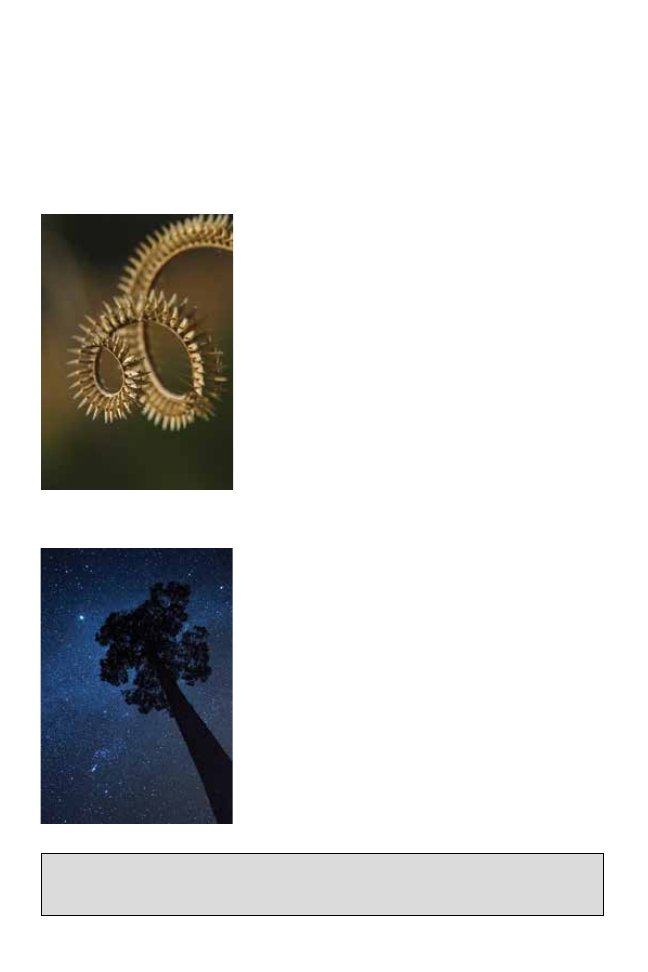
1st Place,
Graceful aging
Daniel McNair
University of Southern Mississippi
2nd Place
Longleaf pine in the DeSoto National
Forest
Daniel McNair
University of Southern Mississippi
Triarch "Botanical Images"
Student Travel Awards
Established by Dr. Paul Conant, and supported by TRIARCH Incorporated, this award provides
acknowledgement and travel support to BSA meetings for outstanding student work coupling digital
images (botanical) with scientific explanations/descriptions designed for the general public.
Toothache grass, named for the numbing effect of the
isobutylamides it contains, is endemic to the Coastal Plain of the
southeastern United States where it grows in wet pine savannas. Like
many other plants within the longleaf pine ecosystem, toothache
grass usually flowers in response to fire. Young inflorescences
appear relatively straight but begin to curl as they age and drop
their seeds.
This photograph was taken in the DeSoto National Forest in
Mississippi, one of the few remaining tracks of intact longleaf pine
savanna. Within a one mile radius of this particular location, the
candling of Red-cockaded Woodpeckers can be seen on 100-year-
old pines, gopher tortoise burrows litter the tops of sandy hills, and
pitcher plant bogs thrive in response to controlled fires (naturally
occurring fires rarely reach the now fragmented savannas). Less
than 3% of longleaf pine ecosystems remain intact.
The remains of a toothache grass
inflorescence
See all the 2014 entries at
botany.org/PlantImages/ConantSTA2014.php
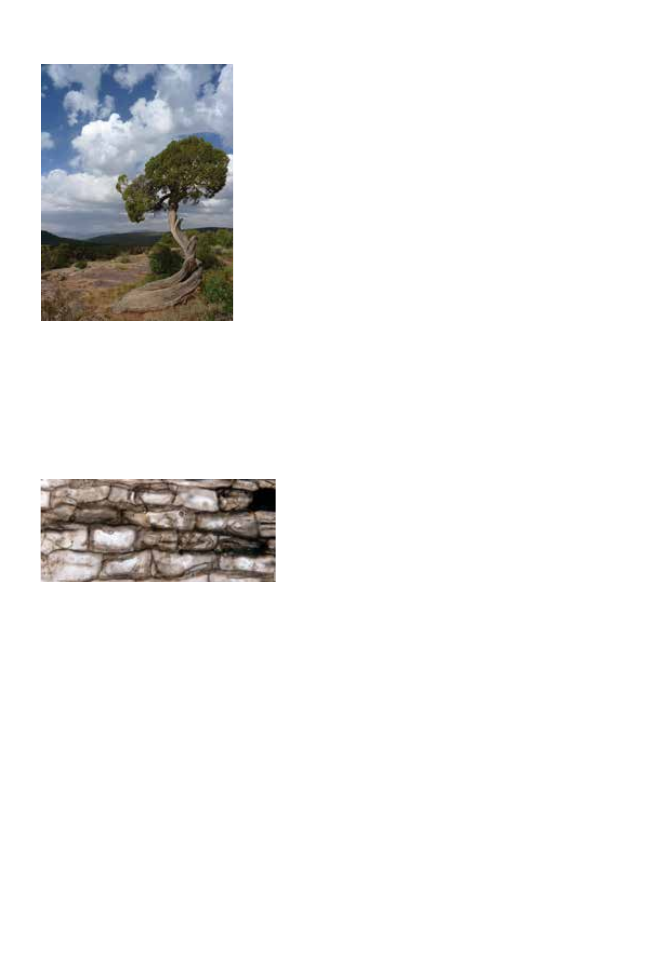
97
Plant Science Bulletin 60(2) 2014
3rd Place Abby Glauser
University of Kansas
Resilience
3rd Place
Carla Harper
University of Kansas
Native to the southwestern United States, Juniperus osteosperma,
the Utah Juniper, has evolved several strategies to endure the harsh
conditions of desert ecosystems. This particular Utah Juniper was
found nestled near the canyon rim in Black Canyon of the Gunnison
National Park, where it must periodically withstand extreme heat,
drought, and intense winds. First in its line of defense against arid
conditions is the growth of a taproot. Extending up to 25 feet in
depth, this large root grows vertically downward into the earth in
search of moisture. The taproot also provides stability for the tree.
In fact, even when toppled by wind or storms the Utah Juniper may continue to grow. Additional roots
may extend laterally up to 100 feet away from their source to scavenge for limited resources, which allow
these trees to be very competitive and often more successful than neighboring vegetation. The beautifully
twisting trunk and branches of the Utah Juniper are the result of a drought resistance strategy, as well. The
tree is capable of self-pruning, sacrificing entire limbs to conserve resources and instead allocate them to
survival. Blocking the flow of nutrients to specific areas stops growth and kills the tissue, resulting in the
aesthetically captivating morphology for which this desert species is commonly recognized.
Mycorrhizal (mycos = fungus, rhiza = root) associations are a type of mutualistic symbiotic relationship
between a fungus and a plant. Each partner benefits from this exchange, i.e., the plant receives nutrients from the
fungus, and the fungus receives carbon from the plant. This plant-fungal relationship occurs in ~80-90% of plant
families living today. This ancient relationship has been found in ~400-million-year-old plants. It has also been
hypothesized that mycorrhizae were essential to the establishment of early plants on land, and were as crucial in
paleoecosystems as they are today. As the field and study of fossil fungi advances, we are becoming increasingly
aware that fossil mycorrhizae are associated with many ancient plants. Permian (~260-million-year-old) Antarctic
fossils provide exceptional examples of anatomically preserved plants. Included within these ancient groups are
the Glossopterids. Glossopteris is a type of extinct plant called a seed-fern, a plant that had fern-like leaves, but
produced seeds (ferns today only produce spores) that lived during the Permian. It was also an important fossil
used as evidence for the theory of continental drift. This image represents the first mycorrhizal association with
seed ferns, specifically Glossopteris. The picture is a longitudinal section of a young Glossopteris rootlet with
coiling mycorrhizal fungal hyphae within and penetrating through root cells. The image is a composite of 50+
microscope images, digitally stitched together using Adobe Photoshop. Today, mycorrhizae are classified into two
principle morphologies: Arum-type and Paris-type. Due to the coiling nature of the fungus, this mycorrhiza is a
Paris-type and is the oldest in the fossil record. This important discovery provides insight into the evolution and
microbial interactions of the Glossopterids and seed ferns during the Permian of Antarctica.
260 million year old (Permian) vesicular
arbuscular Paris-type mycorrhizal fungi
in the seed fern Glossopteris, from
Antarctica
The Utah Juniper twisting upward from the
desert soil

98
Plant Science Bulletin 60(2) 2014
Missouri Botanical
Garden Herbarium Collection
Reaches 6.5 Million Specimens
Garden researcher’s newly
described genus is latest specimen
(ST. LOUIS) The Missouri Botanical Garden’s
Herbarium collection reached 6.5 million
specimens with the addition of a new genus
described by Garden curator Dr. Carmen Ulloa
in collaboration with Dr. Fabián Michelangeli and
Karla Sosa of The New York Botanical Garden.
Their discovery, “Quipuanthus, a New Genus of
Melastomataceae from the foothills of the Andes
in Ecuador and Peru” was recently published in the
scientific journal Systematic Botany.
In November 2012, Ulloa and her colleagues
were examining melastome specimens in the
herbarium when they discovered some specimens
with peculiar inflorescences from a rosette-like
plant that did not match any currently known name
species in the plant family. The collections, some
gathered more than three decades ago, had been
moved from one genus to another without a suitable
match. The researchers discovered the flowers had
a single series of stamens, a rare characteristic in
the melastome family that usually has stamens
in double the number of petals. Additional
morphological studies, along with anatomical and
molecular research, led the authors to describe this
new genus with only one known species named
Quipuanthus epipetricus Michelangeli & C.Ulloa.
“The Garden’s herbarium is one of the largest
and fastest growing in the world and an essential
foundation for botanical research,” said Dr. James
Solomon, herbarium curator. “The herbarium
allows researchers from all over the world to
compare dried plant specimens that grow in
different regions side by side resulting in exciting
discoveries such as this one.”
The authors chose a combination of the Quecha
word quipu (meaning record-keeping cords) and
the Greek word anthos (flower) to formally name
their discovery. Quipu were long-knotted strings
of fiber used by pre-colonial Andean societies to
encode information. The species name epipetricus
refers to the fact that all collections of this herb have
been found growing on rocks.
“The overall appearance of the flowers and fruits
arranged like knots on strings and the unique
combination of characters in this genus reminded
us of this enigmatic record system used by Andean
societies long before the arrival of the Spanish
writing system,” said Ulloa.
Only two populations of the species are known
and both are located on the foothills of the
Eastern Andes Mountains: one in Ecuador and
one in northern Peru. It has been recognized as
Endangered according to the conservation status
by the International Union for Conservation
of Nature. The collection commemorating this
herbarium milestone that lead to this discovery
was collected in Peru in 1996 during a Missouri
Botanical Garden–sponsored expedition.
The Missouri Botanical Garden is one of the
three largest plant science programs in the world.
The Garden focuses its work on areas that are rich in
biodiversity yet threatened by habitat destruction,
and operates the world’s most active research and
training programs in tropical botany. Garden
scientists collaborate with local institutions, schools
and indigenous peoples to understand plants, create
awareness, offer alternatives and craft conservation
strategies. The Missouri Botanical Garden is striving
for a world that can sustain us without sacrificing
prosperity for future generations, a world where
people share a commitment to managing biological
diversity for the common benefit. Learn more at
www.mobot.org.

99
Putting PhDs to work: Career planning for today’s scientist.
Hobin, Jennifer A., Philip S. Clifford, Ben M. Dunn, Susan Rich and Louis B. Justement. 2014.
CBE-Life Sciences Education 13:49-53.I
Individual development plan (IDP)? What is this? As a mentor of graduate students, I should know—
but I didn’t. Graduate students and post-docs should know—but most don’t. We all acknowledge
that it’s not like the old days where we, the professors, were basically concerned only with training our
replacements for academic positions. What other options are available? That’s where the IDP comes into
play. According to this paper, fewer than 50% of post-docs and only 20% of mentors are even aware of
IDPs, but for those who reported creating an IDP, the process helped to identify skills and abilities that
could match young scientists to a variety of careers outside of traditional academe. Although not a “nuts
and bolts” outline of how to create an IDP, the paper does provide a number of recommendations for post-
docs/graduate students and mentors to begin the process, as well as the necessary references to proceed.
Development of a meiosis concept inventory.
Kalas, Pamela, Angie O’Neill, Carol Pollock, and Gülnur Birol. 2013. CBE-Life Sciences Educa-
tion 12: 655-664.
Meiosis: we teach it in every introductory class from high school through college and review it in many
upper division and graduate courses. Yet, how many graduate students could actually diagram the salient
features of this nuclear division on a prelim exam? In my experience, about 50% provide an adequate
response. In this paper the authors identify six basic underlying concepts responsible for the difficulty
students have in understanding the process. The instrument they developed is an excellent formative
tool to identify specific problems confronting your students and thus make it easier for you to target
remediation or refine your teaching approaches.
Editor’s Choice Review

100
Geocaching as a means to teach
botany to the public
Dirk Albach
Botanical Garden
Carl von Ossietzky-Universität Oldenburg
Philosophenweg 39-41
D-26121 Oldenburg, Germany
DOI: 10.3732/psb.1400001
Submitted 27 January 2014.
Accepted 7 April 2014.
Acknowledgments: The author thanks Simone
Heinke for establishing the geocaches at the
Botanical Garden Oldenburg.
Do you find it difficult to get your students to
go to the library? Or to get them excited about
studying course material about botany when they
think everything they need to know is in their
smartphones? Isn´t it even more challenging to get
the general public to use botany books in the library
and raise interest in botany? Yes, but now ways to
include smartphones and GPS devices in education
suddenly make plants cool to study and attractive
for a broader audience. There are many applications
and worldwide initiatives that use smartphones
and GPS devices to teach students in elementary
schools (Huang, Lin, and Cheng, 2010), high
schools (March, 2012) and universities (Santos,
Hernández-Leo, and Blat, in press) about plants.
One aspect all those initiatives have in common
is that they are established in regular courses, and
students have the incentive to get a good grade at
the end. But smartphones and GPS devices may
also hold promise for educating the general public.
What is their incentive? For many people searching
for and finding a treasure outside is incentive
enough. And they are willing to go some distance
literally and intellectually for the most prized ones
in a relatively new activity called geocaching.
Geocaching has become a favorite outdoor
activity of more than 6 million people around the
world (www.geocaching.com) since its invention by
American Dave Ulmer in the forests near Portland,
Oregon in May 2000 (http://geocaching.gpsgames.
org). It is a modern type of treasure hunting in
which participants search for more than 2 million
Reports
containers of various kinds, called “caches.”
Geocaching requires a GPS-enabled device and
internet access to acquire the information (GPS
coordinates) about the cache’s location. Several
internet sites provide such cache information, with
www.geocaching.com being by far the largest. On
the site, you search for a cache in the area you would
like to go and note the coordinates and all other
information given. Then you go out in the field and
navigate to the coordinates. The location of a cache
can be in a crowded place or in a very isolated spot.
Finding the cache at the coordinates may still be a
considerable task since they are hidden from sight
for the normal public strolling by.
Caches can be as small as a few milliliters and as
large as 20 liters. They can be nondescript capsule
or small artworks. Once you have found the cache,
you sign in the log book within the cache. They
usually contain also some kind of treasure, usually
small toys, which may be exchanged but not taken
away without replacement, so that others can enjoy
the feeling of finding a hidden treasure. Once you
have found a cache, you may log it at the respective
internet site and record your finding as well as
provide information on how you liked the cache
and how difficult it was to find it. Traditional caches
are simple containers directly at the coordinates
given, but there are also more complex and more
creative ways of hiding the caches.
Whole books have been written about
geocaching, its technology (Sherman, 2004)
and its application in education (Lo, 2010).
Geocaching has been recognized as a good method
for accidental, informal learning (Clough, 2010)
for a group of people who may be interested not
only in experiencing nature, but also in learning
about it (Schneider, Silverberg, and Chavez, 2011).
Therefore, many national parks, nature reserves,
and archaeological parks have installed geocaches
as a new way to transmit knowledge about their
sites. I would argue that geocaching also offers
opportunities for small botanical gardens and
botany institutions. Here, I explain what we have
established at the Botanischer Garten Oldenburg
and comment on our experiences.
Several different types of caches could be used
in a botanical garden to get more people from
the general public to come to the garden and
learn about plants. Traditional caches, with their
coordinates given on geocaching websites, are a
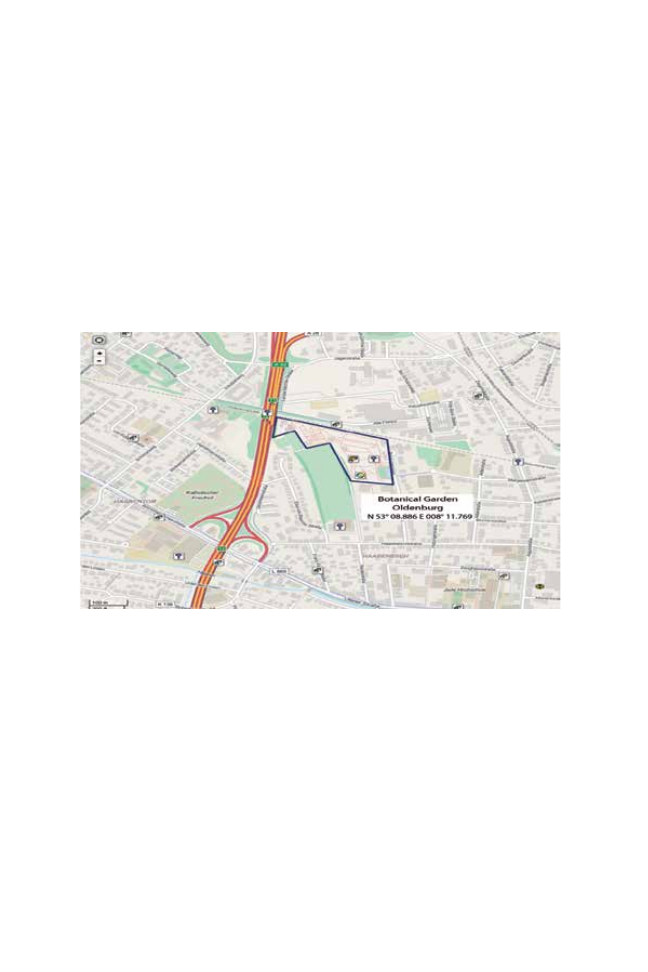
101
Plant Science Bulletin 60(2) 2014
feeling that they have learned something about
some important native trees.
Another multi-mystery cache starts at the
dining hall of the University of Oldenburg. From
there, geocachers are directed about one mile to
the Botanical Garden, since they were “told” at
the internet site (under the title “Not am Herd” [=
emergency at the stove]) that they need to provide
six edible items for the dining hall chef from the
Oldenburg Botanical Garden. They are also given
the coordinates of the final cache (located in the
botanical garden) at N53 08.ABC E 08 11.DEF.
Once they find the edible plants in the garden small
signs at the plant (such as A=8) will help them
complete the coordinates. This cache is a great
way to make people stroll around the garden and
actually look for plants they may only know from
their table, such as bamboo, vanilla (Fig. 2), potato,
rice, or various spices. To counter the problem of
plants being available only part of the year, we have
designed both a summer and a winter version of the
cache.
The success of this cache stimulated us to plan
a geocache called “Botanik 1.1” (= Botany 101).
Here, the starting coordinates are placed right in
the lecture hall of the university, but participants
don´t actually have to physically go there. Instead
they are directed to the PDF file on our university
website with the first botany lesson. At the end of
each lesson, geocachers will be directed to another
good way to attract people to places in the garden
that are rarely visited. For example, to attract public
to a little-known downtown orchard, in which local
conservationist exhibit traditional fruit varieties,
we have installed a traditional cache there at N
53° 07.358 E 008° 12.257. Multi-caches have their
starting point given on a website, and once there,
participants get the next set of coordinates; this
is the preferred cache for a nature trail. Mystery
caches do not provide complete coordinates but
instead a riddle must be solved or questions must
be answered to obtain them. More than 2 million
caches exist worldwide, and in a city like Oldenburg
with about 160,000 inhabitants, there are close to
500 caches, with 15 in the 2 square kilometers
around the botanical garden (Fig. 1).
Together with a local nature conservation
group, we have installed a multi-mystery cache
(“Oldenburger Baumpfad” [= Oldenburg tree
trail]) along eight prominent trees within the
city of Oldenburg, Germany. Starting at N53
08.902 E8 12.701 near a birch tree, geocachers
must solve multiple-choice questions about the
tree to complete the coordinates N53 08.A38 E8
12.5B3, where A and B can be determined only by
answering the questions. To do this, the treasure-
hunters must really look at the tree and touch and/
or smell it. For example, which of the detail photos
(downloadable from the geocaching site) does not
belong to birch? Photo 1 (A =5), photo 2 (A =7),
photo 3 (A =8), or photo 4 (A =0)? At the end, not
just the treasure awaits the geocacher, but also the
Fig. 1: Map of Oldenburg with caches in the vicinity of the Botanical Garden Oldenburg (from www.
geocaching.com).
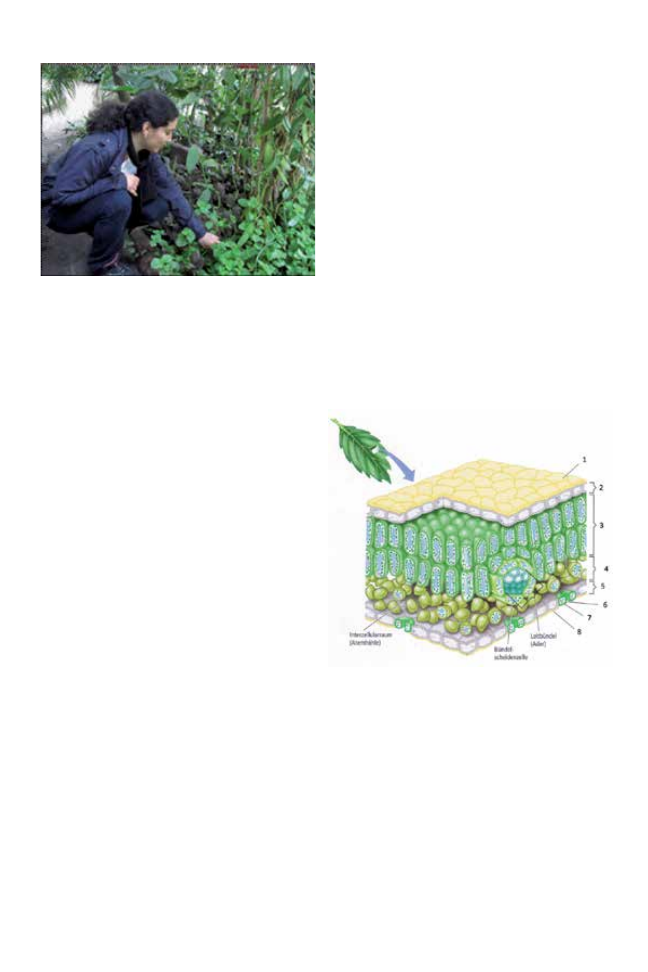
102
Plant Science Bulletin 60(2) 2014
PDF file with a new lesson, and each time a question
must be answered to get the internet address of the
next lesson. For example, in the lesson on leaves,all
the different leaf tissues are explained and cross-
references with a letter. At the end, a diagram
of a leaf cross-section is given with numbers for
each tissue (Fig. 3). To get the correct address of
the next lesson, the numbers in the diagram have
to be matched and replaced by the letters in the
text. We have assembled eight lessons regarding
the following “Botany 101” topics: essential
characters of life, essential characters of plants,
evolution of plants (introducing mosses, ferns,
gymnosperms, angiosperms as the maingroups
of land plants and explaining their species
richness and characteristics), the basic bauplan of
angiosperms (what are roots, stems, leaves and how
can they be modified?), energy budget (explaining
the basics of photosynthesis), water balance (how
is it transported in the plant?), and reproduction
(what different pollination types and fruit types are
there?). After finishing the last lesson, “students”
are directed to a PDF congratulating them and
providing the coordinates of the real cache. So, after
studying for about 45 to 60 minutes in front of the
computer performing this exercise, it is time to go
outside, find the cache, and enjoy some real plants.
A great part of geocaching is that after finding
a treasure, people will register and sign when they
have completed a cache and give comments on it.
In the one-and-a-half years since the start of this
program, we had 52 (tree trail), 58 (Botany 101),
60 (Emergency at the stove), and 165 (orchard)
geocachers recording that they found the cache.
Based on an additional survey, we learned that
the geocachers are two thirds male, 80% with a
university degree, and on average 40 years old.
About 15% responded that they hadn´t known
about the Botanical Garden, and 40% visited the
garden for the first time. Thirty percent promised
to return even without a new cache.
The success of a cache is visible by checking
how many participants called the cache a favorite.
For every ten caches logged, geocachers are
allowed to call one a favorite. For our caches, the
traditional cache at the orchard had 20% favorite
rating, whereas the mystery caches (Botany 101,
Emergency at the stove) had 30% and the tree
trail through Oldenburg as much as a 35% favorite
rating. Apart from these statistics, the internet site is
a great way to get feedback and a good opportunity
to improve your caches. In particular, you get
immediate feedback when the cache or hints are
destroyed. Also, geocachers reported when they
considered parts too difficult. For our “Botany 101“
course, many people responded how fascinating it
was to learn about plants in such a challenging and
rewarding way, even if solving the whole lecture
series took some participants more than an hour.
So, do you finally want to meet your “students”?
Then plan an event cache! Our event cache at the
end of November attracted a group of more than
40 geocachers. Like everyone else, geocachers like
to socialize with others who share their hobby.
Therefore, event caches are given with coordinates
as well as the time and date when people will gather
with food and drink and share their experiences
with each other. And they are more than willing to
give you feedback on your caches and what kind
Fig. 3: Leaf cross-section used for the “exam” in the lec-
ture on leaves (figure from Nabors and Schiebe [2007]).
Fig.2: Geocacher searching for vanilla in our tropical
greenhouse.

103
Plant Science Bulletin 60(2) 2014
of lesson they would like to learn about next time.
Feedback at our event cache and at the geocaching
website demonstrated that we attracted a group of
people rarely seen in a botanical garden before and
most were enthusiastic about what they learned
about plants. So, maybe we should plan for Botany
201 next year.
Literature cited
Clough, G. 2010. Geolearners: Location-based
informal learning with mobile and social
technologies. IEEE Transactions on Learning
Technologies 3: 33-44.
Huang, Y.-M., Y.-T. Lin, and S.-C. Cheng. 2010.
Effectiveness of a Mobile Plant Learning
System in a science curriculum in Taiwanese
elementary education. Computers & Education
54: 47-58.
Lo, B. 2010. GPS and Geocaching in Education.
International Society for Technology in
Education.
March, K. A. 2012. Backyard Botany: Using GPS
Technology in the Science Classroom. The
American Biology Teacher 74: 172-177.
Nabors, M. W., and R. Scheibe. 2007. Botanik.
Pearson Deutschland GmbH.
Santos, P., D. Hernández-Leo, and J. Blat. In press.
To be or not to be in situ outdoors, and other
implications for design and implementation,
in geolocated mobile learning. Pervasive and
Mobile Computing.
Schneider, I. E., K. E. Silverberg, and D. Chavez.
2011. Geocachers: Benefits sought and
environmental attitudes. LARNet - The Cyber
Journal of Applied Leisure and Recreation
Research 14: 1-11.
Sherman, E. 2004. Geocaching: hike and seek with
your GPS. Apress, Berkeley, CA, USA.

104
Book Reviews
Ecological
Plant and Animal Endemism in California .....................................................................104
Economic Botany
Caper: The Genus Capparis ...........................................................................................105
Honey in Traditional and Modern Medicine ..................................................................106
The Savage Garden: Cultivating Carnivorous Plants, revised edition ...........................107
Systematics
Colorado Rocky Mountain Wildflowers. App for Apple and Android ...........................108
The Ferns and Lycophytes of Texas ...............................................................................109
Ecological
Plant and Animal Endemism in
California
Susan P. Harrison
2013. ISBN-13: 978-0-520-27554-6
Cloth, US$49.95. 189 pp.
University of California Press, Oakland,
California, USA
California is a hotspot, not only in the world
of popular culture, but also in the biotic realm.
About 70% of the state is contained in its own
biogeographic region, the California Floristic
Province; this province reaches up into Oregon and
sweeps down into Baja California. This is one of
five regions on the globe where the Mediterranean
climate, and hence Mediterranean flora, is found.
Something about a long hot dry summer and a
rainy cool winter results in outstanding botanical
diversity; indeed, the California Floristic Province
contains 20% of the world’s vascular plants in only
2% of the world’s land area.
Endemism is the restriction of a taxon to a particular
geographic area. In the California Floristic
Province, high endemism equals biotic richness.
Of the combined total of 6,506 genera and species
known in the state of California, 2,264 species, or
nearly 35%, are endemic. If considering taxa only
on the species level, 28% are endemic. This high
biodiversity extends itself to the animal kingdom
as well, as fish, amphibians, and a few groups of
invertebrates also show high levels of endemism in
California. Indeed, with these numbers, one could
see how high endemism gives this state its biotic
uniqueness and justifies it as a biological hotspot.
Plant and Animal Endemism in California by Susan
P. Harrison is an engaging treatise on biological
endemism in the 31st state of the Union. The book is
divided into six major topics: the biotic uniqueness
of the California flora and fauna; the history of
geology, climate, and floristics; the patterns and
causes of plant endemism; animal endemism in
California; biological conservation; and synthesis
and conclusions.
Taking a closer look, this 189-page volume opens
by explaining what endemism is, clarifying its
meaning and definition, and then describes
patterns of species richness and endemism on
the state, regional, and global levels. The second
chapter recounts previous theories on the origins
and development of the California flora that were
mainly put forth by Raven and Axelrod in their
scholarly treatise in 1978. In Chapter 3, these
now classical ideas are examined in the light of
new scientific studies on the geologic history of
California; development of the Mediterranean
climate as a driving force for plant adaptations
to long, hot, dry summers; internal barriers that
may promote endemism; and long-term climatic
stability. The fourth chapter covers animal
endemism, while the fifth chapter discusses the
urgent need for conservation as well as conservation
issues concerning an endemics-rich region such as
the California Floristic Province.
While Harrison’s discussion on endemism is
fascinating throughout the book, it turns out
that the last chapter—the one with the dry title

105
Plant Science Bulletin 60(2) 2014
of “Synthesis and Conclusions”—has the juiciest
contents. For it is Chapter 6 that contains the
intriguing results of Harrison’s many years of work
on California endemism. At the risk of being a
“spoiler,” I will mention only a few teasers here (skip
to the next paragraph if you don’t want me to give
away the ending): Plant endemism does not seem to
stimulate animal endemism. Plants are not animals
and were affected differently by the forces driving
endemism. Elevated speciation and low extinction
rates played important roles, while biogeographic
barriers did not. In fact, geomorphological
heterogeneity, which is always associated with
present-day California (think: beaches and rocky
shorelines, deserts, foothills, rugged mountain
ranges, and fertile wide-bottomed valleys), is not
the key to the high endemism in this state.
Plant and Animal Endemism in California is a well-
written and well-documented scholarly treatise
on biological endemism in the California Floristic
Province. The development of topics is logical and
seamless, taking the reader smoothly through the
book. It helps to have such good explanatory figures
and tables. In the first four chapters of the book,
hardly a page goes by without such an illustration.
There are over 24 black-and-white figures, which
are mostly maps, but also include graphs, charts,
drawings, and photos, as well as 15 tables. The last
30 pages of the volume are dedicated to listing the
thousands of plant species that are endemic to the
California Floristic Province, organized by family
and with a note on their present-day biogeography
(i.e., found in California, Oregon, or Baja).
I love the retro look of this hardbound book. In its
size and graphic design, it has the clean lines of a
1960s primer in California—my formative years in
school. The book cover is thick and creamy to the
touch. Featured on the front is a photo of three plant
genera rich in California endemic species: Allium
falcifolium (sickle-leaved onion), Sedum oreganum
(Oregon stonecrop), and Lewisia cotyledon
(Siskiyou bitterroot). The pop of fresh color
provided by the striped pink and white flowers and
deep pink inflorescence peduncle of the bitterroot,
the rosy pink leaves of the two succulents, and the
spring green of the leaves is accentuated by the pink
and green stripes at the bottom of the book cover.
While the subject matter of this book will be most
appealing to specialists and students in botany,
ecology, and biogeography, Plant and Animal
Endemism in California will also be of great use
to zoologists interested in California endemism.
Similarly, the chapter on conservation is a must
for policymakers and nature lovers who value the
biotic richness and uniqueness of this western
state. Furthermore, the list price of less than $50
for this scholarly and beautifully hardbound book
makes it easy for libraries and museums all over the
world to obtain this volume, especially during these
financially restrictive times.
The main reason, though, to get your hands on a
copy of Plant and Animal Endemism in California
is because it is a landmark in the study of plant and
animal endemism that will surely form the basis for
future studies to come in ecology, biogeography,
floristics, and endemism.
–Carole T. Gee, on sabbatical at Huntington Botani-
cal Gardens, San Marino, California, and at the
Natural History Museum of Los Angeles County, Los
Angeles, California, USA
Economic Botany
Caper: The Genus Capparis
Ephraim Philip Lansky, Helena Maaria
Paavilainen, and Shifra Lansky
2013. ISBN-13: 978-1-4398-6136-3
Hardcover, US$129.95. xxiv + 317 pp.
Traditional Herbal Medicines for Modern
Times vol. 12
CRC Press, Boca Raton, Florida, USA
Mythopoesis. No, I had never seen this word
either. According to the dictionary, the title of
Chapter 1 means “the creation of myths.” Okay,
though I wouldn’t have thought a serious piece
of academic research would care much about
myth-making. The authors are concerned with
explaining the derivation of the common name
and the genus name of the book’s title, which they
claim both derive from the word for goat (language
unspecified). Only this much is surely true, that the
word caper is derived from the Latin capparis.
In Latin, the domesticated goat is Capra aegagrus,
and the word comes into English in, for example,
Isle of Capri. I can find no dictionary, including
the Oxford English Dictionary, that derives caper
(in the sense of “stunt” or “criminal behavior”) or
caprice (“whim”) from the Latin for goat. In any
case, Quattrocchi, in CRC World Dictionary of

106
Plant Science Bulletin 60(2) 2014
Plant Names, suggests that the Latin capparis is
derived from the Greek kapros, meaning “a wild
boar, provided with tusks.” This etymology at
least keeps the vowels and consonants in order,
which the authors’ myth-making does not. The
source of the foodstuff capers, the flower buds
of Capparis spinosa, is a shrub with its stipules
converted to hard, sharp spines—tusks, with a bit
of imagination. (Chapter 28 is a page and a half
of recipes for capers. The “recipes” are devoid of
any measurements whatever, and are addressed to
creative cooks and chefs.)
The authors assert that there are between 250 and
400 species in the genus, mostly tropical. That
range of numbers immediately says that there is
no modern monograph available. This raises the
question of how the sixty or so species covered in
detail in this book were identified. It appears that
the authors simply adopted the name used in the
article they are citing, as is common in the literature
of plant biochemistry and herbal medicine—these
are the topics that occupy the bulk of the book.
The various species contain an extensive array of
phytochemicals that may be effective against all
manner of inflammations, as well as high blood
pressure, seizures, and even Alzheimer’s disease.
The literature is very large, and the authors give the
full literature citation at the end of each chapter,
rather than at the end of the book before the index.
This leads to some duplication, but I think readers
will appreciate this approach, just as they and
librarians will appreciate that article titles and the
titles of both periodicals and books are given in full,
without abbreviations.
The book closes with Chapter 29, “Breaking
Advances in Medical Capparology,” and Chapter
30, “Centers of Capparology” (meaning universities
and research institutions). The neologism
“capparology” combines a Latin root with a Greek
suffix, perhaps unavoidably. Kaprology, anyone?
–Neil A. Harriman, Biology Department, University
of Wisconsin-Oshkosh, Oshkosh, Wisconsin, USA.
harriman@uwosh.edu
Honey in Traditional and Modern
Medicine
Laïd Boukraâ (ed.)
2014. ISBN-13: 978-1-4398-4016-0 (Cloth,
US$139.95. 470 pp.)
eISBN-13: 978-1-4398-4017-7 (e-book
US$97.00)
Traditional Herbal Medicines for Modern
Times vol. 11
CRC Press, Boca Raton, Florida, USA
Honey in Traditional and Modern Medicine
provides a comprehensive look at the traditional
and medicinal applications of honey. The volume
nicely bridges the gap between modern applications
of honey and its ancient and traditional uses. The
editor has done a commendable job in bringing
together academics, researchers, and investigators
from around the globe working on medicinal
aspects of honey research.
The volume comprises 19 chapters, with a
smooth transition between ethnomedicinal
and traditional studies on honey to modern-
day medicinal applications. Uses of honey in
different branches of modern medicine (such as
pediatrics, gastrointestinal and cardiovascular
diseases, diabetic ulcers, and cancer, to mention
only a few) are well documented. Traditional
medicinal uses of honey are documented from
cultures across the globe, with a chapter devoted
to Ayurvedic medicine. Two chapters that illustrate
the diversity of subjects covered in the volume are
“Biochemistry and Physicochemical Properties
of Honey,” which explores the latest approaches
of chemical analysis of honey, and “Mad Honey:
The Reality,” which was an interesting read from
both a historical and a medicinal perspective. Each
chapter stands independently, providing tables,
schematic charts, graphs, word diagrams, and
illustrations. The division of chapters into different
subtopics adds variety and interest for readers, and
color illustrations help to explain key concepts. In
addition, the bibliography provided at the end of
each chapter, along with the helpful index at the
end of the book, will be quite useful for researchers.
This volume highlights how honey has become
an important component of the nutraceutical and
functional food industry—covering its culinary
uses, promoting honey as a source of nutrients, and
describing its use across the globe in modern drug

107
Plant Science Bulletin 60(2) 2014
formulations. Some repetitions of information
were observed across different chapters, but that
is not unexpected in a multi-chapter, multi-author
volume on a narrow topic. One shortcoming
is the lack of any mention of the use of honey in
traditional Chinese medicine or its use in South
and Central American tribal medicinal practices.
Suggested improvements to increase usability
for future editions include dividing the volume
into three or four thematic subsections, as well as
the addition of a short section at the end of each
chapter highlighting key summary points.
This volume will be extremely useful as a reference
volume for both undergraduate and postgraduate
students in the disciplines of apiculture, economic
zoology and botany, economic geography, biological
chemistry, food sciences and food technology,
ethnobotany, ethnomedicine, preventive and social
medicine, and pharmacology. It will also be useful
for general readers who are interested in exploring
both traditional and modern applications of
honey for promoting better health. The editor
deserves special credit for maintaining a balance of
information throughout the volume that prevents
the content from becoming overwhelming and
hence provides an enjoyable reading experience
and resource.
–Saikat Kumar Basu, Department of Biological Sci-
ences, University of Lethbridge, Lethbridge, Alberta,
Canada
The Savage Garden: Cultivating
Carnivorous Plants, revised edition
Peter D’Amato
2013. ISBN-13: 978-1-60774-410-8
Paperback, US$25.99. 384 pp.
Ten Speed Press, Emeryville, California, USA
Upon opening the newly revised edition of The
Savage Garden: Cultivating Carnivorous Plants, one
risks falling into a mesmerizing pitcher plant or
getting stuck on a dainty but deadly sundew leaf.
This is exactly what author Peter D’Amato intended,
as the entrapped reader has no choice but to read on
and learn more about these remarkable organisms.
Throughout this book, vivid photographs of “CPs”
and the author’s entertaining and colorful prose
highlight a beautiful, diverse, and often unfamiliar
group of plants.
Like the original The Savage Garden (D’Amato,
1998), this revised version is organized into
three major sections. The first provides general
information about cultivating carnivorous plants:
soil ingredients, light and water requirements,
fertilizing and feeding, and pest control. The
second section discusses where to grow these
plants, including information about spaces as
varied as outdoor bog gardens, windowsills, and
greenhouses. Both chapters assume little or no
prior horticultural experience, and thus the book
is quite beginner friendly. The third section is by
far the longest, and contains information about
the carnivorous plants available to gardeners. Each
chapter in this section addresses a particular genus,
providing historical information, brief descriptions
of species and some cultivars, and extremely
thorough propagation and cultivation instructions.
These instructions are judiciously illustrated to
clarify unique pollination or vegetative propagation
techniques. The dimensions of The Savage Garden
contribute to its utility as a horticultural reference:
The book measures 23 × 15 × 2.5 centimeters (9 × 6
× 1 inches) and weighs 868 grams (1.9 pounds), an
ideal size to be carried through the nursery while
examining potential purchases.
The revised version has several significant
advantages over its predecessor. All measurements
are now in both US customary and SI units, which
should make this useful book accessible to a wider
audience. Spelling mistakes from the original
(Myers-Rice, 1998) have been corrected, although
a few typographical errors are present in the new
version. Dozens of species and cultivars discovered
or registered since the first publication are included
here, as are many new color photographs. Most
importantly, though, the authoritative cultivation
recommendations that stem from D’Amato’s
decades of experience remain the central focus of
the book.
Although this book is an excellent horticultural
resource, it is not without flaws and limitations. It
is quite clear that most of the book is drawn from
the author’s extensive personal experience, but
D’Amato still frequently references other works,
including several taxonomic monographs. A
reference list at the end of the book would make it
easier for readers to locate these primary sources.
(A brief “Selected Reading” list was included as
an appendix to the first edition of The Savage
Garden, but was removed in the revised edition.)
The descriptions and photographs provided for

108
Plant Science Bulletin 60(2) 2014
some species are not sufficient for identification.
Finally, D’Amato’s brief treatment of carnivorous
plant evolution makes no mention of adaptation
or selection, and never addresses any hypotheses
about why carnivory has evolved. Furthermore,
the phylogenetic diversity of carnivorous plants
(and therefore the idea that carnivory has arisen
multiple times in plant evolutionary history)
is not discussed. At several points the author
hints at relationships between carnivorous plant
genera, but relatedness at the family or order level
is not explicitly discussed. While knowing that
American pitcher plants are in the Ericales while
tropical pitcher plants are in the Caryophyllales is
not essential for proper cultivation, it does make
gardening more interesting.
However, these faults should not be given too
much weight. This book is not meant to be an
introduction to the scientific literature, nor an
exhaustive identification resource, nor a book
about evolution. In the introduction to The Savage
Garden, Peter D’Amato emphasizes that his book is
“a practical guide to growing carnivorous plants.”
The flaws discussed above do not detract from that
objective in the slightest, although their omission
may be a missed opportunity to use horticulture
as a medium for broader education about botany.
For a carnivorous plant bibliography or discussion
of evolution, Carnivorous Plants and Their Habitats
(McPherson, 2010) is a good place to begin, but
for a book about cultivation The Savage Garden is
essential.
As a wonderful horticultural resource and an
introduction to the morphological diversity of
carnivorous plants, this book belongs on the shelf
of gardeners, greenhouse managers, and anyone
broadly interested in botany. Now that I’ve read
it, I can provide more than guesses the next time
a friend asks me how to keep a Venus flytrap alive.
–Ian D. Medeiros, College of the Atlantic, Bar Har-
bor, Maine, USA
LITERATURE CITED
D’AMATO, P. 1998. The Savage Garden: Cultivating
Carnivorous Plants. Ten Speed Press,
Emeryville, California, USA.
MCPHERSON, S. 2010. Carnivorous Plants and
Their Habitats, Vols. 1 & 2. Redfern Natural
History Productions, Poole, Dorset, United
Kingdom.
MEYERS-RICE, B. 1998. Book Review. Carnivorous
Plant Newsletter 27(3): 72–73.
SYSTEMATICS
Colorado Rocky Mountain Wild-
flowers. App for Apple and Android
Al Schneider and Whitney Tilt 2012.
US$9.99 High Country Apps: http://www.
highcountryapps.com/
Botanical enthusiasts have varying levels of
experience. Some are casual weekend hikers looking
to identify the flowers they are photographing,
while others are professional botanists who spend
their careers identifying specimens. The “Colorado
Rocky Mountain Wildflowers” app created by
Al Schneider and Whitney Tilt is an excellent
resource, particularly for those on the more casual
end of this spectrum. I was excited to review this
after many visits to Schneider’s website (http://
www.swcoloradowildflowers.com/) and was
pleased to find that the app has the same excellent
photos, thorough descriptions, and interesting
commentary. There are numerous images for most
of the plant species, including photos of habitat,
growth form, flowers, and fruits. Distribution
maps and habitat information help the user
evaluate where the plant can be found. Experts
and amateurs alike will appreciate these features.
Unlike the website, the app is extremely portable as
it loads onto an iPhone, iPad, Android, or Kindle
Fire device and can be taken far from internet
availability. This alone is worth the cost for me.
While this app has features that anyone will
appreciate, it is directed more toward casual users.
Botanical experts will find that the app lacks the
dichotomous keys necessary to key difficult species
and, since it only directly covers 520 species, experts
may be frustrated that the app may not include
a species of interest. The app relies on a multi-

109
Plant Science Bulletin 60(2) 2014
entry key where the user inputs characteristics of
the plant (such as flower color, plant habit, leaf
shape, and a host of other characteristics) and the
app creates a list of potential species. Schneider
and Tilt are clearly expert botanists who have
worked hard to make these keys accessible to the
general public. Their app is better than many other
popular wildflower guides and the large number
of characteristics in the multi-entry key allows the
user to rapidly narrow down possible species. The
commentary page often describes similar species,
allowing easy comparison of plants that may
superficially look similar. While the keys are useful
and likely sufficient for most casual botanists, as
someone who teaches plant identification I miss
the inclusion of technical keys and the lack of
exhaustive coverage of plants of the area.
The app covers most of the common species in the
Rocky Mountains. The authors have hand-selected
species, but the app is far from exhaustive and the
target area could use clarification. The inclusion
of some foothill species and the lack of certain
high alpine species make it difficult to assess what
the boundaries of this guide are. For example,
Penstemon mensarum is a common species at 9,000
feet on the Grand Mesa in western Colorado, but a
botanist on the Grand Mesa will not find it in the
app. Most casual users may not need an exhaustive
key, but if you are set on identifying a plant and it
is a member of a difficult taxonomic group with
many endemic species, such as a Penstemon, the
app will not be sufficient to confidently key it to
species. This app is useful for general interest and
will satisfy most curious minds but will not be a
stand-alone tool for more serious botanists.
For $9.99, this app is a wonderful investment and
starting place for beginning botanists. It is much
less intimidating than technical keys, and those
using it will be satisfied when they can confidently
key out their plants. The photographs, commentary,
and portability mean that this app is likely the first
and last tool that casual botanical enthusiasts might
use to identify a plant. As a professional botanist
and someone who teaches plant identification
courses, this application will not replace the
technical keys and floras that are the heart of our
profession. In the future, it would be wonderful if
Schneider and Tilt combined the stellar pictures
and commentary already present in this app with
one of the wonderful technical keys available for
understanding and identifying the plants of the
Colorado Rockies. I hope both for myself and for
my students that this dream soon becomes a reality!
–Stephen Stern, Department of Biological Sciences,
Colorado Mesa University, Grand Junction, Colo-
rado, USA
The Ferns and Lycophytes of Texas
George M. Diggs Jr. and Barney L. Lipscomb
2014. ISBN-13: 978-1-889878-37-9
Flexbound, US$29.95. xii + 380 pp.
Botanical Research Institute of Texas and
Austin College, Fort Worth, Texas, USA
Cover 2: Vegetational areas of Texas
Front endpaper: Areas of high fern and lycophyte
diversity [with county names]
Back endpaper: Families and genera [with page
numbers]
Cover 3: Summary data and comparisons with
other pteridophyte floras
These are listed here because they are excellent uses
of what would otherwise be blank space. The full-
color cover that extends across the spine to cover
4 is titled “Fern Habitat in the Pineywoods of East
Texas”. It features Osmundastrum cinnamomeum
and (on cover 4 and on p. 46) the Eastern phoebe;
the species are all explained on p. iv. The Texas leaf-
cutter ant is barely visible on the cover 1 flap, but it
is shown in the upper left portion of the illustration
opposite of page 1. (The cover painting, when
replicated within the book, is a mirror image.) It’s
a beautiful picture, and one can almost hear the
midsummer swarms of mosquitoes in this bald-
cypress swamp. A county locator of Texas, given on
pp. 378–379, is essential because there are 254 of
them.
There are 127 recognized species in this work, and
it is claimed that this is the most of any state in
the continental United States. I think that’s true;
however, Texas (268,820 square miles) is 4.5 times
as large as Georgia (59,425 square miles), which
claims 119 species (Snyder and Bruce, 1986). The
Texans’ claim is strained.
A feature I’ve never seen in a fern book is Table 1:
Texas “Record-Holders” and “Prize Winners.” This
includes “Worst Weed,” Salvinia molesta, which
also wins the prize for “Fastest Reproducer,” and

110
Plant Science Bulletin 60(2) 2014
of publication or production notes relevant to the
edition”), wherein the technical details of book
creation and production are explained—the art
and science behind it all. Here, it is not brief. There
were 1500 copies printed; buy one, before they’re
all gone.
Biographical details of the authors, including exact
dates of birth, are given on p. 376. Page 377 gives
“biographies” of Austin College (Diggs) and BRIT
(Lipscomb). Their book is a credit to the long-
established educational and research traditions of
both institutions. It is a fine piece of scholarship
that will appeal to the specialist as well as to fern
lovers in general.
–Neil A. Harriman, Biology Department, University
of Wisconsin-Oshkosh, Oshkosh, Wisconsin, USA.
harriman@uwosh.edu
LITERATURE CITED
Snyder, L. H. Jr., and J. G. Bruce. 1986. Field
Guide to the Ferns and other Pteridophytes of
Georgia. University of Georgia Press, Athens,
Georgia, USA.
“Oldest Species,” Onoclea sensibilis; this latter, it is
explained on p. 175, is essentially unchanged from
57-million-year-old Paleocene fossils,.
The molecular evidence for the overall classification
adopted in this book is reviewed extensively and
lucidly. Both the generic names and the specific
epithets for each recognized species are translated
or explained. Even the common names are
explained, to the extent possible. One appreciates
that the family names, which are Latin plurals, are
treated grammatically as plural.
Every species is illustrated in a line drawing, together
with one or more color photographs in most cases.
The Texas distribution is shown by county dot-
maps, and the general distribution in the USA is
shown by dots or shading, as appropriate. Further
distributional details are appended to the species’
descriptions. In the descriptions, words that might
be unfamiliar to the reader (such as “lithophytic,”
“rhizophores,” and other such arcana) are defined
in plain English. There is a full-scale glossary as
well.
There is a section toward the end of the volume
(p. 375) labeled Colophon (“A brief description

111
The Ferns and Lycophytes of Texas. 2014. Diggs, George M. Jr. and Barney L.
Lipscomb. ISBN 978-1-889878-37-9 (Flex US$29.95) 392pp. Botanical Research
Institute of Texas, 1700 University Drive, Fort Worth, Texas 76107.
A Field Guide to California Lichens. 2014. Sharnoff, Stephen. ISBN 978-0-300-
19500-2 (flex US$32.50) 434pp. Yale University Press, P.O. Box 209040, New Haven,
CT 06520-9040.
Field Guide to the Sedges of the Pacific Northwest, 2
nd
ed. 2014. Wilson, Barbara
L., Richard Brainerd, Danna Lytjen, Bruce Newhouse, and Nick Otting. 2014. ISBN
978-0-87071-729-1 (paper US$35.00) 432pp. Oregon State University Press, 121 The
Valley Library, Corvallis, OR 97331-4501.
Genera Palmarum: The Evolution and Classification of Palms. Dransfield, John,
Natalie W. Uhl, Conny B. Asmussen, William J. Baker, Madeline M. Harley and Carl
E. Lewis. 2014. ISBN 978-1-84246-182-2 (Cloth US$170.00) 732 pp. International
Palm Society, Kew. Distributed by University of Chicago Press, 1427 East 60
th
Street,
Chicago, IL 60637.
The Genus Tulipa: Tulips of the World. Everett, Diana. 2013. ISBN 978-1-84246-
481-6 (Cloth US$112.00) 380pp. Royal Botanic Gardens, Kew. Distributed by
University of Chicago Press, 1427 East 60
th
Street, Chicago, IL 60637.
Handbook of Plant and Crop Physiology, 3
rd
ed. Pessarakli, Mohammad (Ed.) 2014.
ISBN 978-1-4665-5328-6 (Cloth US$199.95) 993 pp. CRC Press, Taylor and Francis
Group, 6000 Broken Sound Parkway NW, Suite 300. Boca Raton, FL 33487-2742.
The Olmsted Parks of Louisville: A Botanical Field Guide. Haragan, Patricia
Dalton. 2014. ISBN 978-0-8131-4454-2 (Flex US$50.00) 472pp. University Press of
Kentucky, 663 South Limestone Street, Lexington, KY 40508.
Photosynthesis in the Marine Environment. Sven Beer, Mats Bjork, John Beardall.
2014. ISBN: 978-1-119-97957-9 (Paper US$89.95) 224 pages. Wiley-Blackwell.
Sustainable Landscaping: Principles and Practices. Loehrlein, Marietta. 2014 ISBN
13-978-1-4665-9320-6 (Cloth US$89.95) 305 pp. CRC Press, Taylor and Francis
Group, 6000 Broken Sound Parkway NW, Suite 300. Boca Raton, FL 33487-2742.
Books Received
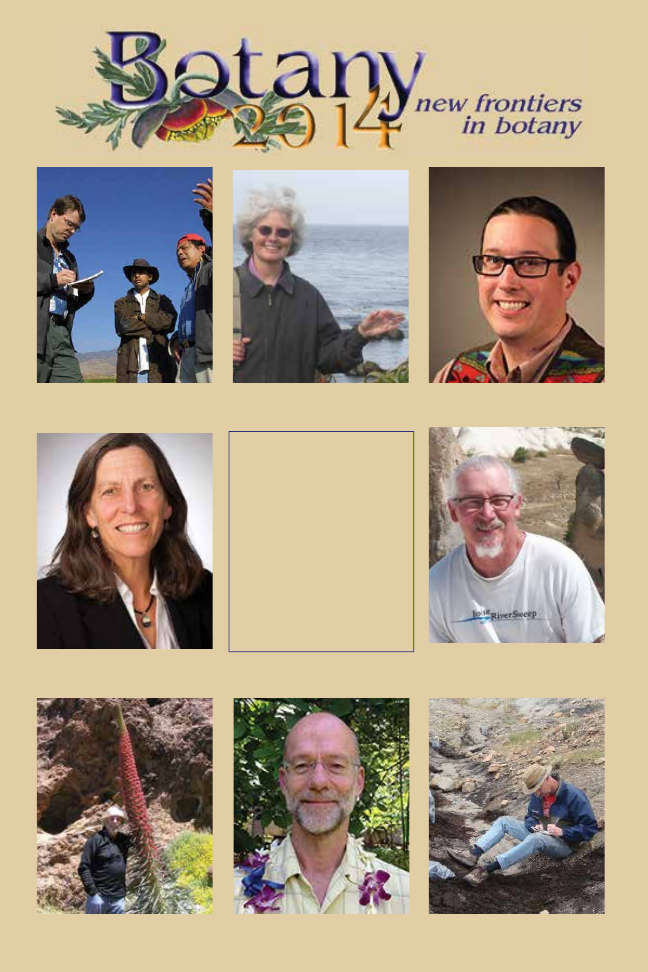
112
Plenary speaker
Charles Mann
Pelton Award Lecture
MArtha Hawes
Diversity Lunch
Michael Dockry
Kaplan Lecture
Sarah Hake
Annals of Botany
Spencer Barrett
Regional Botany
Steve Novak
BSA President Elect
Thomas Ranker
ASPT President Elect
Patrick Herendeen
In addition to
almost 900
submitted
abstracts,
workshops and
fi eld trips and
networking events
you don’t want to
miss these featured
speakers!
 View on Issuu.com